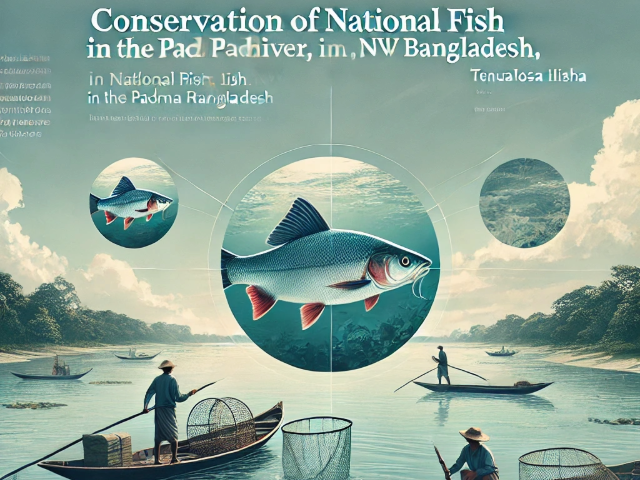
Professor Dr. Moha: Yamin Hossain
Department of Fisheries, University of Rajshahi.
There are several important steps to appearing smart and giving an effective presentation on the topic “Conservation of National Fish Tenualosa ilisha in the Padma River, NW Bangladesh”.
Here is a detailed explanation of how you should prepare for this presentation, how to create your slides, and make the delivery engaging and impactful.
1. Presentation Preparation:
a. Acquire in-depth knowledge about the topic:
⊕ Learn in detail about your main topic—Conservation of Tenualosa ilisha (Hilsa fish) and the characteristics of the Padma River.
⊕ Try to understand Hilsa biodiversity, its breeding cycle, and why the river’s environmental condition is crucial for its conservation.
⊕ Research the ecological and economic importance of Hilsa in the northwest (NW) region of Bangladesh.
b. Prepare according to the audience profile:
⊕ Prepare your presentation according to your audience. If they are experts, use research-based information. If they are general audience, present the topic in simple language.
⊕ Clearly state your background as a member of the Institute of Natural Resources Research and Development (INRRD), so the audience knows which organization you represent.
c. Define the main objective:
⊕ Make sure that your main presentation objective is to highlight the importance of Hilsa conservation and its status in the Padma River. Clearly explain why it is important and what actions are necessary for its preservation.
2. Creating the Presentation:
a. Slide Design & Content:
1. Title Slide:
⊕ Title: “Conservation of National Fish Tenualosa ilisha in the Padma River, NW Bangladesh”
⊕ Presenter’s Name: Tahsin Muhtady (Ph.D)
⊕ Affiliation: Institute of Natural Resources Research and Development (INRRD)
⊕ Date of Presentation: 18 December 2024
 Some tips:
® Use a readable font on the title (like Arial or Calibri).
® Ensure each slide has a clean and attractive design without unnecessary clutter.
2. Introduction Slide:
⊕ Briefly introduce Hilsa fish and the Padma River.
⊕ Highlight the importance of Hilsa’s biodiversity and its significance in Bangladesh’s economy and food security.
3. Data and Statistics:
⊕ Provide information about Hilsa’s status in the Padma River, breeding season, and current challenges.
⊕ Use graphs or images to present Hilsa’s situation and conservation initiatives.
4. Challenges and threats:
⊕ “What are the main challenges to Hilsa conservation?”
⊕ Discuss issues like climate change, illegal fishing, river pollution, etc.
⊕ Briefly explain these problems and describe their impact.
5. Conservation Measures and Recommendations:
⊕ What measures have been taken and what more is needed (such as legal actions, establishment of biological breeding centers, reducing river pollution, etc.).
⊕ Highlight activities related to your affiliation: “Institute of Natural Resources Research and Development (INRRD)”—share how the institute is working on the issue and its contribution through research.
6. Conclusion:
⊕ Emphasize the importance of conservation.
⊕ Everyone’s cooperation is needed in Hilsa conservation, especially the local community and government.
b. Use of Visual Elements:
⊕ Images and Graphs:
® Use images of the Padma River and Hilsa fish to make it more straightforward and presentable.
® Present graphics on Hilsa’s biodiversity or its breeding cycle.
⊕ Use charts to analyze fish catch rates, breeding numbers, etc.
⊕ Maps:
Utilize maps showing the Padma River and Hilsa fishing areas in Bangladesh.
c. Typography and Color Selection:
⊕ Be careful in color selection; especially, you may use green and blue to match Hilsa’s environment.
⊕ Keep font size and style simple so the audience can easily read.
3. Practice the Presentation:
a. Rehearsal:
⊕ Practice the entire presentation several times. Manage your time so there’s enough for each slide.
⊕ Allocate 1 to 2 minutes for each slide of your presentation.
b. Speak confidently:
⊕ Speak confidently and clearly on every part of your presentation.
⊕ Speak slowly and with clear pronunciation, rather than rushing.
⊕ It’s important to sound natural. Avoid excessive slang or complex words.
4. Delivering the Presentation:
a. Body language and building rapport:
⊕ Maintain communication with the audience—look at them while you speak.
⊕ Use hand gestures, but keep them relevant to your presentation.
b. Q&A session:
⊕ Have a Q&A session at the end so the audience can express their doubts and ask questions.
⊕ Prepare answers to likely questions: “How can the local community help in Hilsa conservation?”
Or
“What steps are being taken to increase Hilsa’s breeding rate?”
5. Conclusion:
a. Summary and Thanks:
⊕ In conclusion, highlight everyone’s role in Hilsa conservation and its crucial importance.
⊕ Express your gratitude and thanks to the audience for their time and attention.
If you follow these steps, you can prepare a smart and impactful presentation on “Conservation of National Fish Tenualosa ilisha in the Padma River, NW Bangladesh”.
✪ All students, young colleagues, researchers, and fellows should save (and share) this post for a lifetime, no matter what profession you pursue in the future, you will need to deliver presentations in today’s digital era. ✪
Note: Collected from Facebook:——–https://www.facebook.com/share/p/15LGids1by/
In English:
Detailed step-by-step guide for delivering a smart and effective presentation on the topic:
“Conservation of National Fish Tenualosa ilisha in the Padma River, NW Bangladesh”
1. Preparation for the Presentation:
a. Gaining In-depth Knowledge on the Topic
– Understand the topic deeply, particularly Tenualosa ilisha (Hilsa fish) and its conservation, and the importance of the Padma River.
– Research the ecological significance of Hilsa, its life cycle, and how the river’s health impacts conservation efforts.
– Focus on the importance of Hilsa fish in Bangladesh’s economy, food security, and its role in biodiversity.
– Be well-versed with challenges facing the conservation of Hilsa in the Padma River, including overfishing, pollution, and climate change.
b. Understanding Your Audience:
– Tailor the presentation to your audience’s level of understanding. If they are experts in environmental science, use more technical data; if they are general audiences, simplify the language.
As a representative of the
Institute of Natural Resources Research and Development (INRRD), make sure to clarify your affiliation and how the organization is involved in the conservation of Hilsa.
c. Defining the Objective
– The goal of your presentation should be to highlight the importance of Hilsa conservation and explain the current state of Hilsa in the Padma River.
– Discuss the challenges and propose practical solutions for ensuring sustainable Hilsa populations in the region.
2. Creating the Presentation:
a. Slide Design and Content:
1. Title Slide:
– Title: Conservation of National Fish Tenualosa ilisha in the Padma River, NW Bangladesh
– Presenter: Tahsin Muhtady
– Affiliation: Institute of Natural Resources Research and Development (INRRD)
– Date of Presentation
Tips:
– Use a readable font (e.g., Arial or Calibri) and keep it clear and professional.
– Avoid too much text on the title slide—just the essential information.
2. Introduction Slide:
– Introduce the topic: Briefly explain what Tenualosa ilisha (Hilsa fish) is and why it’s important to Bangladesh.
– Provide context on the Padma River, its ecosystem, and the connection to Hilsa fish.
3. Data and Statistics:
– Present data on Hilsa population trends, fish catch statistics, and environmental factors affecting the fishery.
– Use graphs and charts to visually represent the declining Hilsa populations, fishing patterns, and conservation efforts.
4. Challenges and Issues:
– Identify the main challenges to Hilsa conservation, such as overfishing, illegal fishing practices, river pollution, and climate change.
– Illustrate these issues with relevant statistics, facts, or case studies.
5. Conservation Measures and Recommendations:
– Discuss current conservation efforts such as fishing bans during breeding seasons, aquaculture practices, and community-based management strategies.
– Share recommendations for further actions, including strengthening regulations, local community engagement, and international cooperation.
6. Conclusion:
– Summarize the key points: the ecological and economic importance of Hilsa, the threats it faces, and the need for urgent conservation efforts.
– End with a call to action: emphasize collective efforts for sustainable fisheries management.
b. Visuals and Graphics
– Use images of Hilsa fish, Padma River, and Hilsa fisheries to make your presentation visually appealing.
– Create infographics and maps that illustrate the areas where Hilsa is caught in the Padma River.
– Incorporate charts or graphs to show trends in fish populations, fishing practices, and conservation impacts.
c. Typography and Color Scheme:
– Keep the color scheme simple and related to nature: shades of blue, green, and earthy tones.
– Use large and clear fonts for better readability. Sans-serif fonts like Arial work well for presentations.
3. Practice and Rehearsal:
a. Rehearsing the Presentation:
– Rehearse your presentation multiple times to get comfortable with the flow of information.
– Time your presentation, ensuring that each slide gets 1-2 minutes, and the entire presentation fits within your allotted time (usually 10-20 minutes).
b. Speaking Confidently:
– Speak clearly and confidently. Avoid rushing through slides.
– Practice making eye contact with the audience, and use a conversational tone to engage your listeners.
– Avoid using too many filler words like “um,” “uh,” or “like.” Speak at a moderate pace for clarity.
4. Delivering the Presentation**
a. Body Language and Engagement:
– Maintain eye contact with the audience to establish a connection.
– Use hand gestures naturally to emphasize key points, but don’t overdo it.
b. Handling Questions:
– Allow time for questions at the end of your presentation. Engage with the audience by inviting them to ask about the conservation strategies, Hilsa biology, or river ecology.
– Be prepared for questions like:
– “What specific actions are needed to reduce illegal fishing?”
– “How can local communities be involved in Hilsa conservation?”
– If you don’t know the answer to a question, be honest. Say something like, “That’s a great question; I’ll look into it and get back to you with more information.”
5. Conclusion and Closing Remarks:
a. Summary and Final Thoughts**
– Recap the main points briefly: the importance of Hilsa conservation for biodiversity and the economy, the challenges, and the proposed solutions.
b. Thank the Audience:
– Conclude with a thank you to your audience for their attention and participation.
– Invite further discussion or questions after the presentation if appropriate.
By following these steps, you will be able to deliver a smart, clear, and engaging presentation on “Conservation of National Fish Tenualosa ilisha in the Padma River, NW Bangladesh”, ensuring that your audience remains engaged while gaining valuable insights into the topic.