Rafik is a university student. He has a remarkable ability—he can recite π (pi) to many decimal places: 3.1415926535…, but he forgets what he had for breakfast this morning!
His friends joke, “You’ve become a scientist!“
Rafik wonders, do scientists actually have these kinds of traits?
Let’s see what some fun signs of being a scientist might be, and whether there’s any scientific basis behind them.
Are Scientists Really Weird?
If we analyze the personal lives of many of the world’s successful scientists, we’ll see that in most cases, they’re a little different from ordinary people. A 2019 Harvard University study showed that people engaged in science and research can easily remember specific bits of information, but often forget many important aspects of everyday life.
One survey found that 75% of physicists use mobile notes to remember their daily tasks, but at the same time, they can easily memorize complicated equations or prime numbers.
So why does this happen?
According to U.S. neuroscientist Dr. John Hopkins, “When our brains become deeply immersed in research, they filter out less important information. That’s why scientists might remember complicated formulas, but forget what’s in the fridge in the kitchen.”
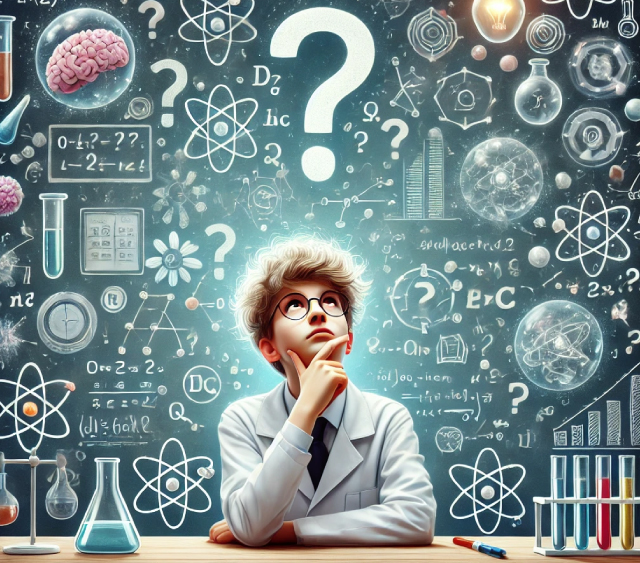
The Habit of Asking ‘Why’
Another fun trait of scientists—they look for the “why” behind everything.
🔹 Why is the sky blue?
🔹 Why is water transparent?
🔹 Why are there bubbles in a cup of tea?
While most people just accept things as they are, scientists can’t rest until they find out the “why.”
According to research from Stanford University, curiosity activates the brain’s dopamine center (reward center), which increases the desire to learn. That’s why scientists keep asking childlike questions and feel drawn toward new discoveries.
Dopamine is a neurotransmitter in our brain that mainly regulates our sense of reward. When we learn something new or find the answer to a question out of curiosity, the brain’s “reward center” becomes activated and releases dopamine. This increases our motivation to learn even more and makes us more curious.
The Stanford University study shows that scientists are naturally more curious and love learning new things and doing research—because they have higher dopamine activity in their brains. When scientists solve a new problem or discover a theory, their brains experience a kind of “reward feeling,” which drives them to do even more research. This explains why scientists often ask a string of “why” questions, just like children.
Loves Complex Things, but Not Interested in Simple Things!
Here’s a fun fact—many Nobel Prize-winning scientists were very disorganized in their personal lives.
- Albert Einstein Albert Einstein was a brilliant theoretical physicist, but he was somewhat forgetful in daily life. His colleagues and friends often noticed he would lose personal items, especially his door keys.
- Isaac Newton One day, to let his cat go outside, he made two holes in the door—one big, one small! He forgot that the small cat could have used the big hole as well.
- Richard Feynman Richard Feynman was not only a theoretical physicist but also a popular teacher and a wonderful storyteller. But another amusing aspect of his personality—he was interested in more than just complex theories and difficult research; he also loved playing the guitar, painting, and even tried boxing. But when it came to everyday household chores, he wasn’t very skilled. He didn’t know much about cooking or housework, because his mind was always busy solving complex problems.
Scientists are so preoccupied with complex math and theories that ordinary things just don’t stick in their minds. One survey found that 65% of scientists working in research and development can’t keep track of their shopping or struggle with splitting bills.
A Different Perspective
Scientists look for unique reasoning in everything.
When it rains, some people get sentimental, others think of love. But a scientist wonders—“How is light refracting inside those water droplets?”
Research in the U.S. has shown that when researchers’ brains are scanned, their default mode network (DMN)—which is responsible for new ideas and creative thinking—is 30% more active than in ordinary people.
You Can Be a Scientist Too!
Now the question is—if you have some of these traits, does that mean you’re a scientist?
The answer: Very likely!
Because being a scientist doesn’t just mean working in a lab or doing research. If you’re always eager to learn new things, double-check information, and see the world differently—you’re already on your way to becoming a scientist!
Being a scientist doesn’t just mean working in a laboratory, but rather developing a special way of thinking. So, if you love to ask questions about little things and constantly try to learn something new—then maybe you’re a future scientist too!
“Science isn’t just for books—it’s a way of life!”
What’s your way of thinking? Do you see these traits in yourself? If yes, congratulations—you might just be a scientist! 🔬🚀