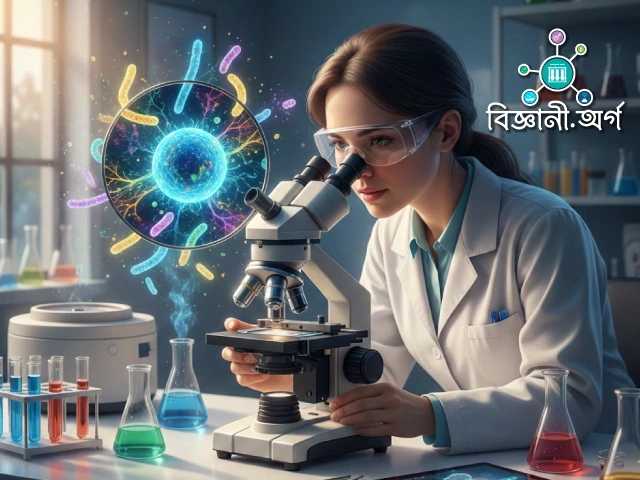
With the help of technology, scientists have uncovered many mysteries of the world. But some mysteries are so minute that our eyes could never perceive them — if not for the microscope. Imagine you are looking at a drop of water. To the naked eye, it appears clear and harmless. But when you peer through the microscope’s lens, you see a bustling universe of life — invisible creatures, movement, color, and structure as if it’s another world altogether. The key to opening this door is the microscope.
The History of Invention: From the Netherlands to Global Wonder
The story of the microscope begins in the late 16th century in the Netherlands. Hans Janssen and his son Zacharias Janssen are believed to have built the first compound microscope around 1590. Although there is some debate among historians, another powerful figure is Antonie van Leeuwenhoek — who, in the 1670s, used a very powerful single-lens microscope to give humanity its first real look at the world of microbes. Many consider Leeuwenhoek the “Father of Microbiology,” as he was the first to observe bacteria, sperm cells, red blood cells, and more.
Over the next few centuries, microscope technology continued to advance in Europe. In the 19th century, Ernst Abbe and Carl Zeiss in Germany revolutionized optical design and lens technology. Thus, a tiny curiosity has now become an essential tool in biology, chemistry, physics, medicine, and even nanotechnology.
Principle of Operation: The Magic of Light Bending and Glass
The basic principle of the microscope is actually light refraction. An objective lens collects light from very close to the sample and projects it in a magnified form, while the eyepiece lens further enlarges this image and brings it to our eyes. The more precise the path of light, the clearer the image will be.
A conventional light microscope usually has two or more lenses — the objective and the eyepiece. But today, there are various types of microscopes:
- Light Microscope – Common in schools and universities.
- Electron Microscope – Uses a beam of electrons instead of light to create images at the nano scale.
- Fluorescence Microscope – Uses specific wavelengths of light to illuminate and visualize special molecules within cells.
- Atomic Force Microscope (AFM) – Uses a fine probe instead of light to map the surface of samples at the atomic level.
What Types of Research Are They Used For?
The microscope is vital in almost every field of scientific inquiry.
- Biology: Observing cell division, identifying bacteria and viruses, examining plant tissue structure.
- Chemistry: Analyzing nanoparticles, observing structural changes during chemical reactions.
- Physics & Semiconductor Research: Studying semiconductors and nanomaterials with electron microscopes.
- Medical Science: Blood tests, cancer cell identification, tissue analysis for disease diagnosis.
A real-life example: Cryo-electron microscopy played an outstanding role in understanding the structure of the COVID-19 virus and the development of vaccines.
Ease of Use and Importance
The light microscope is comparatively easy to use and inexpensive. Many colleges and universities in Bangladesh have light microscopes, though they are not always well maintained. Advanced instruments like electron microscopes or AFMs are expensive and technically complex, but access is possible through international collaboration and specialized research labs.
Modern science is virtually impossible without the microscope. Without understanding the micro world, major advances in biology, medicine, or nano-engineering would not be possible.
Groundbreaking Discoveries
The microscope has changed humanity’s perspective. Leeuwenhoek was the first to see microorganisms — proving that life is not limited to the large organisms visible to the naked eye. The germ theory of Robert Koch and Louis Pasteur, the genetic experiments of Gregor Mendel, and the later analysis, as well as modern genetic engineering, would all have been unimaginable without the microscope.
Relevance for Researchers in Bangladesh
Advanced research laboratories in Bangladesh are equipped with electron microscopes, including at the University of Dhaka, Bangladesh Agricultural University, and some private research institutes. However, many students are unaware of their existence or how to use them.
In addition, online microscope simulators exist, such as the University of Delaware’s Virtual Microscope Project, which can provide hands-on experience to students free of cost. By participating in joint projects with foreign research institutions, Bangladeshi students can learn to use advanced instruments.
Conclusion: Journey from the Micro to the Macro
The microscope has taught us that small things are never insignificant. Just as countless living organisms are hidden in a drop of water, groundbreaking discoveries can arise from the smallest beginnings in research. If young researchers and students in Bangladesh can master the use of this instrument, new horizons will open in the nation’s scientific research.
For more information, you can visit: