Three friends from Khulna—Shahriar, Anika, and Sadman—are now studying at a private university in Dhaka. Even though they’re in their final year, their faces reflect a kind of uncertainty. Why? Because they see that scientific research and technological innovation in the country are alarmingly scarce. One afternoon, sitting at a campus tea stall, Shahriar posed a question—“Do you know why there aren’t any major scientific discoveries in our country?”
In response, Anika said, “Are our research projects even up to international standards? Many labs still lack modern equipment. Besides, we don’t even have the necessary funding.”
Sadman backed it up with recent statistics, “According to the Global Innovation Index published in 2023, we rank 102nd out of 132 countries in innovation. India is in 40th place, and Singapore is 7th. This gap is, frankly, embarrassing for us.”
The Crisis of Research and Innovation in Bangladesh
Anika’s view is not unfounded. According to official government data on research, most universities in Bangladesh allocate only 0.37% of GDP to research. In many developed countries, this is 2-3% or even more. Due to insufficient infrastructure and funding for research, teachers are largely forced to stay limited to classroom instruction. As a result, vast opportunities for research and innovation are left unexplored.
Shahriar then raised a question, “Honestly, many of us don’t even know the state of STEM (Science, Technology, Engineering, Mathematics) education in our country. No university in Bangladesh is ranked among the top 1,000 in the Times Higher Education ranking. So how can world-class research happen?”
Sadman argued, “Research isn’t just about publishing papers; its application in real life is crucial. Here, we can’t really say there’s any solid connection between education and industry. Many students finish their degrees without developing problem-solving skills for real-world challenges.”
Where is the Problem?
1. Lack of Research Funding: Every university in the country needs significant research allocations, but what’s available right now is insufficient. In top universities of developed countries, each lab may receive $20–50 million in funding, while in Bangladesh it’s limited to only a few crore taka.
2. Falling Behind in Quality Education and Rankings: According to the Times Higher Education ranking, Bangladesh is not even in the top 1,000. As a result, our standing in international science remains weak.
3. Lack of Education-Industry Collaboration: It’s not enough to just publish papers—they have to be applied in real contexts. Effective partnerships between industry and universities have yet to take shape in Bangladesh.
Possible Solutions: What Can Be Done?
Anika said, “Can’t we follow a model like Singapore’s? Fifty years ago, they were as far behind as us. Now they’re world leaders in research.”
- Increase Research Funding: At least 1% of GDP should be allocated to research. This could bring about visible changes in research and innovation over the next 10 years.
- Forge University-Industry Collaboration: Like in developed countries where labs work with major companies, this culture needs to be established in Bangladesh too. That way, real-world problems can be solved and innovation can flourish.
- Innovation Competitions and Startup Funding: National and international-level STEM incubators, hackathons, and startup funds must be developed so that young people can move ahead with their own innovations.
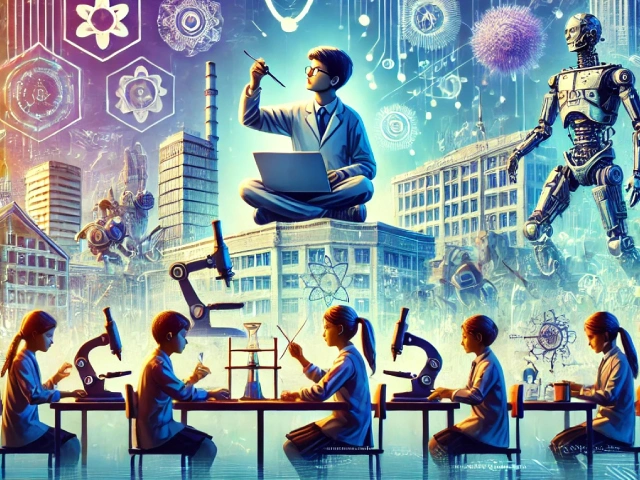
- Modern Curriculum and Technology-Based Education: Universities should effectively incorporate modern subjects like AI, Robotics, and Data Science. Online platforms and digital libraries should also be expanded.
Ray of Hope
Even as night falls, Shahriar, Anika, and Sadman don’t stop. They believe that if the new generation values research, learns proactively, and takes proper steps to build their skills, a revolution in STEM education is possible.
Conclusion
In reality, improving STEM education in Bangladesh is not impossible. It requires adequate funding, effective policies, motivated students, and experienced teachers working together. With more research and innovation, employment will increase, advanced technologies can be exported, and Bangladeshi talent will be recognized across the world.
What do you think? What would you like to do to improve STEM education in Bangladesh? With the right plans and decisive actions, Bangladesh can one day become a center of innovation—because truly, there is no future without STEM.