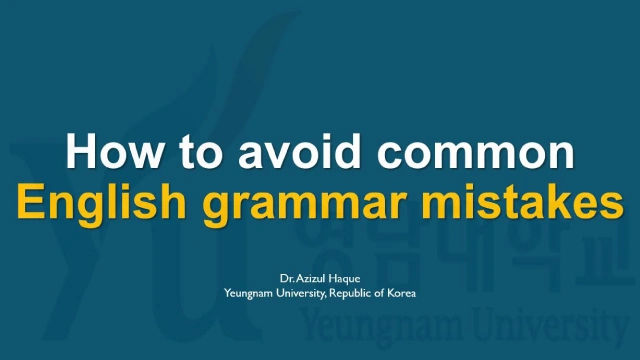
Guest author – Azizul Haque
Assistant Professor, Yeungnam University.
If your research paper’s English grammar is weak, it can obscure the core message and also undermine your credibility with the reader. After you finish your research and draft your paper, it is crucial to thoroughly check the grammar before submission. For example: correct comma usage, subject-verb agreement, or where to place adverbs—these are points to keep in mind. Such errors often lead to unnecessary revisions or even rejection of the paper.
If English is not your native language, understanding proper grammar can be even more challenging. Spell-check or grammar-check tools are certainly helpful, but having a colleague or a native English speaker proofread your paper before submission is even more effective.
Here we discuss the five most common English grammar mistakes found in research papers and other writing (According to Editage and Wiley). Being aware of these can help you easily avoid basic mistakes when writing.
1. Make sure the subject and verb agree
The subject of a sentence (the noun performing an action) and the verb (the action) must agree in number. Singular subjects get singular verbs, and plural subjects get plural verbs.
Singular: Mary enjoys reading.
Plural: Mary and Jane enjoy reading.
2. Minimize usage of verb nominalization
Nominalization refers to using a noun created from another part of speech, which can weaken the quality of your writing. It is better to use verbs in their original form to strengthen your writing and increase sentence impact.
Incorrect: We made a decision.
Correct: We decided.
3. Use the adverb “respectively” in the right context
Respectively means “in the order given.” This term can make sentences more concise when relating a list of two or more items to another in the same order.
Incorrect: Matt plays tennis, Tim plays basketball, and Bill plays football.
Correct: Matt, Tim, and Bill play tennis, basketball, and football, respectively.
4. Check your usage of introductory commas
Commas can separate introductory text from the rest of the sentence and tell the reader to pause slightly.
Incorrect: In this experiment we found that white blood cells increased.
Correct: In this experiment, we found that white blood cells increased.
5. Employ parallelism when applicable
Use parallelism when you have two or more components or phrases with similar grammatical structure in the same sentence. This strategy balances parts of speech with one another to make the sentence clear and concise.
Incorrect: Sarah likes swimming, crafting, and to bake.
Correct: Sarah likes swimming, crafting, and baking.
OR Sarah likes to swim, craft, and bake.
🔍 Final note: If you can avoid these common mistakes in your writing, your work will not only be grammatically correct, but also more professional and credible.
Note: Collected from Facebook:——–
https://www.facebook.com/share/p/19wvhkJU6u/