


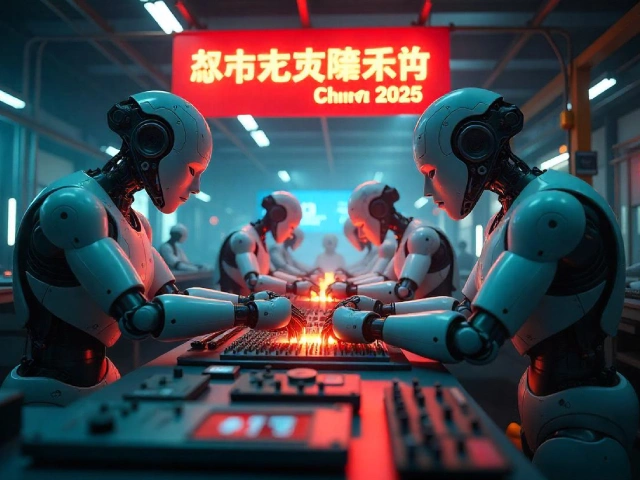
In the current global race for technological supremacy, robotics and automated production systems have taken center stage. In this field, China has rapidly emerged as an unstoppable force. Recent reports show that China’s factories employ a vast number of robotic workers, which is shaping the future of both technology and the economy.
“Made in China 2025”: Strategy and Implementation
In 2015, the Chinese government launched an ambitious and comprehensive national plan called “Made in China 2025.” Its primary goal was to modernize domestic manufacturing and increase technological capabilities. The strategy placed special emphasis on ten high-tech sectors, including robotics, electric vehicles, and high-speed railways.
As part of the plan, a target was set to produce at least 100,000 industrial robots per year. By 2022-2023, China had already installed more than 276,000 industrial robots, accounting for more than half of all robot installations worldwide.
What Is Robotics Technology and Why Is It Important?
Robotics is a technology where machines or software can automatically perform tasks in a human-like manner. Industrial robots are specialized robots used in manufacturing that can carry out specific tasks with precision and repetition, such as packing, welding, screwing, and painting. This reduces production time and costs while ensuring product quality.
Reasons Behind China’s Success
- Government Planning and Investment: The proactive “Made in China 2025” initiative undertaken by the government.
- Cost Reduction: Extensive production capacity at lower costs through the use of robotics.
- Abundant Rare Earth Metals: China is the world’s largest producer of rare earth metals (such as neodymium, dysprosium), which are essential for manufacturing robots and technological products.
- Government Support and Incentives: Tax and expenditure benefits, as well as economic incentives, for the manufacturing sector.
The Challenges and Limitations of the United States
The United States still lags behind in robotics and automated production systems. The country’s manufacturing sector mainly focuses on products like aircraft, medical devices, and other high-tech goods, which are not easily produced by robots. Additionally, investment in robotics and industry-based implementation has barely begun in the U.S.
Trump’s Tariff War and China’s Response
After President Donald Trump imposed extensive tariffs—up to 145%—on Chinese goods, China limited the export of rare earth metals to the U.S. As a result, technology companies like Tesla faced difficulties. Tesla CEO Elon Musk openly expressed concern over the issue. Later, Trump hinted at lowering tariffs, which was seen as a strategic win for China.
Explanation of Technical Terms
- Industrial Robot: An automated machine used in factories that can repeatedly perform specific tasks.
- Rare Earth Elements: Special types of scarce metals used in the production of robots, sensors, and chips.
- Automation: The automatic completion of human tasks by machines.
- Tariff: Additional tax imposed by the government on imported goods.
The Future and Global Politics
Robotics is not just technology; it is becoming a key tool for controlling future economic and political power. China is already far ahead in this race. If other countries, including the United States, do not act swiftly, China could become the undisputed leader in the coming robotics war.