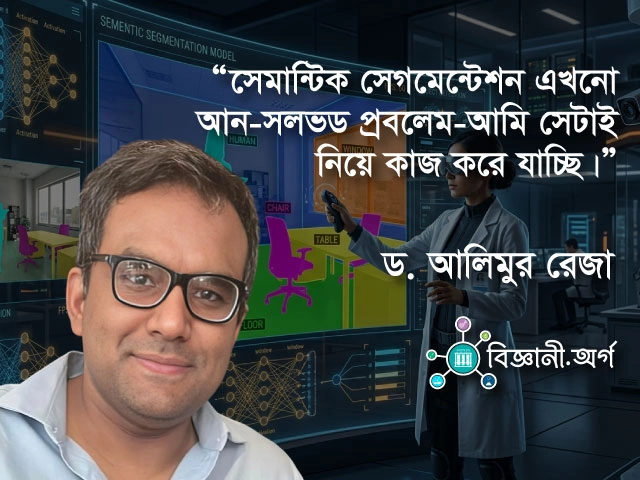
No matter how dazzling the world of artificial intelligence may seem, beneath the surface many ‘unfinished questions’ remain. When we see our phone camera recognizing faces, cars driving themselves, or an app identifying objects within an image, it may appear that machines now see just like humans. But Dr. Alimur Reza pauses us to remind: “Seeing” isn’t actually that simple.
To understand semantic segmentation (dividing an image into meaningful parts and labeling each part), first imagine an image as a map. Just as rivers, roads, and fields are marked in different colors on a map, semantic segmentation marks “person,” “wall,” “floor,” “chair”—all distinctly within an image. It’s not enough to simply say, “there’s a person here”; rather, it’s necessary to indicate precisely which pixels (tiny colored units of an image) represent a person. This is because if a robot or an automated machine is moving inside a room, it needs to know what is a walking path, what is an obstacle, what is moving, and what is stationary.
But here’s the problem—the real world is never the same. The floor in your room may look different in the morning light than in the evening. Someone’s shirt may appear as a different color on camera. Shadows cast on a wall might be mistaken as ‘new objects.’ And changing the camera angle changes the shape of the same thing. Dr. Alimur Reza points out that a major reason segmentation remains an ‘unsolved problem’ today is because this technology depends heavily on machine learning (the process of learning from data). In other words, performance depends on what kind of examples the machine is shown, how diverse the data is, and how powerful the model is.
This is where the real excitement of research lies. Because no matter how good a segmentation model is, in a new environment—a new city, a new room, a different camera—its performance can drop. Just as people make mistakes with new types of questions after little practice, machines do too. The difference is that humans learn naturally from their mistakes—but with machines, that learning has to be engineered separately. That’s why researchers test new approaches, new datasets, new model architectures (structures of networks)—so that the machine can make sense of things reliably, even as circumstances change.
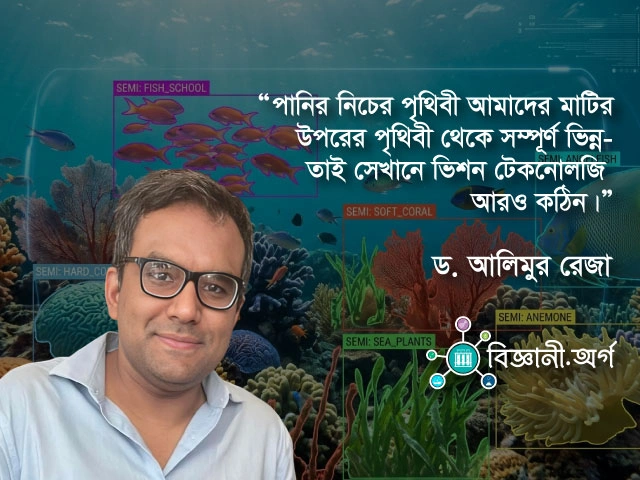
Dr. Alimur Reza hasn’t limited himself to scenes inside rooms; he’s shown that the challenges of segmentation become even greater when the environment is beyond human experience—like underwater. Underwater, there’s less light, colors are distorted, scenes are blurry—so regular vision technology breaks down. A part of his recent work tackles this reality: how to accurately separate various objects underwater. In the future, such applications could be used for monitoring fish health, aquaculture, or observing marine biodiversity—and since fisheries are so important in Bangladesh, the practical relevance of this research is clear.
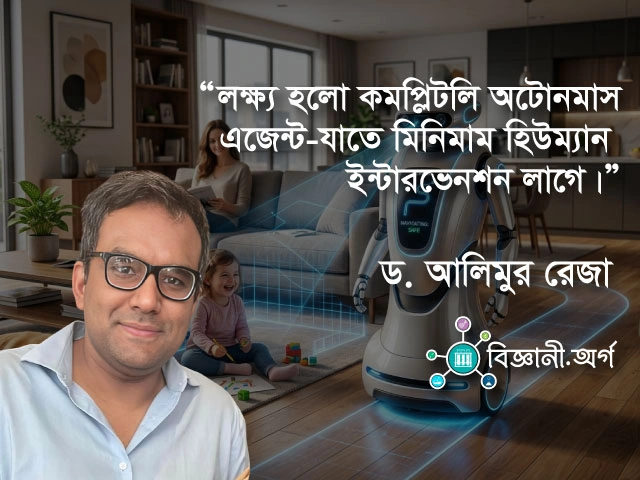
All in all, the main takeaway from Dr. Alimur Reza’s perspective is to see AI not as magic, but as a science. It’s the “unsolved problems” that push science forward. And along that path are born the robots of the future—not just robots that move, but that move with an understanding of their surroundings.
In the full interview, Dr. Alimur Reza discusses in greater detail his educational journey, the intricacies of his research, the future of robotics, and real-world questions about AI applications. Read and watch Dr. Alimur Reza’s full interview below.