One of the most beautiful sights in nature is rain. When the tiny droplets fall from the sky, it almost seems as if the sky is expressing its own language of tears. But why are raindrops almost always round? Many people are surprised and look for the answer to this question. In this article, we will learn—why raindrops are round, which physical principles are involved, and details about their nature.
Origin of a Raindrop
Raindrops are formed inside clouds. Essentially, when the water vapor floating in the air cools and turns into tiny water droplets, these small particles begin to merge and grow larger. At some point, they become so heavy that gravity can no longer keep them afloat within the cloud. That’s when they fall toward the earth as raindrops.
First Impression: Small Drops Mean Perfect Spheres
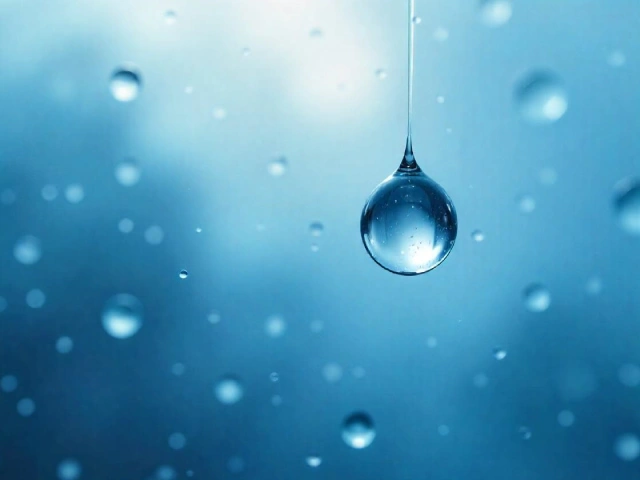
Many people think that raindrops are perfectly round like water droplets, just like we see dew drops sitting on a leaf. In reality, small raindrops really are almost perfectly spherical. This is due to surface tension.
What is Surface Tension?
Surface tension is the cohesive force between water molecules. The water molecules pull toward each other and try to take on a compact form. As a result, they seek the most stable shape—a sphere. A round shape is equally balanced from all sides and has the smallest surface area. So, when small raindrops are floating in the air, they remain round because of surface tension.
Do Larger Drops Stay Round?
Here’s where it gets interesting. As raindrops get bigger (about 1 millimeter or more), surface tension alone can no longer maintain their shape. At this point, air resistance flattens the bottom of the drop.
As a result, large droplets look more like a parachute or a hamburger—rounded on the top, flat on the bottom. And if a drop becomes very large, it will break up into smaller droplets before hitting the ground. That’s why we never see a gigantic raindrop falling to the earth.
Some Misconceptions About Raindrop Shapes
Many cartoons or books depict raindrops as being narrow at the bottom and wide at the top (the so-called teardrop shape). In reality, this shape is only seen when a drop falls very quickly and air pressure momentarily distorts its shape. But this isn’t backed by science—rather, it’s used by artists as a simple representation.
What Happens Outside of Earth?
Here’s something fun: if you splash water in space (in zero gravity), the droplets will become almost perfectly spherical. That’s because there’s no gravity or air to distort their shape. So only surface tension is at work, resulting in a perfect ball of water.
Conclusion
Science explains why raindrops are round. Small drops stay round because of surface tension, while larger drops lose their roundness due to air resistance. In short, even if not every raindrop is perfectly round, their shape is determined by various physical factors such as size, speed, and air pressure.
Just as science unravels the mysteries of nature, every raindrop carries a piece of that mystery. Next time you stand in the rain, remember—the drop that lands on you is a remarkable outcome of natural science.
Hossain Md. Arafat
Department of Chemistry, Chittagong College.