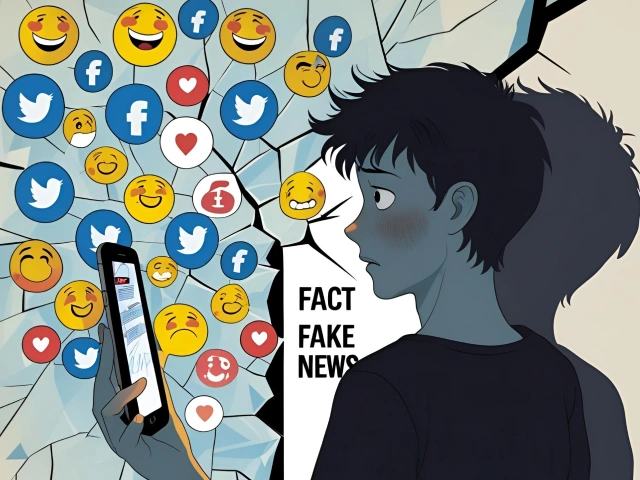
Social media has opened new doors for us to access information. Every day, we see thousands of posts, videos, and comments—many of which genuinely influence our thoughts. But the question is, how trustworthy is this information? Are we really getting a complete picture, or just a fragmentary snapshot?
Imagine you see a comment—a single voice, a clip, a status update. It may be an unimportant or imagined opinion from someone insignificant, but because it goes viral, it becomes ‘important.’ This culture of ‘virality’ on social media sets a standard where the measure of significance is determined by attention, not by substance. Meanwhile, the valuable analysis of an expert may be lost due to having fewer views or likes. As a result, we end up living in a misleading reality.
This is where social media’s major limitation lies—here, the value of information is defined by likes, shares, and comments, not by credibility or professional expertise. This calls into question the reliability of information and increases the risk of misinformation spreading within society. In many cases, false or misleading information influences people’s behavior, opinions, and decision-making.
In traditional journalism, when a professional journalist reports on a subject, they do not just present one single perspective. Instead, they analyze the context, consider various viewpoints, and consult relevant experts. A journalist investigates, verifies, and works within a framework where fact-checking is a fundamental principle. This allows us to receive a more in-depth and reliable picture. Yes, journalists can have their own biases, but their professional ethics and fact-checking protocols operate within a structure, which is mostly absent on social media.
Another dangerous aspect of social media is its algorithm. It is designed to show content based solely on your preferences, interests, and search history. As a result, you end up trapped in an “echo chamber”—where only your own viewpoints are echoed back at you. What you need to know may not appear before you at all—or may be deliberately hidden from you.
Suppose you are interested in a particular political topic. You see and like only partisan posts about it. Consequently, the algorithm starts to show you more of the same, filtering out other perspectives. This traps you inside a narrow circle and restricts the diversity of your thinking.
And perhaps the most dangerous part is that you may believe no one can influence you. But the reality is different. The algorithm works so subtly that you may not even realize when your thoughts, opinions, or even feelings are being altered. As humans, we don’t always rely on logic; often, emotions and social influences play a major role in our decisions. Social media knows how to exploit these weaknesses perfectly.
For these reasons, it is best to use social media solely for entertainment or as a means for quick information. However, if it becomes our only or primary source of information, we put ourselves in a risky position.
In conclusion: Social media is a powerful medium, but depending on it as the sole source of information is dangerous. To obtain in-depth and credible information, it is better to rely on mainstream media, journalistic standards, and professional analysts’ perspectives. Otherwise, we will be living not in a world of information, but in a world of misinformation. If we truly want to be aware and informed citizens, we need to know how trustworthy our sources are and who is providing that information. At the same time, we should listen to, verify, and analyze different viewpoints before forming our own opinions. Social media can provide us with that opportunity, but only if we use it wisely.