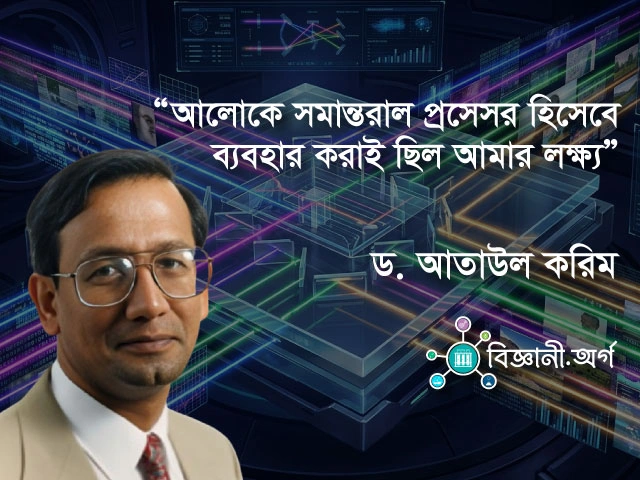
The history of the development of computer technology is essentially the history of increasing speed. Tasks that once took hours to complete can now be accomplished in seconds. Yet even now this speed is not sufficient for modern scientists. The amount of data is growing, and so is the need for artificial intelligence and high-powered simulations. Against this backdrop, Dr. Mohammad Ataul Karim’s research experience offers a unique approach. In his words, “My goal was to use light as a parallel processor.”
This statement stems from a fundamental technological insight. Conventional computers operate using electrical signals, where information is processed one item after another. This creates a natural limit to speed. However, light, or photons, can travel through multiple paths simultaneously. Using this property, a large amount of information can be processed at the same time—what we call parallel processing. To put it simply, sending information via electricity is like running a train on a single-track railway, while sending information via light is like using many tracks at once. This enables not only faster transport, but also faster information processing.
At a certain stage in Dr. Karim’s career, this concept began to take shape. The limitations of electronic processors compelled him to think—if the properties of light could be harnessed, computing speed could be increased manifold. This line of thought led him to focus on optical computing. His research proposed not using light just in one dimension, but rather in two dimensions. In other words, instead of sending light through a single path, he sought to use broad fields of light to perform many computations at once.
The applications of this research were also practical. His work played a key role in technologies such as image processing in optical systems, high-speed sensor data analysis, and night vision displays. For example, military or rescue operations often require quick decisions in the dark of night. If image processing is slow in such situations, the risk increases. The optical computing concept offers a pathway for rapid and precise analysis in these scenarios.
According to Dr. Karim, this research was not easy. Pursuing new technologies requires funding, infrastructure, and interdisciplinary collaboration. He had to bring together physics, electrical engineering, and computer science. This experience taught him that major technological shifts never remain confined to a single field; instead, new horizons open up where disciplines intersect.
The goal of using light as a parallel processor is thus not just a technological strategy—it reflects a visionary outlook for the future of computing. Dr. Karim’s research experience shows us that new pathways are born from challenging conventional limitations—pathways where the technology of the future can become faster and more powerful.
Read Dr. Mohammad Ataul Karim’s full interview: https://biggani.com/dr_ataul_karim/
Read the full interview with Dr. Mohammad Ataul Karim: