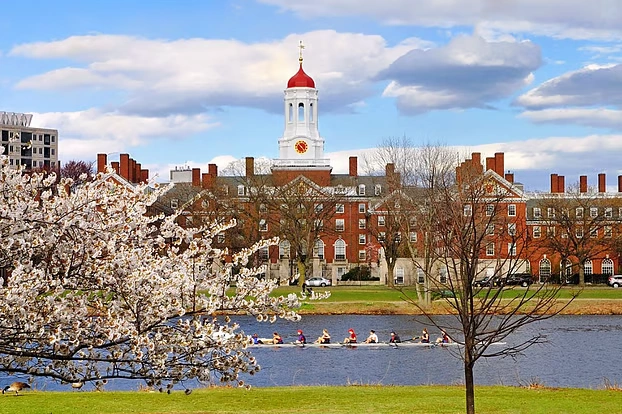
Harvard University’s financial endowment exceeds $50 billion. So, while some university activities may be hampered by the fund that Trump has blocked, the institution itself will not shut down.Photo: Collected
Guest Writer: Rauful Alam
Writer and Researcher
Email: [email protected]
Since coming to power, Donald Trump has taken many controversial steps. Most recently, he has created a new controversy by halting Harvard University’s billion-dollar federal fund. No other president in U.S. history had ever ordered the halting of Harvard’s funding before Trump.
Trump also got into conflict with universities during his earlier term. In July 2020, Harvard and MIT jointly filed a lawsuit against the Trump administration. Analysts have viewed Trump’s personal conflict with elite universities in various ways.
Although Trump argues that there has been a rise in “anti-Semitic activities” or antisemitism at Harvard University, it appears to be an attempt to silence dissent by publicizing this claim. However, this reasoning has found little acceptance in the academic community.
American universities do not generally treat their country’s president as especially important; in fact, such a culture does not exist. Presidents also do not typically engage in administrative conflicts with universities.
Most of the top-ranked universities in the U.S. are private institutions. Harvard, MIT, Princeton, Stanford, Columbia, Yale, UPenn, and so on are all private. Public universities, on the other hand, are essentially state institutions.
Examples include the University of California, Berkeley (UC Berkeley), Michigan State University, and Virginia State University, among many others. Whether private or public, there is no scope or tradition for direct administrative intervention by the president or the federal government in these universities.
As a result, these universities are autonomous. In fact, American universities are even more autonomous and independent than those in Europe.
Even though there is no central government intervention in academic or administrative affairs, funding and research policy are still influenced. The federal government allocates funding, in varying degrees, to all universities.
The federal government also controls the disbursement and allocation of those funds. Private universities receive not only federal funding but also private funds, students’ tuition fees, and donations. They conduct research programs with various industries, from which they also earn significant amounts.
Additionally, they receive donations from many wealthy families. Public or state universities receive funding from state governments as well. For instance, Harvard’s endowment is over $50 billion. Their financial resources exceed those of any other university in the world.
Therefore, while the fund Trump blocked may affect some of Harvard’s activities, the university itself will not close down. Trump actually only halted Harvard’s federal funding; he cannot block its private funds.
So by what authority did Trump block Harvard’s fund? As head of state, the president of the United States holds extensive administrative powers. Through executive orders, he can do many things.
He exercised that authority in this case. The Harvard administration is not sitting idly by either. Here, institutions have the right to file lawsuits even against presidential actions.
Harvard’s president (equivalent to vice-chancellor), Ellen Garber, is battling against Trump. The university authorities have sued the Trump administration, and legal proceedings are ongoing.
Trump cannot stay in power for more than four years, but Harvard University will remain. Trump may cut Harvard University’s funding, but only time will tell how long that will last.
Even if Trump wins the ongoing legal battle, it will still enhance Harvard University’s prestige. Perhaps after four years, Harvard will rise stronger than before. But the mere fact that a university administration can stand up to the president of one of the world’s most powerful countries—this is true governance, this is what courage means.
Societies where such governance has developed don’t collapse easily—not in any respect. The courage and independence of one institution encourages others as well, helping them to grow autonomously.
Neither the president nor the Department of Education plays any role in appointing vice-chancellors (presidents in some universities) at American public or private universities.
Appointments are controlled by the university’s Board of Trustees. A search committee is formed to invite applications for the position, and the best candidate is selected from among them.
In contrast, vice-chancellors at Bangladeshi universities are appointed by the president. This process involves direct recommendations from the prime minister and even from other party leaders.
For this reason, a vice-chancellor rarely wants to go against the government’s unethical decisions, fearing for their job security. The more a vice-chancellor aligns with the party, the more secure their position tends to be.
Thirty years ago, Ahmad Sofa described such vice-chancellors in his book “Gabhi Bittanta,” and unfortunately, our universities have not yet broken free from the influence of such leaders.
Just as now, when the Trump administration first came to power, it created many immigration-related complications. UPenn’s president, Amy Gutmann, used to protest such decisions. Her statements would be published on the university’s website. She would declare her support for students in opposition to government policies. I used to marvel at the fact that here, a vice-chancellor would stand by the university and its students, even when disagreeing with the government’s policies! In such countries, universities themselves seem like nation-states—almost countries within a country. Administrative leadership does not change with political power shifts.
Universities are fundamentally different from all other institutions in terms of wisdom and stature. They host the largest numbers of scholars, analysts, researchers, writers, and faculty. If universities simply become tools of government orders, how will other institutions have the backbone to stand independently?
When a country’s universities weaken their backbone, other institutions inevitably become subservient to the government as well.
Unfortunately, our governments have always wanted to keep universities within their sphere of influence. As a result, preferred vice-chancellors and pro-vice-chancellors are appointed by design.
The main aim of the government is to control the universities, because universities play a significant role in keeping governments in power and removing them. In the history of independent Bangladesh, whenever universities have slipped out of government control, those governments have lost power.
As a result, our universities have played a much greater role in changes in political power than in advancing knowledge and research. I consider this a historic curse for us. Yet, no government has tried to resolve this structural complication; instead, they have continued to openly support their affiliated student groups and have hired party-based teachers.
Faculty associations became mouthpieces for the government, and depriving student unions of elections while allowing party-aligned students to occupy campuses and halls has become the norm. These practices are now so entrenched that even the youth cannot break free from them.
The government must make a firm decision about what it expects from universities. Unless our universities are freed from the grip of centralized power, they will never truly function as universities.
When Trump first came to power, I was working as a postdoctoral researcher at the University of Pennsylvania (UPenn). At that time, Amy Gutmann was UPenn’s president.
Even then, as now, the Trump administration introduced many immigration-related complications. Amy Gutmann spoke out against those decisions. Her protests would be published on the university website, and she would voice support for students in opposition to government regulations.
I was astonished to see that a university president would take a stand against government policy to support students and the university itself! In such countries, the university itself feels like a nation-state, an independent country within a country. The administrative structure of the institution does not change with shifts in government power.
Will our universities ever develop in this way? If not to that extent, at least something close to it? We want our universities to have backbones, even if just a little like Harvard. May they serve as beacons for the youth and for the nation as a whole.
Source:
This article is collected from an essay published in Prothom Alo.
Author: Dr. Rauful Alam, Researcher, University of Pennsylvania, USA.