Guest author – Azizul Haque
Assistant Professor, Yeungnam University.
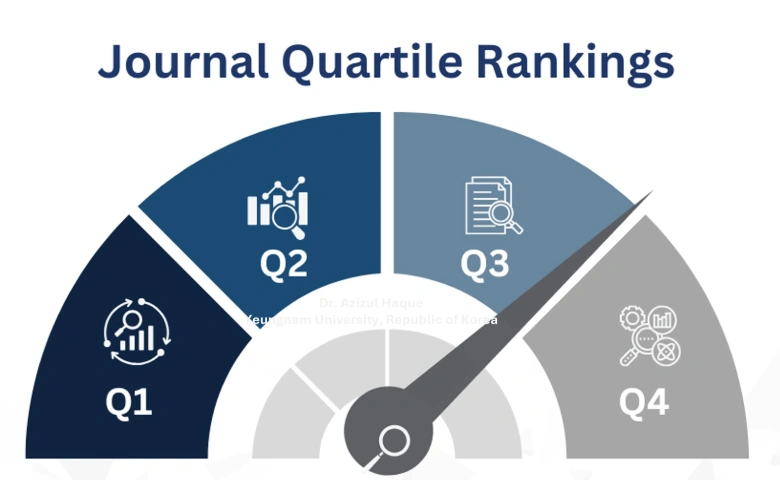
Journal quartile ranking is a statistical method for classifying scientific and academic journals based on their quality and impact. It is primarily determined from data provided by internationally recognized databases such as Scopus and Web of Science. Each journal is comparatively evaluated within its subject area and divided into four tiers: Q1, Q2, Q3, and Q4. This classification or quartile is often considered an important indicator of journal ranking.
Specific indicators or metrics are used to determine which quartile a journal falls into, with the main ones being: Impact Factor (IF), CiteScore, SCImago Journal Rank (SJR), and SNIP (Source Normalized Impact per Paper). Impact Factor is usually determined from the Web of Science database, while CiteScore, SJR, and SNIP are Scopus-based metrics. Within each subject area, the ranking of journals is determined by these metrics, and that ranking is divided by the total number of journals to obtain a value, which is called the Z value. Based on this Z value, it is determined whether a journal belongs to the Q1, Q2, Q3, or Q4 quartile.
Different levels of quartiles
Q1: The most prestigious quartile, where the top 25% of journals in each subject area are included.
Q2: Journals ranked from 26% to 50%. These journals also publish fairly high-quality research and follow a reliable peer-review process.
Q3: Journals in the Q3 quartile generally fall within the 51% to 75% ranking in their subject area. These are comparatively of mid-level quality, and their peer-review process is somewhat more flexible than that of Q1 or Q2.
Q4: The last or lowest quartile, where journals ranked from 76% to 100% are included. These journals generally have lower impact factors and citation counts.
Method of determining quartile ranking
Q1: 0% < Z ≤ 25% The highest-ranking journals in any subject area
Q2: 25% < Z ≤ 50%
Q3: 50% < Z ≤ 75%
Q4: 75% < Z The lowest-ranking journals in any subject area
Formula to determine Z
Z = (X/Y)
X = Position of the journal by impact factor within a specific subject area
Y = Total number of journals in that subject area
Examples
If a journal is ranked 78th out of a total of 314 journals in a specific subject area based on its impact factor, then Z = 78 ÷ 314 = 0.248 (or 24.8%). Since the Z value is below 25%, this journal is considered a Q1 quartile journal.
If a journal is ranked 102nd out of 204 journals in a subject area according to impact factor, then Z = 102 ÷ 204 = 0.5 (or 50%). Since this Z value falls between 25% and 50%, this journal will be included in the Q2 quartile.
To check a journal’s quartile ranking, click the link below:
https://www.scimagojr.com/journalrank.php