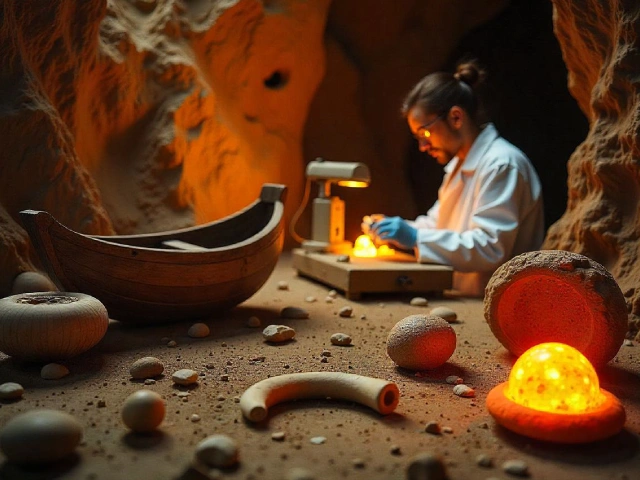
When we discover an ancient stone statue, a cave painting made on rocks, or a thousand-year-old wooden boat, a common question arises—how old is this object? When was it made? To answer this, scientists use various methods, the most popular of which is Carbon-14 (Radiocarbon) dating. However, this is not the only method. Different scientific techniques are applied depending on the type of material, environment, and time period. Let’s find out how scientists take on this complex yet exciting task.
Carbon-14 Dating: History’s Timekeeper
Carbon-14 is a radioactive isotope that naturally occurs in the environment. It is essentially a different form of carbon. The most common forms of carbon are Carbon-12 and Carbon-13. But Carbon-14 is relatively rare, and because it’s radioactive, it decays over time.
How does this method work?
All living things (humans, animals, plants) contain both Carbon-14 and Carbon-12 while alive since they absorb carbon through food and air. But once a plant or animal dies, it stops taking in new carbon. After that, the Carbon-14 within its remains slowly decays. Scientists know the half-life of Carbon-14—that is, the time it takes for half of it to decay—is about 5,730 years. By measuring how much Carbon-14 is left in organic matter (like wood, bone, or cloth), scientists can estimate when the organism died or when the item was made.
For example, if we find that a piece of wood has half its original Carbon-14 remaining, we know it’s about 5,730 years old. If only a quarter remains, its age would be roughly 11,460 years.
Limitations of Carbon-14 Dating
Although effective, this method has its limits. Carbon-14 dating can only be used on organic materials—such as bone, wood, fabric, leather, etc. It cannot be used to date stones, metals, or ceramics. Additionally, if an object is older than about 50,000 years, the remaining Carbon-14 becomes so minimal that it’s no longer reliably measurable.
What are the other methods?
Besides Carbon-14 dating, there are several other advanced methods used to determine the age of different types of artifacts. Here are some of the most important ones:
1. Potassium-Argon Dating
This method is especially used to determine the age of rocks formed from volcanic activity. The radioactive element Potassium-40 slowly transforms into Argon-40 over time. Knowing the rate of this transformation allows scientists to date rocks or lava samples.
Potassium-Argon dating can measure ages going back millions of years. That’s why it’s particularly used for studying the age of dinosaurs or understanding Earth’s geological history.
2. Uranium-Lead Dating
This technique is used to date Earth’s oldest minerals. Uranium slowly decays into lead. Since the rate of decay is well-established, by measuring the proportions of uranium and lead in a mineral, scientists can determine how old it is.
This method can even date items billions of years old.
3. Thermoluminescence Dating
This is mainly used to determine the age of ceramics, pottery, or fired bricks. When an object is fired in a kiln, some electrons become trapped inside. If the object is heated again after a long period, those electrons are released as light. By analyzing that light, scientists can determine how many years have passed since it was last fired.
4. Tree-Ring Dating (Dendrochronology)
In this method, a tree’s age is determined by counting the rings in its trunk—one ring forms each year. By cutting and counting the rings in a tree’s trunk, its age can be easily determined. Moreover, by comparing tree-ring patterns from different regions, researchers can also learn about local climate history.
This technique is also helpful for determining the age of ancient wood or wooden buildings.
5. Archaeomagnetic Dating
The direction of Earth’s magnetic field changes gradually over time. When soil or pottery is heated and then cools, particles within them align with the magnetic field as it was at that time. By measuring the direction of magnetism, scientists can estimate when the object was last fired.
Practical Applications of These Methods
In Bangladesh, these techniques are also used. For example, Carbon-14 and Thermoluminescence dating have been used to determine the age of archaeological finds in Mahasthangarh, Mainamati, and Panam City. Potassium-Argon dating has been applied to understand the geological history of the Himalayan region.
Age Determination Means More Than Just Counting Years
Knowing how old something is is more than just a number—it helps us understand our past. To determine when ancient civilizations began, how climates changed, or how people developed new technologies, age determination is essential for answering these questions.
For instance, if human bones found in Africa are dated to be 30,000 years old, it means that area was habitable since then. Or, if pottery found in the Middle East is 7,000 years old, we can infer that agriculture and urban culture began to emerge around that time.
The Importance for Bangladesh
Our country’s history is thousands of years old. Knowing the age of archaeological finds from historical sites like Mahasthangarh, Wari-Bateshwar, Paharpur, or Mainamati plays an important role in shaping our national identity. Without scientific age determination, we could never reliably state when civilizations arose in this region or where people first settled.
Conclusion:
Whether it’s Carbon-14 dating or Uranium-Lead, every age determination method opens doors to our past. This scientific research teaches us who we are, where we came from, and how our civilization developed. As technology advances, these methods are becoming even more accurate and widespread, so in the future, we may be able to explore our roots even more clearly through the mist of history.
If universities increase research on these modern techniques and develop the necessary laboratories in Bangladesh, the nation will take a big leap in understanding its own history. Because history is not just about the past—it is a guide to our future.
If you want to learn more about how science explains our past, stay tuned to biggani.org.
If you have any questions about this article or are eager to learn about a new topic, don’t hesitate to let us know.
– Author
Science Journalist
biggani.org