The first time I sat down to write a research paper, that empty white page on my computer screen made me nervous. I kept thinking—so many ideas, so much data, so many experiments—can all this really fit into just a few pages? What if nobody reads it? What if the reviewer leaves harsh comments?
This experience is not unique to me. Anyone who sets out on the research path eventually faces this blank page. Writing a research paper is not literary work, yet it is still an art—where you transform information into a story and data into arguments. Today, we’ll step inside that art.
What Is a Research Paper: More Than a Report, It’s a Logical Story
Many think a research paper is just a description of experiments. In reality—it’s a scientific story with a beginning, conflict, and resolution. You start with a question. Then, you present evidence, methods, and analysis. In the end, you show what you learned and why it matters. A good research paper says— “What question did I seek to answer, why did I ask it, how did I investigate, and what did I find?” Your reader isn’t your classmate; your reader is the entire world. So your writing must be clear, honest, and logically strong.
If the Question Isn’t Right, the Writing Won’t Be Good
A good research paper starts with a good question. A weak question leads to a weak paper. A good question is—specific, measurable, connected to previous work, and reveals something new.
For example, “There is water pollution in Bangladesh”—that’s an observation. But “A comparison of heavy metal concentrations in groundwater from two industrial areas of Dhaka”—that’s a research question. The sharper your question, the better your writing will be.
Read First, Then Write: The Importance of Literature Review
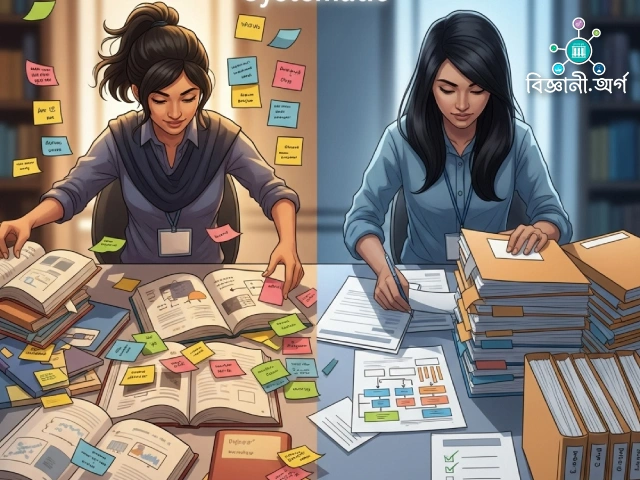
Those who don’t read can’t write well. Before you write a research paper, you need to know—who has done what before you. This reading is your literature review. Literature review teaches you three things:
- You’re not alone.
- Where the gaps are.
- Where you are making an addition.
Don’t just summarize here; compare, debate, and raise questions. Show where your work fits by understanding others’ work.
Methods: The Workshop of Your Research
This is where science becomes real science. Explain clearly—how did you collect data, what instruments did you use, what software did you run, how did you analyze—everything. Why? Because someone else should be able to replicate your study. If they can’t, your research is incomplete. Remember this: Hiding your methods invites suspicion.
Results: When Data Speaks
Don’t tell stories in the results section—let the data speak. Charts, tables, graphs—these are your language. But avoid unnecessary noise; only include what’s essential. Don’t make this mistake: results do not mean explanation. Interpretation comes in the next section.
Discussion: This Is Where You Become a Researcher
In this section, explain—why are these results important? Do they match or conflict with previous research? Why? What new contribution does your work make? This is where the depth of your thinking is shown.
Conclusion: Short, but Powerful
Don’t make grand statements when closing. Briefly mention—what you have taught and what can be done in the future.
Language & Style: Clarity Is Strength
Good writing doesn’t mean complicated writing. Good writing means—simple, clear, direct. Follow these three rules:
- One idea per sentence
- Remove unnecessary words
- Use active voice
References: Whose Shoulders Are You Standing On?
Provide the foundation for what you say. References show gratitude. Incorrect references mean more than losing marks—they break trust.
Review & Rejection: No Doesn’t Mean the End
Even the best papers don’t get published on the first try. A review is not an insult; it’s a ladder for improvement. Those who break after reading a review don’t become researchers. Those who read the review and write again become researchers.
Final Words: Write Today, Even If It’s Bad
Many wait to become “good” before starting. But writing gets better through writing. Write one sentence today. A paragraph tomorrow. A page the day after. Tell yourself:
“Even if my paper isn’t perfect, it will be honest.”
One day, your writing will be someone else’s literature review.
One day, your question will guide someone else.
Start writing—today.