Thirty years ago, Swiss astronomers Michel Mayor and Didier Queloz made an announcement that took human imagination and curiosity to new heights. Their 1995 announcement was the discovery of the first planet orbiting a star similar to our Sun. This planet, named “51 Pegasi b,” was a type of “hot Jupiter”—a giant gas planet orbiting its star at a blazing speed. From that very moment, a new chapter began: we started to look beyond our own solar system, searching for the answer—could there be another planet like ours, somewhere out there?
Since that announcement, thirty years have passed. During this period, scientists have discovered over 6,000 exoplanets, with hints of thousands more. NASA’s Kepler and TESS missions have been the main driving force behind these discoveries. What seemed unbelievable three decades ago is now a regular success of science.
An exoplanet is any planet located outside our solar system. Astronomers are particularly interested in finding exoplanets situated within the “Habitable Zone” of their star. In this region, the possibility of liquid water on the planet’s surface exists—crucial for life.
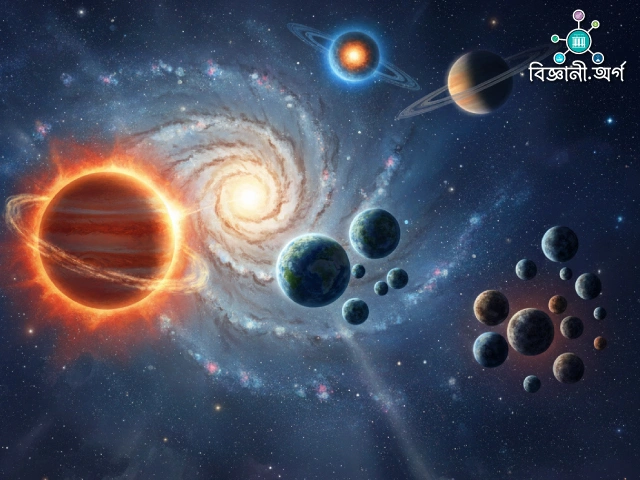
But amidst these numbers, the real fascination lies in their diversity. Some planets orbit so close to their stars that one year there equals just a few days on Earth. Elsewhere we find “super-Earths”—planets larger than ours, but not gas giants; new types with exciting potential. In some systems, multiple planets orbit in such precise harmony that their motion is as rhythmic as music. And then there are worlds like Tatooine, circling twin suns. Each discovery has taught us that the universe’s normal is far more expansive than our imagination. Let’s take a look at some of these remarkable planets.
Proxima Centauri (4.24 light-years): The star closest to our Sun is orbited by at least two small planets, one of which lies within the habitable zone. That means there may be liquid water there. Due to this nearness, Proxima Centauri is the top candidate for humanity’s first interstellar journey. Although the “Breakthrough Starshot” project has yet to succeed, European and American astronomers are confident—humans will reach there before the end of this century.
TRAPPIST-1 (about 39 light-years): This small star, just 12 parsecs from Earth, is orbited by seven Earth-sized planets; several of these lie within the habitable zone. The James Webb Space Telescope is studying their atmospheres. So far, results haven’t been too promising, but maybe one day we’ll find signs of a second Earth there.
K2-138 (about 620 light-years): In this system, six planets orbit in perfect resonance. Their orbital rhythms are so precise that scientists have translated them into music. This system teaches us how planets can gradually form in orderly patterns.
TOI-178 (about 205 light-years): In this system, 63 parsecs from Earth, six planets are packed within the orbit of Mercury, the closest planet to our Sun. This discovery proved that without the collaboration of multiple telescopes, we cannot understand the universe. NASA’s TESS signaled their existence, while the European Cheops satellite confirmed it. TOI-178 stands as a prime example of the power of international scientific collaboration.
Kepler-47 (about 3,400 light-years): This system has three planets orbiting a pair of stars. At least one of these planets lies in the habitable zone of the twin stars. This system proves that planet formation does not only occur around single stars—in fact, Earth-like planets can also form around binary stars.
These discoveries might seem like mere scientific curiosities to the general public. But hidden within them are the possibilities of the future. When humanity sends its first spacecraft towards Proxima Centauri, the technology, the international scientific cooperation, and the financial investments will create new opportunities for every country on Earth. Exploring the universe is not a luxury—it is a powerful force for technological development, science education, and inspiring the next generation.
This is the main lesson for Bangladesh. We may not be able to send our own spacecraft yet—but we can reshape our universities’ approach to astronomy, space technology, and data analysis. The massive datasets from Kepler or James Webb are open to all. Our youth can analyze this data, discover new exoplanets, and contribute to international scientific publications if they wish.
Just as the exoplanet revolution began three decades ago from a small Swiss lab, a new movement of astronomers could also start from a university or startup in Bangladesh. Generation after generation, people have gazed at the sky and asked—are we alone? Now, on the path to finding a scientific answer to that question, we have come a long way.
Every new discovery in the universe shows us that there are no boundaries—not only in geography, but also in imagination. This 30-year journey of exoplanet exploration reminds us—the doors of the universe are open, we just need to know how to look. If Bangladesh wants to find its place in this scientific voyage, now is the time to turn our gaze to the skies.