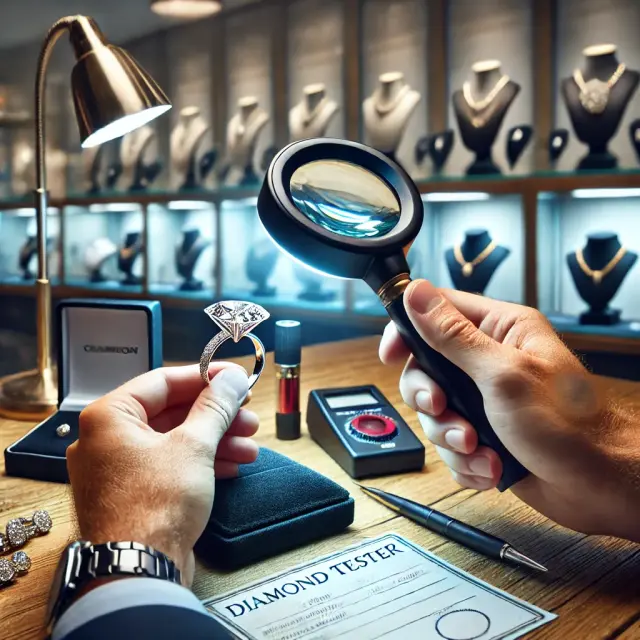
Since buying diamond jewelry requires a significant investment, it is essential to be cautious. With the increasing prevalence of fake diamonds in the market, many people worry whether they have bought a genuine diamond or not. Verifying the authenticity of a diamond at the time of purchase is extremely important, as it not only safeguards your investment but also gives you peace of mind.
In this article, we will discuss various ways you can verify the authenticity of the diamond you purchased. Although these methods can help you check the authenticity, professional testing is always strongly recommended.
1. Check for Certification
The first and most important thing is that your purchased diamond should come with a certification. Certificates issued by organizations such as the GIA (Gemological Institute of America), AGS (American Gem Society), HRD (Hoge Raad voor Diamant), or IGI (International Gemological Institute) confirm the quality and authenticity of the diamond. This certificate includes the accurate weight, cut, color, clarity, and other features of the diamond. Always check the certificate at the time of purchase and make sure it comes from a trusted source.
2. Test Diamond’s Refraction
Diamonds are famous for their refractive properties, which reflect light in such a way that creates a remarkable brilliance and sparkle. A common test is to place the diamond over a piece of printed text or a newspaper and try to read through it. If you can clearly see the letters through the diamond, it is not real. A genuine diamond refracts light so much that it’s impossible to see objects or writing clearly through it.
3. Scratch Test on Glass
A real diamond is one of the hardest substances on earth, so it can easily scratch glass objects. If you want to test your diamond yourself, gently rub it against a glass surface. If the diamond makes a scratch on the glass, it could be real. However, be cautious while performing this test, as it might damage your diamond.
4. Water Test
Diamonds have a very high density, so they sink when placed in water. If you doubt your diamond’s authenticity, drop it into a glass of water. If it sinks, it could be real. On the other hand, if it floats or stands upright in the glass, it may be a fake.
5. Breath Test
Diamonds have excellent thermal conductivity, which allows them to absorb heat quickly. A simple test is to breathe on your diamond and see how long the fog remains. Real diamonds dissipate heat rapidly and the fog disappears almost instantly. In contrast, fake diamonds or crystals will hold the fog for a longer period.
6. Black Light Test
Some real diamonds fluoresce blue when exposed to black light (UV light). If you test your diamond with a black light and it exhibits a bluish glow, it could be genuine. However, remember that not all diamonds have fluorescence, so while this is a helpful test, it’s important to use other methods before making a final decision.
7. Heat Test
Diamonds are famous for their thermal conductivity, which is higher than many other substances. To perform a heat test, hold your diamond close to a hot flame for a few seconds and then quickly drop it into cold water. If the diamond does not crack or get damaged, it could be real. Fake diamonds may crack due to the sudden change in temperature.
8. Professional Testing
Although the above tests are helpful in checking the authenticity of your diamond, there is no substitute for professional testing. You can take your diamond to a trusted jewelry store or gemologist, where they will use specialized equipment and technology to assess its authenticity. They typically use microscopes, spectrometers, and other procedures to determine the quality of the diamond.
9. Electronic Diamond Tester
An electronic diamond tester is a popular device used to test the thermal conductivity of diamonds. When you touch the surface of the diamond with this device, it will instantly indicate whether it is real or not. However, some fake diamonds, such as moissanite, possess thermal conductivity similar to real diamonds and could pass this test. Therefore, this device should be considered a preliminary check only.
10. Identifying Fake Diamonds
It is important to know some common features to recognize fake diamonds. There are various fake diamonds available in the market, such as crystal, zirconia, and moissanite, which closely resemble genuine diamonds. However, their refractive index, thermal conductivity, and weight often differ from real diamonds. To identify these imitations, it is best to consult an experienced gemologist.
Conclusion
Buying a diamond is a significant investment, and verifying its authenticity is essential. Although the above tests can help, the best way is to be completely sure through professional testing. Purchasing a diamond from a trusted jewelry store and checking its certification is the first step in protecting your investment. Remember, a genuine diamond is not just about beauty—it is a valuable asset as well. Therefore, always be vigilant before and after purchasing, and verify the authenticity of your diamond.