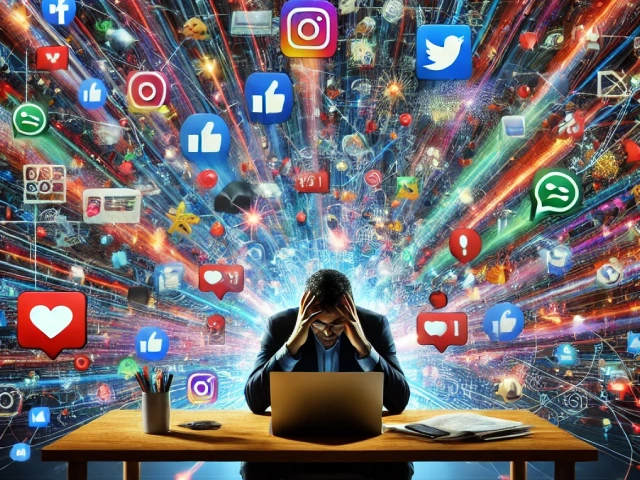
It’s 7:00 in the evening. Sitting in the university library, Shubho is trying to study for tomorrow’s exam. His mobile phone is beside him, but he keeps thinking, “Let me just check Facebook for a minute.” “Nothing will happen in a minute,” he tells himself and starts scrolling. One post, two comments, a video… then come the trending reels, viral news, funny videos… Without realizing it, time slips away. Just like that, 40 minutes are gone!
Running his hand through his hair, Shubho wonders, “Where did all that time go?”
Have you ever had this experience? You decide you’ll just check your phone for five minutes, but then hours disappear before you even notice!
Have you ever thought about how much unnecessary information enters your head every day, slowly making you more distracted? You’re not alone. Statistics say that the average person spends about 7 hours 58 minutes online each day. Of that, 2 hours 27 minutes are just on social media! (Source: Global Digital Report 2023)
This tendency to overconsume information is called information overload. And it’s having a serious impact on our productivity.
Brains Drowning in a Flood of Information
There was a time when people suffered from a lack of information. Back then, we tried to find ways to gather more information. Now, it’s the opposite problem—an overload of information. Since 2000, the average attention span has been shrinking steadily. A Microsoft study says that the average human attention span is just 8 seconds! (Source: Microsoft Study)
So, what’s happening as a result?
- We know a lot, but we don’t understand things deeply.
- All this unnecessary information weakens our decision-making ability.
- Our concentration drops, and we get easily distracted while studying or working.
A Harvard Business Review study found that people who consume less unnecessary information are 25% more productive.
So, should we stop consuming information altogether? Not at all! Instead, we need to follow a healthy strategy for information consumption, which is called an “information diet”.
What is an Information Diet?
An “information diet” is the practice of choosing the right information. Just as we eat good food to keep our bodies healthy, we must also consume good and necessary information to keep our minds healthy.
This is what a good information diet follower does—
✅ Filters – Avoids unnecessary or misleading information.
✅ Practices Selective Consumption – Focuses on gaining knowledge that’s actually useful.
✅ Maintains Digital Hygiene – Limits time spent on social media.
✅ Does Deep Work – Focuses on one task at a time.
How to Start an Information Diet?
Shubho decided that from now on, he’ll control his use of social media. But how?
📌 Turn Off Notifications –
Notifications on your phone are one of the biggest distractions. Research shows that a person checks a new notification or message every 11 minutes, which can reduce productivity by almost 40%. (Source: University of California, Irvine)
➡ What to do: Turn off notifications for unnecessary apps, especially social media and news apps.
📌 Set a Fixed Time –
The average person spends 2 hours 27 minutes on social media every day, which adds up to about 37 days a year! (Source: Global Digital Report 2023)
➡ What to do: Allocate a specific time slot—set a timer to spend 30 minutes to 1 hour on social media daily.
📌 Read Constructive Content –
Often, we waste time on viral videos, trending memes, or gossip news. Research from Stanford University shows that engaging with constructive content strengthens the brain’s neural connections, improving thinking and decision-making ability.
➡ What to do: Make it a habit to read research papers, books, or watch educational videos that build personal skills.
📌 Do a Digital Detox –
To get relief from digital overload, it’s important to spend at least one day a week without the Internet. This reduces stress and increases focus.
➡ What to do: Practice a weekly ‘No Internet Day’—on that day, read books, spend time in nature, or learn a new skill.
These habits will help you become a smart information user. 😊 If you want, I can explain them in more detail!
Successful people around the world—Steve Jobs, Bill Gates, Elon Musk—always controlled their information consumption patterns. They stayed away from unnecessary information and focused only on what was essential.
According to a study from Stanford University, only 30% of the information we consume is actually necessary; the rest is unnecessary. (Source: Harvard Business Review)
So, why wait? Start your information diet today! Remember, unnecessary information is a heavy burden for your brain.
Take steps now to change your mindset. Are you ready? 🚀