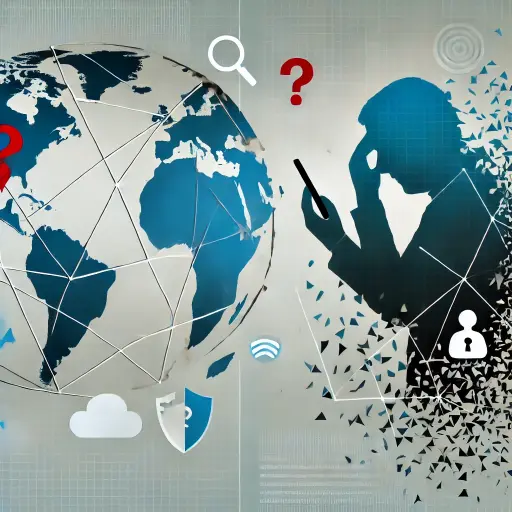
When the Internet first began its journey in the 1990s, it showed us all a new ray of hope. We believed the world was truly becoming a “global village.” People were able to connect with one another rapidly through Internet technology, accessing information more easily, and gaining knowledge that became much more accessible. But alongside this unprecedented progress, some complexities and problems arose, among which one of the most significant is the spread of misinformation and the growing decline in people’s trust in the Internet.
The Dawn of the Internet & Early Trust
The Internet’s journey began in the 1990s mainly with the purpose of sharing information easily with one another, based on trust. Academics, researchers, and technologists shared their knowledge and experience on various online platforms, where they could help others and enrich their own work. At that time, the Internet was a reliable medium where truth and credibility were central concerns. People trusted the information they found online and made decisions based on it.
The Impact of Freedom: Advantages and Disadvantages
One major feature of the Internet is its freedom. Anyone can share any type of information, which grants people the freedom to express their opinions. As a result of this freedom, people began to easily express their thoughts online, and with the advent of social media, this became even easier. On social media, people started sharing their daily experiences, opinions, and knowledge, which transformed the Internet into a larger and more diverse platform.
However, just as this freedom brings advantages, it also has disadvantages. The freedom of the Internet often spreads negative information and fake news, which gradually erodes people’s trust in the Internet.
The Impact of Misinformation & Declining Trust in the Internet
Misinformation has become a major problem on the Internet. Anyone can upload any kind of information, and due to the lack of proper sources and verification, this information often misleads people. For example, various rumors, false news, and pseudoscientific information spread online, guiding people down the wrong path and creating confusion in society.
Even trustworthy and established organizations are not immune to this problem. They have repeatedly fallen victim to misleading information on the Internet, and their reputations have suffered as a result. Consequently, ordinary people lose faith in the Internet and begin to doubt the accuracy of information.
Social Media & the Crisis of Trust
The advent of social media has made the Internet even more powerful, but it has also intensified the crisis of trust. On social media, personal opinions, experiences, and news are disseminated, often spreading among people without any verification. As a result, truth and falsehood become mixed, leading to confusion.
Additionally, social media algorithms show content based on users’ preferences, which often creates an ‘echo chamber.’ This is a situation where people only receive information that aligns with their own opinions and have little opportunity to encounter different viewpoints. As a result, people become increasingly entrenched in their beliefs, and their perspectives become narrower.
‘Echo Chamber’ is a social and psychological situation where people see, hear, or accept only the information and opinions that conform to their own beliefs and viewpoints. This situation arises when an individual or group does not want to see or hear anything contrary to their beliefs, and they accept only information or opinions that support their views.
Restoring the Credibility of the Internet
Restoring the credibility of the Internet is a complex but urgent task. For this, it is essential to increase the use of fact-checking processes and platforms. Moreover, people need to be more aware of the sources and accuracy of information when using the Internet.
Various tech companies and social media platforms need to play a more responsible role in this regard. They must ensure that fake information cannot spread on their platforms and that accurate information is delivered to users. Additionally, digital literacy needs to be included in the education system so that the new generation becomes aware of various aspects of the Internet and learns how to use it correctly.
Some Sites for Fact Checking
1. FactCheck.org: A project of the Annenberg Public Policy Center, which verifies the factual accuracy of statements made by major U.S. political figures.
2. PolitiFact: Operated by the Tampa Bay Times, this impartial site uses a ‘Truth-O-Meter’ to rate the accuracy of politicians’ claims.
3. Snopes: The oldest and largest fact-checking site, Snopes investigates urban legends, folklore, myths, and misinformation.
4. Reuters Fact Check: Run by Reuters, this service fact-checks a wide variety of topics, including political claims and viral misinformation.
5. AFP Fact Check: A service from Agence France-Presse, it verifies the accuracy of news and information circulating on social media.
Some Fact-Checking Sites in the Bengali Language:
1. Rumor Scanner Bangladesh
This is a recognized fact-checking organization in Bangladesh, established on March 17, 2020. Its goal is to prevent rumors and fake news in Bangladesh and provide accurate information to the public.
2. AFP Fact Check Bangla
Agence France-Presse (AFP) has a fact-checking unit dedicated to debunking false information in Bengali. Their Bengali fact-checking activities are overseen by a team devoted to monitoring local-language online content.
3. FactWatch
This is a Bengali fact-checking initiative run by the University of Liberal Arts Bangladesh (ULAB).
4.Jachai
This is another Bengali fact-checking platform and a notable resource for information verification in Bangladesh.
Conclusion
The process of declining trust in the Internet is a long-term and complex issue, but it is solvable with the right approach. To restore the Internet as a trustworthy, reliable, and safe platform, we all need to be aware and take responsible actions. The importance of Internet freedom is undeniable, but it is equally important to prevent its misuse.
The sooner we realize these issues, the sooner we can restore credibility to the Internet—and this is essential not just for our present, but also for the future. If the Internet regains its credibility, it can once again serve as a powerful and effective tool to improve people’s lives.
This article has explored how the Internet has lost trust and how it can be restored. Regaining trust in the Internet is a continuous process that will only be possible through our active participation and awareness.
References
[1] https://scholarcommons.sc.edu/cgi/viewcontent.cgi?article=1144&context=libsci_facpub
[2] https://www.pewresearch.org/internet/2017/10/19/the-future-of-truth-and-misinformation-online/
[3] https://news.miami.edu/stories/2022/01/the-internets-connectivity-brings-positives-and-negatives.html
[4] https://www.pewresearch.org/data-labs/2024/05/17/when-online-content-disappears/
[5] https://cs.stanford.edu/people/eroberts/courses/cs181/projects/2004-05/political-action/credibility.html
[6] https://www.sweor.com/firstimpressions
[7] https://www.forbes.com/advisor/business/software/website-statistics/
[8] https://www.ipsos.com/en/trust-in-the-internet-2022