
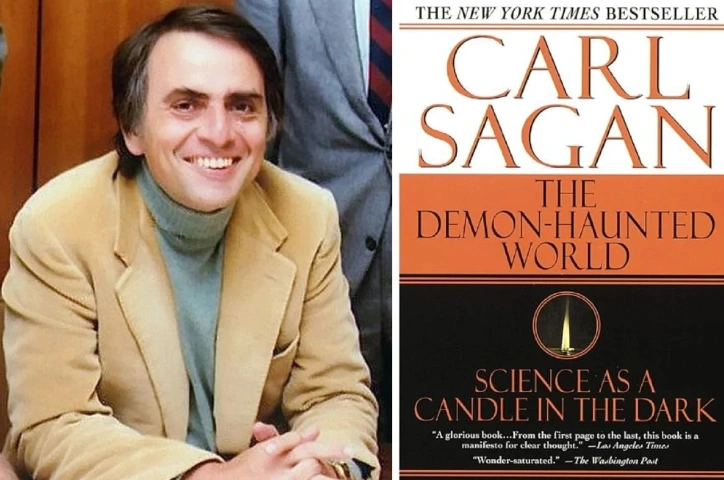
If you are a young researcher or aspire to become a scientist in the future, today I want to introduce you to a book that can play a vital role in your research journey. The book is ‘The Demon-Haunted World: Science as a Candle in the Dark’. Written by Carl Sagan, this is not just another science book—it’s something of an intellectual revolution. Sagan himself called it a love letter to science, where logic, inquiry, and genuine research are championed against blind faith, superstition, and pseudoscience.
Carl Sagan was an astronomer, author, teacher, and outstanding science communicator. Through the Cosmos TV series, he introduced the universe to ordinary people in simple language. His writings carry a kind of courage and moral stance that empower young researchers to ask questions.
He wrote the book at a time when the United States was being swept by astrology, stories of aliens from distant galaxies, miraculous cures, and various forms of pseudoscience. With this work, he explained the importance of scientific values, rationality, and a questioning mindset—needs that are equally relevant in today’s Bangladesh.
The book’s very title, “The Demon-Haunted World,” suggests “a world haunted by ghosts.” Here, the word ‘demon’ is symbolic. It refers to misconceptions, superstitions, or beliefs that have no scientific basis but remain deeply rooted in society. Sagan says, “We live in a society exquisitely dependent on science and technology, in which hardly anyone knows anything about science.”
In Bangladesh, we often see claims—of being possessed by jinn, of shamans performing exorcisms, of removing ‘negative energy’—all common beliefs, yet lacking any scientific explanation. This book teaches us that every claim, every belief, even in science itself, must be questioned.
Sagan explained science as a ‘way of thinking.’ He said science isn’t just about knowing facts; it teaches you how to think. He introduced the idea of a ‘Baloney Detection Kit,’ which gives fundamental guidelines to help you avoid deception, errors, and pseudoscience. These include: repeatedly testing information, considering alternative explanations, avoiding explanations based solely on empty logic or faith, scrutinizing the evidence, and understanding the motives of interested parties. If these habits of thought could be spread among science students in Bangladesh, we would produce not only good scientists, but also socially aware, rational citizens.
Sagan notes, with deep regret, that many people are deprived of the light of science because they were never taught to question or to reason. He says, “Science is more than a body of knowledge; it is a way of thinking.” This book seeks to spread that “light of thought” among young people. Those who want to be scientists should not confine this light merely to their laboratories. It must be taken to every level of society—in villages, cities, classrooms, online forums, and even in political debates.
The special chapters that can reshape your way of thinking include: Science and Hope — why science remains humanity’s final refuge of hope; The Fine Art of Baloney Detection — how to recognize pseudoscience; The Path to Freedom — how scientific thinking leads to intellectual freedom; and Real Patriots Ask Questions — patriotism is not mere agreement, but asking important questions.
Chapter-wise Bengali Summary and Key Topics
1. The Most Precious Thing
👉 Sagan presents science as the most valuable skill, one that teaches us to rely not on belief, but on verified truth.
2. Science and Hope
👉 Science not only identifies problems, it also shows the way to solutions. In tackling environmental crises, diseases, and poverty, science is a beacon of hope.
3. The Man in the Moon and the Face on Mars
👉 How people misinterpret the shapes of celestial bodies and seek out the supernatural. This illustrates the concept of “confirmation bias.”
4. Aliens
👉 The public’s fascination with aliens and the media’s role. Carl Sagan distinguishes between reality and fantasy.
5. Hallucinations & Visions
👉 The inner workings of the human mind, and how illusions and dreams can seem real.
6. The Fine Art of Baloney Detection
👉 The most important chapter. Here Sagan gifts us the ‘Baloney Detection Kit’—teaching us how to protect ourselves from pseudoscience and misinformation.
7. Antiscience
👉 How some groups oppose science in pursuit of their own political or religious interests.
8. Science and Witchcraft
👉 The historical punishment of women and scientists due to misguided beliefs.
9. The Path to Freedom
👉 Science opens the path to personal freedom and free thought.
If you want to become a scientist, it’s not enough to just get good grades—you must also be rational, thoughtful, and inquisitive. And this book is your guide. ‘The Demon-Haunted World’ will teach you how to be a critical thinker, how to verify information, and how to spread scientific enlightenment in society. Carl Sagan will remind you—the power to ask questions is already within you. If you can master that, you can truly become a scientist one day—a beacon of light in a society shrouded in darkness.