One afternoon, I was having a conversation with a little girl. She asked me, “Do scientists discover something every day?” I laughed at her question, but deep inside, I paused for a moment. Because as simple as it sounds, the question is profound. From childhood, we learn that—scientists make discoveries. New planets, new medicines, new machines. But is a scientist’s job only about “discovery”? Or is there something more—something we rarely see or discuss?
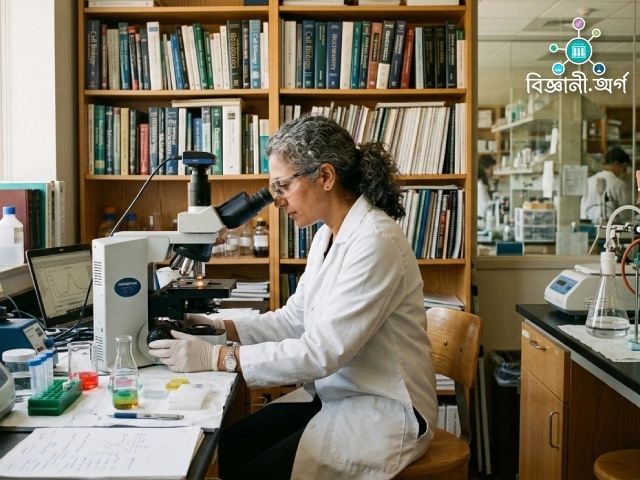
The truth is, a scientist’s day doesn’t start with the thrill of discovery, but with the uncertainty of exploration. Entering the lab in the morning, they have no idea what results the day will bring. They don’t know if the theory will fit, if the machine will work properly, or if the data will once again fail as before. Yet they begin. Because they understand—science is not about definite answers, but about the courage to live with questions.
When we use the word “discovery,” it sounds like stumbling upon hidden treasure. As if a scientist one day opens the lid of a bottle and releases a new truth. In reality, discoveries almost never come suddenly. They arrive at the end of a long search. After years of mistakes, failures, and doubts, a door suddenly opens one day. And then we put a nameplate on that door: Discovery.
Exploration is that silent and overlooked part we never see. Failed nights in the lab, failed projects, canceled grants—none of these make it into the final paper. But they are the daily reality for scientists. So the real work of a scientist is not to discover, but to keep exploring—even when no one is applauding, even when there are no headlines.
If we look closely at history, this picture becomes even clearer. We know that Marie Curie discovered radium. But we rarely mention how many years she worked with unknown ores, how much time was wasted chasing false leads. We know Newton’s apple story, but not about all those nights filled with failed calculations. We reduce Einstein’s theory of relativity to a single equation, but behind that formula were years of solitary thought.
We usually turn the discoverer into a hero, and forget about the explorer. Yet true heroism hides in that silence. The person who doesn’t know if they’ll succeed but still enters the lab the next day—that’s the real scientist.
This brings up an important question—do scientists “find new things,” or do they “see old things in new ways”? The reality is, most of the time scientists don’t discover something new, but think about familiar things in a new light. Apples fell before too, but Newton saw it differently. Light existed before, but Einstein thought about it in a new way.
So exploration isn’t just about moving toward the unknown; it’s also about questioning the familiar. Asking again about what we “know”—that’s the boldness of science. A scientist is someone who doesn’t blindly accept what’s taught in the classroom as the absolute truth, but instead asks, “What if there’s a flaw in this?”
This question is even more important in the context of Bangladesh. In our society, “scientist” still means to many “a bookish person” or “someone in a lab.” But in reality, a scientist is a problem-solver. They work on dengue, think about river erosion, track crop diseases, worry about the toxins in city air. Here, discovery may not mean a new planet, but rather a new approach—a way to make life a little better for people.
At this point, the boundary between discovery and exploration almost disappears. Because a scientist may not invent a new device or provide a new formula, but might offer a new way of understanding a problem. Sometimes, this new understanding is the greatest discovery of all.
Still, when we teach science, we teach results, not process. We teach formulas, but don’t tell the stories of struggle behind reaching them. As a result, children think science is about knowing answers, not about asking questions. But in a scientist’s heart, there are always questions, not answers.
Every day, a scientist does one thing—embraces error. Because every mistake leads them to the next question. Exploration means living peacefully with mistakes, making sure errors do not break you but teach you instead.
In today’s world, the role of a scientist has become even more complex. It’s no longer enough to just sit in a lab; you have to communicate your work to society, to decision-makers. A scientist is now a researcher, a teacher, a speaker, and sometimes an activist. Climate change, pandemics, artificial intelligence—on these issues, scientists can no longer remain neutral observers.
This doesn’t mean that science will become political. It means exploration won’t stay confined only to nature, but will extend into society as well. How people live, how diseases spread, how information is absorbed—these too are scientific questions today.
In this context, discovery versus exploration becomes a matter of mindset. If you believe a scientist’s job is only to “do something new,” you’ll end up disappointed. Because new things come very rarely. But if you understand that a scientist’s work is about taking small steps toward the truth every day, then every day your work becomes meaningful.
The biggest mistake for a young researcher is to think of themselves as a discoverer. This increases pressure and disappointment. But if you see yourself as an explorer, then failures become part of the journey, not a disease.
This is no small difference. It sets you free mentally. You’ll no longer ask, “Did I find something today?” Instead, you’ll ask, “Did I understand something today?”
Science, after all, is the name of that space where people learn to question what they know. That lesson is the scientist’s greatest work. Inventing a new device is the outer expression of this. Creating new thoughts is the inner work.
Someday, maybe your name will also be written in a book, saying—“They discovered something remarkable.” But behind that one line will lie your years and years of exploration. And honestly, it’s that journey of exploration that is your real identity.
So what do scientists really do?
Not discovery—but perseverance.
Not celebration—but practice.
Not answers—but questions.
And it is the courage to live with questions that makes someone a scientist.