A Scientific Investigative Chapter
✍️ Author: Biggani.org |
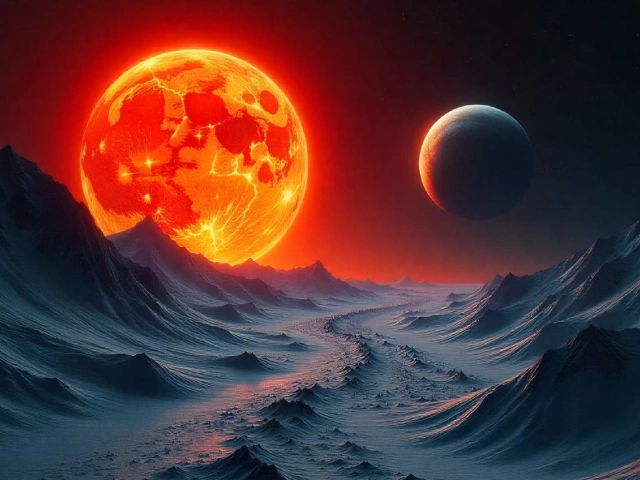
A tale of a distant day—NASA’s telescope is gazing at Pluto. The time marks the beginning of the final phase of the Sun’s life. Earth has already been reduced to ashes in the fiery embrace of a colossal red giant. There are no seas, no mountains, no air. Only boiling rocks and a red, overheated atmosphere remain. Yet, Pluto’s frozen surface is melting, a thin new atmosphere of methane and carbon vapors is forming, and some strange life—perhaps single-celled organisms—are trying to survive, hinting at the possibility of a new world.
This story isn’t real, but it’s not entirely impossible either. As astrophysicist Phil Plait said, “If you give the Sun a few hundred million years, it will become something that incinerates life.” The question is, will life survive somewhere, somehow, even then?
The Sun that rises every morning is a familiar sight to us. But in reality, the Sun is a massive nuclear furnace. Every second, it converts about 600 million tons of hydrogen into helium, releasing vast amounts of heat and light. This helium gradually gathers at the Sun’s core, forming a heavy ‘ash-like’ layer.
The Sun’s other gaseous layers press down upon this core. As a result, the helium core contracts and heats up further. This makes the Sun gradually brighter and larger—eventually transforming into a Red Giant star.
During this transformation, the Sun will swallow Mercury and Venus in its expanding size, and then Earth as well. Earth’s temperature will reach nearly 1300 degrees Celsius. The oceans will vaporize, the atmosphere will evaporate, and even the rocks will melt into seas of lava.
Scientists have arrived at this prediction through years of research, computer simulations, and by observing other stars similar to the Sun. For example, the Hubble Space Telescope has observed the life cycles of many ‘elderly’ stars. Additionally, the European Space Agency’s Gaia mission has provided detailed data about the Sun’s mass, age, and future.
And this prophecy isn’t limited to Earth. Almost every planet in the solar system will fall victim to the Sun’s scorching heat. Mars might survive for a while, but ultimately, its fate will mirror Earth’s.
Yet, hope doesn’t completely fade. Pluto, a frozen dwarf planet about 50 times farther from the Sun than Earth, could become the only potential safe haven. Its surface would still be as cold as -10 degrees Celsius, but its melting ice might form a thin atmosphere. The presence of methane and carbon in this atmosphere could offer minimal support for life.
Scientists have differing opinions on the matter. Some believe that if life were to survive on a cold planet like Pluto, it would have to be entirely different—perhaps microorganisms that breathe in frozen liquid methane. Others suggest that moons outside the solar system, like Jupiter’s Europa or Saturn’s Enceladus—where liquid water might exist beneath the ice—could also harbor hidden life.
New research suggests that if an intelligent, technologically advanced species (like humans) becomes aware in advance, they could sustain life by moving to another planet or even on interstellar spaceships. Yet, this raises not just technical, but major social and ethical questions:
– Who will we choose to save?
– Who will make the decisions?
– How will we prepare, together, before Earth’s destruction?
This field of study has become important not just to scientists, but also to philosophers, ethicists, environmentalists, and even authors. The idea of cosmic migration in light of Earth’s possible doomsday is no longer mere science fiction, but part of scientifically grounded future thinking. Elon Musk’s SpaceX, Jeff Bezos’s Blue Origin, or China’s CNSA—all are now planning interplanetary missions.
What could happen in the next 5–10 years?
- The James Webb Space Telescope is searching for signs of life on new planets and moons.
- Robotic missions to icy moons like Pluto or Europa are making progress.
- Efforts are underway to use artificial intelligence and genetic engineering to create ’lifeforms capable of surviving in extreme conditions.’
- Plans are advancing to establish the Moon or Mars as ‘temporary base camps’ before sending humanity to the stars.
Final thoughts:
Earth will not last forever. One day, the Sun will go out, and Earth will turn to ashes. But will life truly end? Science says life is extraordinarily stubborn—it always finds a way. Perhaps, one distant future day, on another planet, under the light of another distant sun, someone will say, “We came from a planet once called Earth.”
📚 Sources:
- Phil Plait, Bad Astronomy Blog, Slate Magazine
- Nature Astronomy Journal
- NASA JWST Mission Updates
- ESA Gaia Spacecraft Reports
- Scientific American (2025)
📌 This article is written for readers of ‘Biggani.org’—those who know science, love science, and are curious about the possibilities of the future.