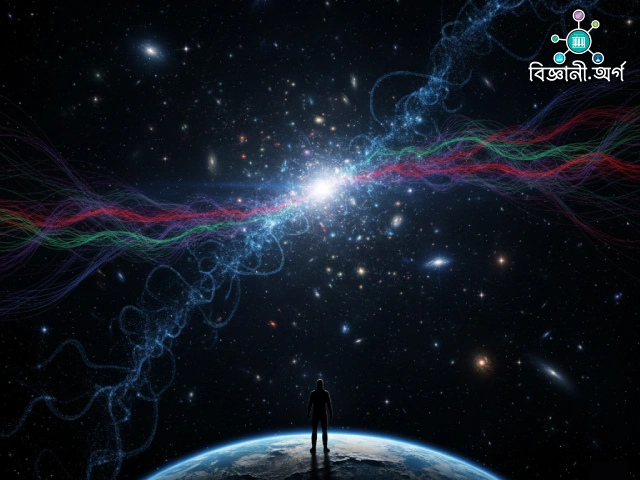
There is a strange paradox in our lives—the reality we inhabit is, for the most part, hidden from our eyes. Modern astronomers say we can directly see or touch only about 5 percent of the universe. The remaining 95 percent is made up of mysterious, invisible substances—dark matter and dark energy—that can’t be seen with the naked eye or even with ordinary telescopes.
Dark matter holds galaxies together through gravitational force, but it neither absorbs nor emits light. And dark energy is that mysterious force which is constantly driving the expansion of the universe. Measurements from satellites like Planck and WMAP confirm this—what we see of the universe is like the tip of a massive iceberg resting above water, while the rest is hidden deep below the surface.
But this invisible reality doesn’t just exist “out there” in space, it’s all around us. Human eyes can see only a small fraction of light—wavelengths from 380 to 740 nanometers. Beyond this range are ultraviolet rays, infrared, X-rays, gamma rays, and radio waves, which continuously flow around the Earth, yet we remain oblivious to them. Similarly, our ears can hear sounds between 20 and 20,000 hertz, while elephants, bats, or dolphins can hear and use sounds that are completely beyond our auditory limits.
When scientists go beyond the reach of our limited senses using advanced technologies, an incredible world emerges. The long-wavelength sounds of deep-sea whales that travel thousands of kilometers; ghostly particles called neutrinos that pass through our bodies every moment; or radio signals arriving from the edge of the Milky Way—these were once beyond imagination.
History shows that as technology advances, so does the limit of our vision. Galileo’s telescope revealed craters on the Moon, the microscope first unveiled the existence of germs, and modern particle accelerators are paving the way to uncover the mysteries of dark matter. Every new discovery proves that reality is much broader and more complex than we imagine.
The question is—how much still remains unseen? Perhaps there are particles, forces, or natural laws still far beyond the reach of today’s instruments. Centuries from now, scientists may smile and say—people in the 21st century were really just peeking at the universe through a tiny crack in the window.
Yet the concept of this invisible reality is not just a matter of scientific curiosity—it deepens philosophical thought as well. No matter how advanced our technology becomes, in the end we must admit—our senses, intellect, and instruments have limits. Still, the urge to transcend those limits is the lifeblood of science. This attempt to see the unseen is what drives human civilization forward.
Perhaps the day is not far when we’ll uncover the mysteries of the hidden 95 percent of the universe. Until then, our journey in search of the unseen will continue—because it is in human nature never to quench the thirst for knowledge.