


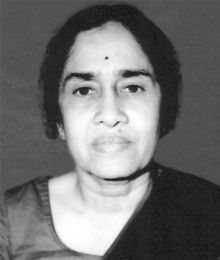
India’s First Woman PhD (in Science) and Gender Discrimination

Gender discrimination has existed throughout the world from time immemorial। Its blatant form is especially apparent in the world of science। At the beginning of the nineteenth century, when India was about to step into the world of modern scientific education, this discrimination became starkly evident.। Many of our national leaders opposed educating women in science। The Father of the Nation, Mahatma Gandhi, is a notable example। In the words of Gandhi:–“ As nature has made man and women different, it is necessary to maintain a difference between the education of the two. True they are equals in life, but their functions differ. It is women right to rule the home. Man is master outside. Man is earner. Women spend and save….In this scheme of nature, and it is just as it should be, women should not have to earn her living.” Despite such circumstances, a few women made remarkable contributions in science, and Kamala Sohonie was among them. The story of her struggle remains unknown to many even today, which is shameful for us. The year 2012 marked her birth centenary। Yet, across the country, there was hardly any noticeable government or private initiative to pay tribute to her.। To this day, we remain unable to give women their due respect.। The aim of this article is to present Kamala’s struggle to the readers। It seeks to depict how intense her struggle was simply because she was a woman. Kamala stands as a shining example of just how extraordinary women’s strength can be.
Kamala’s Early Life:- Kamala belonged to a renowned and highly educated family in Mumbai. Both her father and uncle graduated from Presidency College, Mumbai, with honors in Chemistry. Naturally, they aspired for their daughter to become a great scientist like Madame Curie. At that time, she was Kamala Bhagvat. Accordingly, she cultivated all the qualities required to become a great scientist. She was extraordinarily attentive to her studies. She graduated from the University of Mumbai with the highest marks in Chemistry. Around the same time, Sir C. V. Raman was establishing the Indian Institute of Science in Bangalore. This was an institution in India that offered all the facilities for modern research. Thus, all scientists and aspiring scientists had their eyes set on IISc Bangalore. Kamala was no exception. As the top scorer of Mumbai University, she was determined that she would get the opportunity to do research under Raman. Confident in this belief, she set off for Bangalore with her father and uncle.
(University of Mumbai)
Kamala at Raman’s Research Center:- Kamala had always been under the care of her parents.। Now her real struggle as a woman began। She learned that because she was a woman, she was ineligible for admission to Raman’s research center.। No amount of requests or reasoning from her father and uncle made a difference—Raman dismissed it all out of hand. He declared––“I am a man of single word, I will not allow any girl to admit in my Institution”. So in despair, her father and uncle probably saw no other choice but to take Kamala back home.। But Kamala was made of different mettle. She stood up to Raman’s injustice. She started a satyagraha, demanding a logical reason for her rejection. Though ignored at first, Raman ultimately had to relent to Kamala’s persistence. This was perhaps Kamala’s moral victory. Yet the conditions Raman imposed on her even then make us wonder to this day—have women ever been truly respected in our society? The conditions Raman placed on Kamala were as follows– 1) She would never be considered a regular candidate.
2) Her access to the laboratory would depend on her guide.
3) She must try to maintain the laboratory environment.
Perhaps for this reason, Kamala could never forgive Raman. This is why, at a 1997 felicitation in Mumbai’s Bhabha Atomic Research Center, organized by the Indian Women Scientists Association, Kamala expressed strong resentment toward Raman. At this event, she said–“Though Raman was a great scientist, he was very narrow-minded. I can never forget the way he treated me just because I was a woman,”
It’s clear that Kamala never truly accepted the preconditions for her admission. We realize this when we hear her own words–“Even then, Raman didn’t admit me as a regular student. This was a great insult to me. The bias against women was so bad at that time. What can one expect if even a Nobel laureate behaves in such a way?’’ In other words, Kamala accepted the terms somewhat out of compulsion। For a researcher, this must have been a deep wound। It’s unimaginable to be punished in this way merely for being a woman। However, she considered herself fortunate to have Srinivasan as her teacher. As strict as he was about studies, he was equally liberal as a mentor. It was mainly due to his encouragement that she began research on proteins. At that time, she was probably the only graduate conducting research on proteins. Srinivasan not only helped her academically, but taught her how to communicate with contemporary biologists through correspondence, which helped Kamala become acquainted with modern research in a short time. For her fundamental research on proteins, the University of Mumbai awarded her the MSc degree. Her even greater achievement came when she got the opportunity to do research at Cambridge University. In 1936, she received the SPRINGER scholarship and the Sir Mangaldas Nathubhai scholarship from Mumbai University. The first allowed her to study at Cambridge, and the second allowed her to attend the American Women Scientists meeting. Nevertheless, Kamala’s success opened Raman’s eyes, and he then opened the doors of his research center to women. Reflecting on this, Kamala later said–“This incident forced Raman to change his opinion about women and from that year he admitted a few students every year,”.Even today, when gender discrimination is rampant, this statement may inspire many women। Kamala was deeply grateful to the University of Mumbai: so when she published her research paper with Derek Richter at Cambridge University in 1938, she wrote in the footnote–“The authors wish to thank Sir Frederick Hopkins and Prof. F. Golla for their interest and Dr G. Fraenkel for a gift of animals. One of us (K. B.) wishes to express her gratitude to the University of Bombay for the award of Springer Research and Sir Mangaldas Nathubhai Scholarships.” Perhaps only Indians show such respect to their universities।
(Indian Institute of Science – Bangalore) (Sir C. V. Raman)
Kamala at Cambridge:-
Perhaps the most notable period of Kamala’s research career was her nearly three years at Cambridge. Though her initial training in research came from Srinivasan, she encountered the real laboratory of biochemistry only at Cambridge. At first, though, she was not admitted to Cambridge—she got the chance to enroll in someone else’s place. Nonetheless, she was fortunate to work under Professor Hopkins.
At Cambridge, she worked under Dr. Derek Richter. Derek would give up his desk for Kamala during the day, though he worked there at night. When Derek had to go out for work, Kamala would have the opportunity to work day and night at his desk.। During this time, Dr. Robin Hill also helped her with her research. The nature of their work was similar। Hill worked on plant chlorophyll, while Kamala worked on potatoes. Both were investigating the role of enzymes in oxidation. Kamala discovered the presence of an enzyme named “cytochrome c” in every plant cell; this enzyme plays a pivotal role in the cell’s oxidation process. This discovery is a boon for botany. One night, when a foreign woman researcher was seen working at Derek’s desk, Hopkins became curious and approached Kamala. He learned that, in Derek’s absence, Kamala could work late into the night, and wanted to know what she was researching. Hearing from Kamala about the effect of “cytochrome c,” he was astounded and told her to submit her research paper, recognizing it as original work. Thus, Kamala submitted a research paper of just forty pages, typed in her own hand. In those days, research theses were typically several thousand pages. Astonishingly, Cambridge University awarded her a PhD for this original work—still a record. There has not been, nor is it likely there will ever be, another PhD thesis so short and handwritten in world history.
( Kamala in Cambridge Laboratory) ( With her friend G.D. Loo)
Kamala’s days at Cambridge passed in great happiness, mainly due to the environment and the abundance of research opportunities, but above all because of the wonderful colleagues with whom she worked and by whom she felt greatly supported and satisfied. Hopkins, Derek Richter, and Robin Hill deserve special mention in this context. All Indians remain grateful to them.
(F. G. Hopkins, Derek Richter and Robin Hill)
Kamala’s Career:- Even the joyful life at Cambridge was no match for the pull of her homeland। Kamala returned to India।
She joined Lady Hardinge College, where the Department of Biochemistry had just been established. She joined as its head in 1939. However, all her colleagues were men, making it difficult for her to adjust. Moreover, research facilities were inadequate, so she left this job and joined the Nutrition Research Laboratory at Coonoor.।
(Nutrition Research Laboratory, Coonoor)
There she joined directly as Deputy Director. She began various research projects on vitamins. Her papers were published in journals in India and abroad. However, she continued to feel a sense of frustration, fearing that as a woman, she might not find much success in that institution. At this point, she received a marriage proposal from M. V. Sohonie. She accepted, and moved permanently to Mumbai in 1947.
(Institute of Science, Mumbai)
At that very time, the Maharashtra government opened the Department of Biochemistry at the Royal Institute of Science. They were looking for a suitable professor to lead it. Kamala applied for the position and, needless to say, she was selected. A new chapter commenced in her life—she transitioned from researcher to ideal teacher. She started research on nutrition with her students, which was crucial for the country at that time. Kamala and her students conducted significant research into the nutritional values of pulses, rice, wheat, etc. Their aim was not only research for the sake of research, but also to motivate students to conduct studies relevant to national need. One of her notable projects was research on Neera—a sap extracted from date palm trees. The President of India, Rajendra Prasad, himself encouraged her in this work. Kamala observed that tribal women who drank Neera, especially during adolescence or pregnancy, suffered less from malnutrition. She further noticed that Neera contained vitamin C and other vitamins, which remained potent for a long time. Kamala and her students researched Neera for twelve years. Ultimately, this work was honored with the President’s Award. She also conducted various studies on milk proteins. Along with guiding and nurturing students, she encouraged them to publish work in various research journals. In the final four years of her career, she became the Director of the Institute of Science. It remains unknown whether institutional politics or gender discrimination ever obstructed her path to director. Kamala, of course, never expressed any resentment about this. In fact, on news of her becoming Director, Dr. Derek Richter remarked–“made history by being the first lady Director of such a big science institute.”
Another Side of Kamala:- In 1966, Kamala, along with nine other women, founded the Consumer Guidance Society of India (CGSI). At that time, consumer protection was an especially forward-thinking issue. The organization’s work included research on food adulteration and ensuring that shopkeepers used proper weighing equipment. Kamala herself wrote many articles on consumer protection to inform the public.
She also wrote several books in Marathi for children, to teach science in their mother tongue. On behalf of CGSI, she regularly published a magazine named Kimat, which contained various consumer protection tips.
Kamala’s life was colorful and vibrant. She always engaged herself in creative pursuits.
Final Moments:- Those who deserve honor, perhaps God arranges for them to get it. Kamala worked all her life as a symbol of women’s power. As a researcher, teacher, social worker, and writer—she fought and overcame every obstacle, holding her head high as a woman. It seems even her last moment was written by God in the same manner. The year was 1998. Dr. G. V. Satyavati was then Director General of the Indian Council of Medical Research, and the first woman to head such an institution. Upon learning about Kamala, she organized a grand event to honor her. During the ceremony itself, Kamala fell into a coma while on stage. Can there be a more glorious death??
References:-
1. Sur, Abha (2007). Lilavati’s daughters: The women scientists of India. Indian Academy of Science.
2. Arvind Gupta: Bright Sparks, Inspiring Indian scientists from the past.
3. Tethinaraj T.S. Gopi (1997): “ Raman has a gender bias” Indian Express, July 8,1997.
4. Websites:-Women in Science: An Indian Academic of sciences initiative.
5. For all photos of Cambridge:- Website of Cambridge university –Biochemistry department.
6. Dispersed Radiance: Women Scientists in C. V. Raman’s Laboratory,” which appeared in the journal Meridians, Spring 2001.)
7. Photo Album:– Cambridge university, Biochemistry department.
Submitted by:- Shri Dhrubajyoti Chttopadhyay, MSc, MS(Science Communication)
Education Officer, North Bengal Science Centre, P.O.-Matigara
Siliguri, Dist.- Darjeeling. Pin.- 734010, Phone-9933471510
Email- [email protected]









Leave a comment