Former young researcher of Bangladesh University of Engineering and Technology (BUET), Md. Jahin Alam, has developed a technology that will help doctors detect cancer or tumors with greater accuracy in the future. His research has been published in the international journal Healthcare Analytics, which has become a focal point of interest among medical scientists worldwide.
A young scientist from BUET, Md. Jahin Alam, has invented such a technology that will make it easier for doctors to detect tumors, fibrosis, or inflammation inside the body. His research has now paved the way for his doctoral studies at the PULSE Lab of Johns Hopkins University in the United States.
Who is Jahin Alam?
Jahin Alam completed his undergraduate and master’s degrees in Electrical and Electronic Engineering (EEE) from BUET. During his studies, he conducted joint research with FujiFilm Healthcare (Japan and USA). His interests lie in biomedical signal and image processing—that is, analyzing human body images and data using computers and electronics. He believes, “Medical technology is only successful when it is accessible to ordinary people.”
How Do Ultrasound and SWE Work?
We are all familiar with the term ultrasound—a medical test where high-frequency sound waves are sent into the body and their reflections are used to create images of internal organs.
But just looking at images doesn’t provide all the information. It is also important to know whether a tissue is hard or soft, as cancerous or tumorous tissues are usually hard.
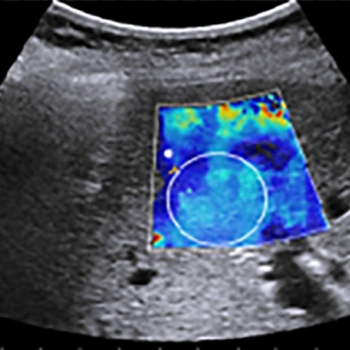
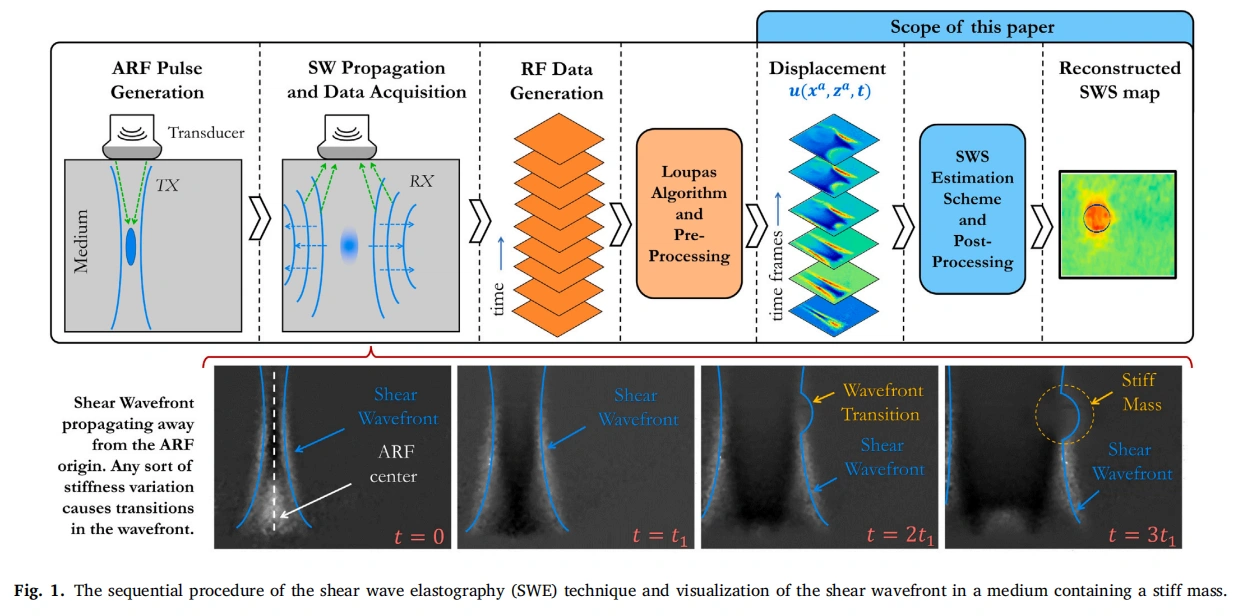
That’s why a special method was developed called Shear Wave Elastography (SWE). In this method, a certain kind of tiny vibration or shear wave is sent inside the body. These waves spread sideways, and by measuring their speed (shear wave speed), we can determine how hard or soft the tissue is. The faster the wave travels, the harder the tissue—that’s the main concept.
So SWE is a non-invasive (meaning without surgery), real-time (meaning immediate) and affordable technology that is now routinely used by doctors in many advanced countries.
Where Was the Problem?
Although SWE technology is highly effective, there were still some major issues. When sound waves are sent inside the body, they reflect and overlap in many places, creating noise—in other words, false or irrelevant signals.
This noise or reflection makes it difficult to measure the correct speed of the wave. Sometimes the computer mistakenly interprets a false signal as the real wave, leading to incorrect results.
Jahin Alam’s New Solution
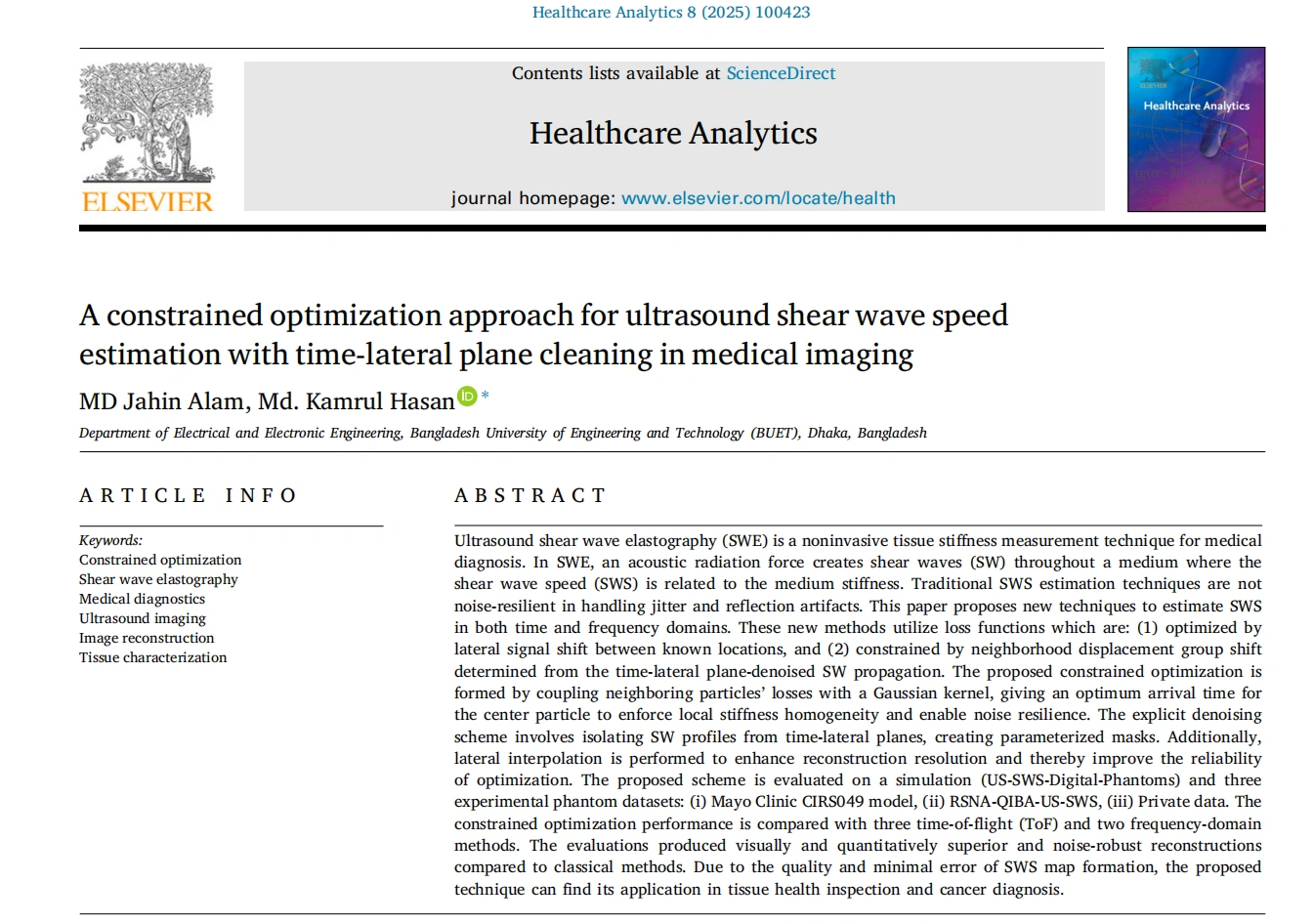
To solve these problems, Jahin Alam developed a new mathematics-based method during his postgraduate research, called Constrained Optimization-based Shear Wave Speed Estimation.
Simply put, this method allows the computer to analyze not just the data from one spot, but also from the surrounding regions at the same time. If there’s noise or distortion in one section, the neighboring data helps correct it. As a result, the outcome is much more accurate and stable.
He has added another new step to the process—Time-Lateral Plane Cleaning. This is a technique that removes false signals or reflections from the SWE data, ensuring that only information from the real wave is used in the analysis.
In this way, the system he developed is noise-resistant, meaning it’s much more protected from the effects of noise or echoes.
What Did the Tests Show?
Jahin Alam tested this new method on various datasets—
One was digital simulation data, and three more were experimental phantom datasets, including those collected from Mayo Clinic and RSNA-QIBA.
In every case, his model delivered far more accurate and robust results than five previously established methods.
This produces a perfectly clear stiffness map, which helps doctors easily distinguish between hard and soft areas inside the body.
Why This Is Important
This discovery is not just a research paper; it is a signpost for the future of healthcare. With this method, doctors can now diagnose diseases of the liver, breast, prostate, and even muscles and tendons faster and more clearly. Most importantly—it’s affordable, practical, and applicable in countries like Bangladesh as well.
Conclusion
Jahin Alam’s journey—from BUET’s laboratory to one of the world’s leading research institutions, Johns Hopkins—proves that young Bangladeshis are capable of producing world-class scientific and technological innovations.
He has shown that with talent and hard work, it is possible to make history from any lab in the world.
His work is not only an advancement for medical technology, but also a symbol of inspiration for young scientists in Bangladesh.
It is notable that in 2024, an interview with scientist Jahin was published on Biggani.org where he discussed his research in detail. Read more: https://biggani.com/jahin-alam/