
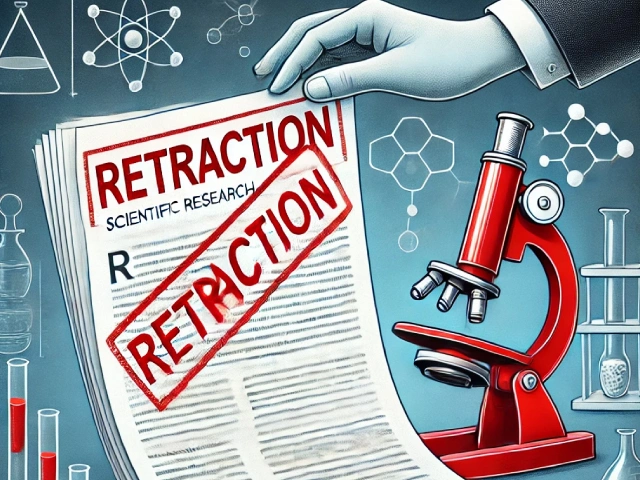
The core foundation of scientific research is the pursuit of truth, where honesty and ethics are of paramount importance. However, recently there has been a noticeable rise in the retraction of research papers, which signals an ethical crisis within the scientific community. A recent detailed analysis published in Nature revealed abnormally high retraction rates at various institutions—from certain hospitals in China to some private colleges in India.
What is Retraction?
When major errors, fraud, or ethical violations are detected in research, that published paper formally loses its legitimacy. The journal authorities then “retract” the work to keep the scientific record clear and to prevent incorrect or fraudulent information from being reused.
Why Are Retractions Increasing?
1) The Culture of Quantitative Evaluation in Paper Publishing: There is a growing tendency to assess a researcher’s qualifications or success by the number of regular publications (paper publishings). In universities and research institutions, recognition, promotions, or funding are often tied to a required or highly valued number of research publications.
As a result, researchers frequently strive to publish new articles as quickly and as often as possible, aiming to submit numerous papers. Under this pressure, some researchers risk resorting to shortcuts or unethical methods (such as data manipulation, inappropriate collaboration, or plagiarism) instead of adhering to integrity and proper methodology. Consequently, the number of fraudulent or flawed publications rises in scientific research, necessitating the retraction of many papers.
2) The Rise of Paper Mills: The aggressive emergence of ‘paper mills’—organizations that manufacture fake research papers—has recently become a notable issue. Their main business is to produce partially or completely fabricated research articles for money. How they operate, why this is a serious problem, and especially its impact on medical science, are discussed below:
- How paper mills operate: Typically, paper mills employ some ‘declared’ or ‘ghost’ writers who draft research papers using entirely fictitious data or information on specific topics or fields. The ‘buyer’ (e.g., the researcher or doctor seeking a publication) then adds their personal information and required details and claims the paper as their own. Sometimes, existing research articles are minimally edited or altered to be republished in a new form, which constitutes plagiarism.
- Why is this a serious problem: Articles from paper mills often contain fabricated data or misused information from genuine research. As a result, they spread misinformation in the name of science.
- An obstacle to scientific progress: Such fraudulent work confuses the scientific community and wastes time and effort in identifying genuine work.
- Ethical risks: Those who purchase these fake articles and pass them off as their own are engaging in severe research misconduct. Personal integrity is compromised, and in the long run, it undermines scientific and social values worldwide.
3) Weak Research Integrity Policies: In some institutions, the research integrity office or ethical oversight is inadequate. This leads to not just one or two, but many researchers within the institution being involved in unethical practices.
4) Flawed or Biased Peer Review: Substandard or fraudulent research can get published through fake or nepotistic reviews and excessive self-citation. Peer review is the process where specialists in the same or a related field review an article before publication. The goal of this review is to ensure the quality, scientific rationale, and accuracy of the publication. However, in many cases, the peer review process suffers from various forms of abuse and error, allowing low-quality or fake research papers to be published.
- Fake or Nepotistic Reviews: A researcher might suggest acquaintances or members of the same research group as reviewers. This means the paper might be accepted based on friendship or family ties rather than its actual merit.
- Illegal ‘Fake’ Reviewers: Some participants create fake email accounts or identities to participate in peer review. This enables them to recommend acceptance of papers for personal or group interests, completely undermining the review process.
- Excessive Self-Citation: In some instances, reviewers (sometimes in collusion with the authors) deliberately encourage the citation of their own previous work to increase their personal citation count.
This does not improve the quality or relevance of the main paper; it only serves the personal interests of the reviewer or authors.
Consequences of Retracting Research Papers
The rise in retractions can erode public trust in scientific research. Policy decisions made by governments may be misled if they are based on fraudulent studies. In medicine, misinformation can lead to patient harm or even loss of life. In addition, the reputation of involved institutions and researchers may be damaged, making it harder to obtain funding in the future.
How Can Retractions Be Addressed?
1) Rigorous Institutional Oversight: Universities and research institutes should set up independent research integrity offices to prevent unethical conduct. These offices should review and regularly audit research papers before submission to journals. Increased accountability and oversight of this kind will help reduce the possibilities of fraud.
2) Qualitative Evaluation Criteria: Researchers should be evaluated not only by the number of publications but also by their impact, reproducibility, and quality. Generally, the value of quality research should be determined by its impact, scientific transparency, and reproducibility—not solely by how many papers have been published. Currently, the “publish or perish” culture leads some to focus on quantity alone, potentially harming research quality.
3) Measures Against Paper Mills and Predatory Journals: Globally coordinated efforts and the creation of tough laws and blacklists are needed to curb fake publications and fraudulent peer reviews. Currently, resources like Cabell’s Predatory Reports, Beall’s List, and the Retraction Watch Database are helping track such practices.
4) Transparent and Robust Peer Review: The review process should be as open and transparent as possible, making use of AI-based platforms to detect data and image manipulation, and promoting the culture of replication studies and reproducibility.
5) Fostering Integrity and Values: From the start, students need to be made aware of research ethics, data analysis, and integrity in writing. True pursuit of knowledge and a sense of responsibility—these two qualities will guide the next generation of scientists in the right direction.
Integrity and quality are the driving forces of scientific progress—indeed, of human progress itself. Only by ensuring commitment, procedural transparency, and upholding ethical standards in research can we overcome the abundance of retractions and move forward in the true light of science. At each step, researchers must have opportunities for self-critique and follow proper methods to verify information. Through consistent practice of ethics and integrity, not only can we tackle this trend of retraction, but also confront all forms of misconduct and fraud in science. Ultimately, the primary purpose of true scientific inquiry is to enrich human welfare and our body of knowledge—this is what will nurture a healthy and thriving research culture for the future.
Reference——– https://www.nature.com/articles/d41586-025-00455-y