


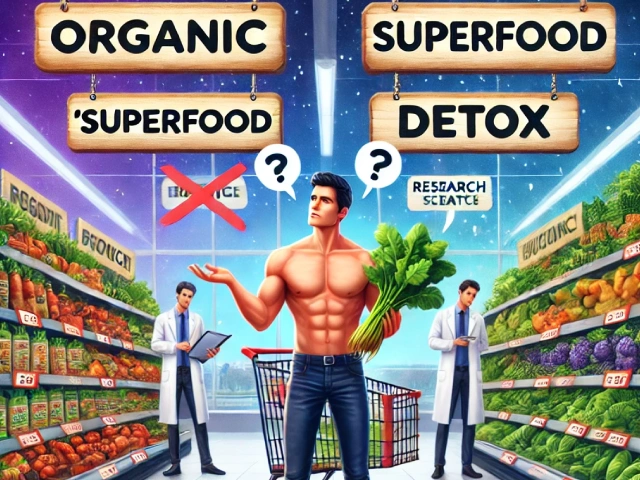
Rahim is an ordinary office worker. His worries about health are nothing new, but lately, the flood of various food-related information on social media has left him even more confused.
“Apparently, only organic food is good, you’ll harm your body if you don’t eat superfoods, and if you don’t regularly detox, toxins will pile up in your system!” – Hearing such claims, Rahim decided he would no longer eat common market food. He started searching for vegetables labeled ‘organic,’ foods marketed as ‘superfoods,’ and made plans to follow a ‘detox diet’ at least once a week.
But after a while, Rahim realized his expenses were multiplying just to buy these special foods. Still, he thought, “What’s the use of money if you don’t have good health?” Yet, even after several months, there was no noticeable change in his physical condition. In fact, he found himself cutting back on other important expenses due to these unnecessary costs. Ultimately, he decided—it was time to break free from the allure of advertisements and think based on real science and facts. Like Rahim, many others are now searching for these answers.
Organic Food: Truth or Misconception?
When we hear the word ‘organic,’ we think of something chemical-free, completely natural, and extremely healthy. But what does science say?
Nutritionist and researcher Dr. Abdul Kader says,
“Just because a food is organic doesn’t mean it’s more nutritious or healthier—there is no clear scientific evidence to prove this. Yes, it may have less chemicals in some cases, but its nutritional value is not significantly different from conventionally farmed food.”
Research shows the nutritional differences between organic and conventional farming are minimal. A Stanford University study in the United States found that the nutritional value of organic food was not significantly higher than regular food. Additionally, according to the Food and Agriculture Organization (FAO) of the United Nations, producing organic food uses more land and water than conventional farming, which poses a challenge for food security.
However, there may be legitimate reasons to choose organic in specific cases. For example, some foods can become contaminated by excessive pesticide use. But before paying double just for an ‘organic’ label, it’s important to know the scientific facts.
Superfoods: More Marketing Than Science?
For several years, the term ‘superfood’ has gained popularity. Blueberries, avocados, quinoa, chia seeds—these foods are branded as ‘superfoods.’ But what does science say?
UK food scientist Dr. Robert Lustig says,
“There is no such thing as a superfood. It’s a marketing term. Yes, some foods are higher in antioxidants, but that doesn’t mean they are extraordinary or absolutely essential compared to other foods.”
Experts say that while foods promoted as superfoods are nutritious, plenty of regular foods also provide ample nutrition. For instance, instead of blueberries, you could have jamun (Java plum) or guava, which are affordable sources of nutrients. A report from the Bangladesh Food Research Institute notes that local fruits such as mango, jackfruit, banana, and guava are also rich in antioxidants and vitamins, serving as potential alternatives to superfoods.
Detox Diets: Does the Body Really Need Detoxification?
When we hear “detox,” it feels like our bodies are filled with toxins that need urgent removal. But does our body really build up such toxins?
Dr. Michael Halpern of Harvard Medical School says,
“Our liver and kidneys naturally detoxify the body. There is no scientific necessity to follow special detox diets or juice diets.”
In other words, as long as we drink enough water and eat a healthy, balanced diet, our body is capable of flushing out harmful substances on its own. Bangladeshi nutritionist Dr. Farhana Rahman says,
“Sometimes these detox diets reduce water intake to such an extent that they can be harmful. So a balanced diet is the safest choice.”
The Real Truth of Food Science
It’s important to verify information about food found in advertisements and on social media. Many people spread misleading claims for commercial gain.
World-renowned nutritionist Dr. Marion Nestle says,
“A balanced diet is the most effective. Obsessing over just superfoods or detox diets may not actually benefit your health.”
Rahim now understands that he doesn’t need to be pressured by advertising into buying expensive ‘organic,’ ‘superfoods’ or following detox diets. Instead, knowing proper nutritional science, eating regular healthy foods, and following a healthy lifestyle are the most important.
Do you follow superfood or detox diets? Or do you find regular food to be more effective? Don’t forget to share your opinion!
References:
https://bangla.bdnews24.com/world/article440419.bdnews
https://bangla.bdnews24.com/world/article440419.bdnews