After the term break, I finally have a bit of free time.
Amidst the busyness, some thoughts have piled up—today, I’m setting one of those free.
The question is very simple:
“Is it really possible to have a balanced diet just by eating Bangladeshi food?”
Yet within this simple question lies our everyday plate, our habits, and, invisibly, our behaviors.
Imagine a typical midday scene.
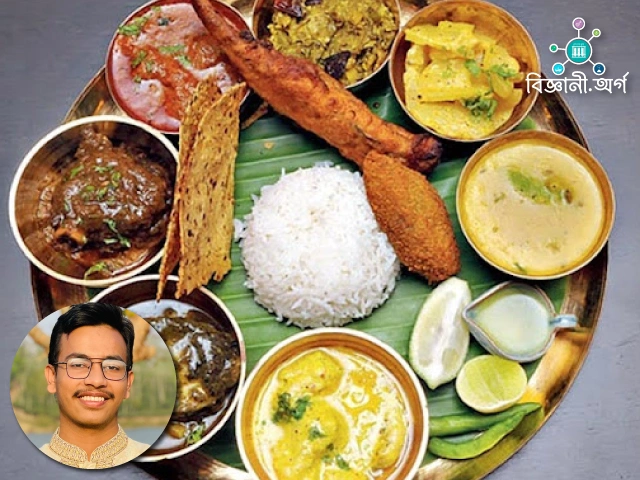
Steam rising from hot rice. Lentils on the side, a piece of fish, a little greens or mashed vegetable.
Everything feels so familiar, so normal.
A plate we eat every day, often without giving it much importance.
But have you ever wondered
if this “ordinary” plate might, in fact, be a quietly arranged scientific balance?
Let’s start with rice.
We often blame rice.
The idea that “eating rice makes you fat” is now so widespread, it feels like rice is the root of all problems.
In reality, rice is energy—direct, easily accessible energy.
Our brains constantly use glucose. Thinking, remembering, making decisions—all these processes are fueled by it.
The problem isn’t rice,
the problem is when there’s no balance among quantity, timing, and the body’s usage.
A sedentary lifestyle with excess rice—
this is what gradually brings trouble.
There’s an important issue here, especially for people with diabetes.
Should rice be avoided completely?
No. But the relationship with rice does need to change.
The main issue in diabetes is the ups and downs of blood glucose.
White rice digests quickly, rapidly raising blood glucose—a high glycemic response.
So what’s the solution?
Maybe not giving up rice entirely,
but slowing it down a bit.
For example,
instead of freshly cooked hot rice, try having rice that’s a bit cooler or from the previous day; this increases resistant starch.
Or choose red or brown rice.
Or reduce the rice portion and add more vegetables and protein to the plate.
Because when rice stands alone, it acts quickly.
But when paired with fiber and protein, its impact slows down.
You can even substitute some of the rice
with oats, whole wheat bread, or mixed grains.
But the main point is just this:
Your meal should not send a sudden shock through your body, but rather, work gradually.
Next comes lentils.
Lentils are a quiet ingredient.
You might not notice them, but inside your body, they do a lot of work.
Together, rice and lentils create a synergy that isn’t possible separately.
They fill protein gaps, slow down digestion, and provide a sense of satiety.
Fish—
a treasure born from the waters of this country.
Besides protein, the fatty acids in fish not only benefit your body,
but also connect to your brain.
Your mood, your attention—
sometimes, even those depend on what’s on your plate.
Greens, vegetables, mashed items—
the things we often consider side dishes.
In truth, these are often the most important part of the plate.
They don’t just provide vitamins;
they alter the environment inside your body.
Fiber works slowly,
influences your gut bacteria,
and in turn, your gut quietly communicates with your brain.
An amazing connection—
What you eat → How your gut functions → How you feel.
So even if everything else is right, where does the problem start?
Not in the food.
The problem forms, often without our knowledge, in our habits.
A familiar scene.
You sit down to eat.
The plate is in front of you.
But your eyes are on your phone.
Videos play, you keep scrolling—
the eating continues, but you’re no longer experiencing your meal.
And when the plate is empty,
you wonder, how did I finish so quickly?
Because, at that moment, you weren’t truly eating.
You were just bringing food to your mouth mechanically.
Your mind was occupied elsewhere.
This is how balance slowly erodes.
The food remains fine—
but the way you eat goes wrong.
Rice portions grow,
vegetables decrease,
protein gets neglected,
meal times become irregular.
Yet, one point remains.
Our simple plate—
rice, lentils, fish, greens—
it isn’t wrong.
In fact, in many ways, this plate is the most realistic, sustainable, and accessible version of a balanced diet.
We just need to understand it,
and rearrange it with a little more care.
Let me leave you with one final scene.
Next time you sit down to eat,
pause for a moment.
Look at your plate.
You might see—
it’s not just food,
but a silent harmony arranged for your body and mind.
And then the question will change—
What am I eating?
will become—
How am I eating?
Md. Iftekhar Hossain
MBBS 2nd Year, Cox’s Bazar Medical College, Bangladesh.
Major interests: Behavioral Science, Neuroscience, and Habit Formation.