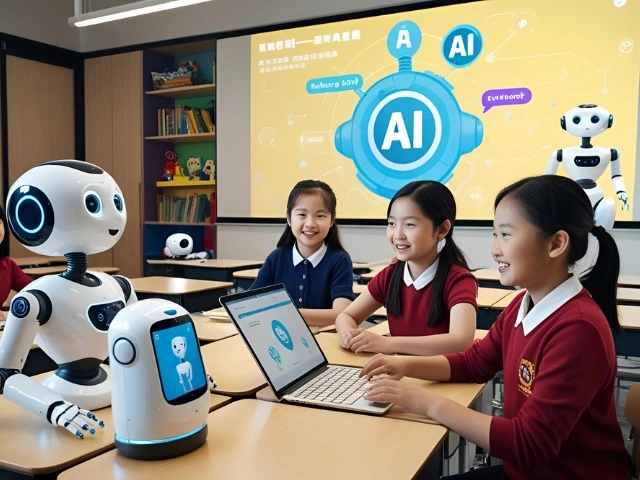
Six-year-old Li Wei stood in front of the classroom, a mix of curiosity and nervousness on his face, and asked, “Sir, can a chatbot laugh like us or feel sad?” The class teacher, Chen Ming, replied with a smile, “That’s exactly what we’re going to learn today, Li. We’ll discover how artificial intelligence can make our lives easier.”
This scene is no longer just imaginary—it’s a real experience in Beijing’s primary schools. Starting this autumn, formal AI education has begun in primary and secondary schools throughout Beijing. The government aims to build a tech-savvy new generation that will help keep the country ahead in future global competition.
Students are not only learning the basic concepts of artificial intelligence (AI) but also exploring the use of chatbots, their technological applications, and ethical considerations in depth. Even outside the classroom, students are participating in various projects that nurture their creativity and problem-solving skills. These classes can be included within science and information technology curricula, or offered as standalone courses in schools.
This initiative by the Chinese government is not just an isolated step—it is part of their long-term strategy. Last December, the Ministry of Education selected 184 schools across the country for pilot projects in AI education. China’s Education Minister, Huai Jinpeng, stated, “Artificial intelligence is the golden key to the future of our education system. To lead the world in the days ahead, we must cultivate a generation highly skilled in this technology.”
What are other countries doing? China’s move has sparked significant discussion on the international stage. Many experts believe that other nations need to act quickly. Some countries—like California in the United States, Italy, and Canada—have already begun integrating AI into their education systems. However, no other country has yet implemented such a broad, coordinated, and well-planned approach as China.
Professor Dr. Mohammad Zafar Iqbal from the Department of Computer Science at the University of Dhaka commented, “Education on artificial intelligence is no longer a luxury—it is a basic necessity. Developing countries like Bangladesh must also realize this reality soon and increase investment in AI education.”
What do the students think? Ten-year-old Zhang Ling from Beijing exclaimed, “I love seeing how chatbots make different school tasks easier for us. I want to become a scientist when I grow up and invent even more advanced AI technology.”
On the other hand, nine-year-old Liu Yao said, “I want to create toys with AI that will help children like me in their studies.”
Seeing the skills and enthusiasm of this new generation in China for using artificial intelligence, experts believe these children will be at the forefront of the coming technological revolution. But a question remains: can the rest of the world keep up?