


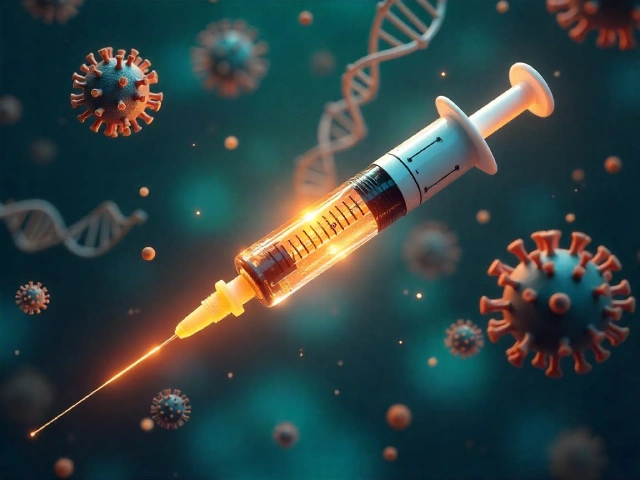
Scientists have been working for a long time to develop a vaccine that could protect against various strains of viruses like flu and COVID—with just a single injection offering years of protection. However, this effort has not yet been successful.
Recently, the United States Department of Health and Human Services (HHS) and the National Institutes of Health (NIH) have launched a new initiative called “Generation Gold Standard,” which takes a different approach compared to the previous ‘Project NextGen’. While Project NextGen focused on developing innovative, technology-based COVID vaccines, Generation Gold Standard is using a classic and proven method—the BPL-inactivated killed whole-virus approach. This aims to develop a universal, durable, and effective protective measure against both flu and coronavirus. The goal is to create a universal vaccine for both flu and coronavirus at once. The proposed budget is $500 million. This project will use the “BPL-inactivated whole-virus” technique—an old but promising technology where the entire virus is inactivated and then used as a vaccine.
Why Do We Need a Universal Vaccine?
Flu and COVID viruses constantly change their form. That is why a new vaccine needs to be developed every year. But if a vaccine can be created that stimulates an immune response against the virus’s stable (conserved) internal components—rather than the ever-changing outer parts—then it could be effective against future strains as well.
Dr. William Schaffner, an infectious disease expert at Vanderbilt University in the United States, said, “This research initiative is encouraging because it will help us further improve our future flu and COVID vaccines.”
The Scientific Perspective Behind This Technology
This approach involves collecting the entire virus and inactivating it—a long-standing and widely used technique in vaccine science. For example, inactivated whole-virus methods have been successfully used in polio and influenza vaccines. Through this process, the virus is no longer infectious, but its stable structure is still able to train the immune system. The inactive virus is then broken down and used to make the vaccine, enabling the immune system to target not only the external parts but also the internal, stable proteins. This method helps build defenses not only against the parts that change but also the universal components.
Research Challenges and Ethical Questions
Creating a vaccine alone is not enough—testing its safety and effectiveness is also crucial. In clinical trials, the most reliable method is to compare results with a placebo or sham vaccine. However, if there are already effective vaccines available on the market, it may be unethical to use a placebo. As a result, researchers are considering alternatives, such as measuring the effectiveness of a new vaccine against existing ones.
Protection Against All Coronaviruses, Not Just COVID
This initiative aims not only to protect against COVID-19 but also to build defenses against MERS, SARS, and other common human coronaviruses. It may also help prevent potential future pandemics.
According to experts, research should move forward on multiple fronts. For example, studies are currently underway on mRNA-based technologies, viral vector-based vaccines, protein subunit vaccines, and T-cell-based vaccines. Each method has its own advantages and limitations. By pursuing multiple approaches simultaneously, it is possible to find the most effective and safest solution for the future. Not all attempts may succeed, and it is impossible to know in advance which will work best. Therefore, creating an open research environment, proper funding, and ethical research conditions will be the key to major breakthroughs in the future.