Guest Author: Rauful Alam
Writer and Researcher
Email: [email protected]
Only four decades ago, China’s culture of research and innovation was not so advanced. Countless Chinese students went to Europe and America for higher education. Most of them did not wish to return to their home country. The Chinese government sought to change this situation. As a result, each province established science research centers (State Key Laboratories—SKL), and universities started to emphasize modern research.
There are now over five hundred state laboratories in China. Many of my Chinese colleagues credit this transformation to Deng Xiaoping. Deng Xiaoping is considered by many to be the architect of modern China.
In 2018, I visited Xi’an Jiaotong University in China to attend a science conference. At that time, I was conducting postdoctoral research at the Ivy League university, University of Pennsylvania in America. I was truly astonished by the research facilities at Xi’an Jiaotong University.
The research opportunities there surpassed many American institutions. They have built highly expensive infrastructure. They are also recruiting the best young researchers from around the world to work there.
Since 2008, the Chinese government launched a state-sponsored “talent hunt” program, known as the Thousand Talents Plan. Under this program, through intense competition, young researchers are brought back to China. They are offered high salaries, benefits, and research funding.
Based on the quality of their PhD and postdoctoral research, and publications, young researchers aged 30–35 would even be offered direct professorships. In just the last 10 years, China’s culture of research and innovation has increased and enriched manifold. The Thousand Talents Program is a major reason for this remarkable progress.
I have noticed a similar effect in India as well. Especially, the Indian IITs conduct world-class research. These institutions are locally producing highly skilled young talent. This is making their investment infrastructure sustainable and nurturing local entrepreneurs. It is considerably strengthening India’s culture of academic and industrial research.
One professor at IIT Mumbai is Debabrata Maiti, a Bengali and young in age. Debabrata Maiti is not only India’s, but all of South Asia’s most renowned organic chemist. Professor Maiti earned his PhD at Johns Hopkins and completed his postdoc under the famous researcher Professor Buchwald. I first met Debabrata Maiti 11–12 years ago at Stockholm University.
After his postdoc, Professor Maiti returned to India to begin his work. The standard and pace of his work is extraordinary. Some of the best organic chemists are being developed in his lab. Now, India is moving ahead globally in many industries, including pharmaceuticals and chemicals. Professors like Maiti play a significant role in this progress.
Many young Bangladeshis publish research of the same quality as Professor Maiti did during his PhD and postdoc. They work with professors abroad at the same caliber as his. If one of Bangladesh’s talented young people returned, they could achieve at least a fifth of what Maiti accomplished after going back to India; but for a Bangladeshi youth, the path is not nearly as easy as it was for Professor Maiti!
For a young Bangladeshi, returning to a public university at home is still not a straightforward path. Has any Vice Chancellor in the country ever taken a talent hunt initiative? Universities still send lecturers or assistant professors abroad for PhDs, but do not openly invite applications from those who already have PhDs and postdocs for faculty positions. The same routine exists in research institutions as well. This practice, ongoing for 54 years, must be changed at some point.
The reason is, Professor Maiti found a welcoming environment when he returned. He found a proper setup to work in. The IITs conduct talent hunts to recruit people like him. Young returnees apply for funding, and the government provides support within its capacity. An ecosystem has developed. Debabrata Maiti knew that if he returned to India instead of staying in the US, he could contribute a lot to his own country. After all, even if 10 Nobel Prize-winning scientists leave America, it won’t make much difference—their research and innovation environment is that robust.
For a young Bangladeshi, returning to a public university at home is still not a straightforward path. Has any Vice Chancellor in the country ever taken a talent hunt initiative? Universities still send lecturers or assistant professors abroad for PhDs, but do not openly invite applications from those who already have PhDs and postdocs for faculty positions. The same routine exists in research institutions as well. This practice, ongoing for 54 years, must be changed at some point.
Today, India, China, and South Korea are selecting the best of their trained and skilled young expatriates and bringing them back, and they are reaping the benefits. To increase foreign investment, building a skilled local workforce is essential. No country in the world has been able to create a sufficient, world-class skilled workforce or boost foreign investment while keeping higher education and research weak. Nor have they been able to establish a sustainable investment set-up.
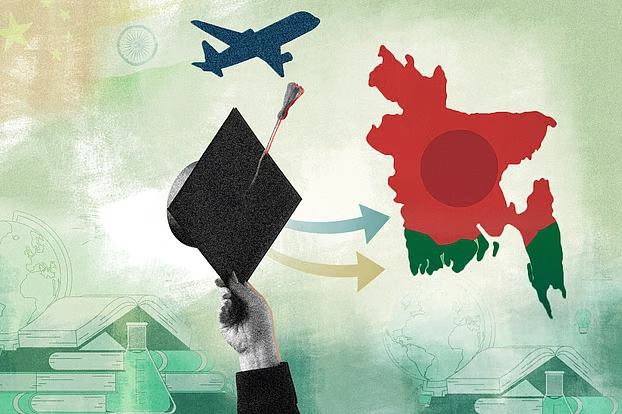
Many Bangladeshi researchers, innovators, teachers, and entrepreneurs are working successfully around the globe. Many of them want to return and contribute at home. There must be initiatives to select and bring back the best among them. They need to be recruited in universities and scientific research labs in the country. Only then will the culture of higher education and research prosper. In the future, more talented young people will be interested in coming home. At the very least, we must begin talent hunts at universities and research institutions—now! Will the current government launch such a national program soon?
Source:
This article was collected from a published essay in the BigganChinta magazine.
Author: Dr. Rauful Alam, Researcher, University of Pennsylvania, USA.