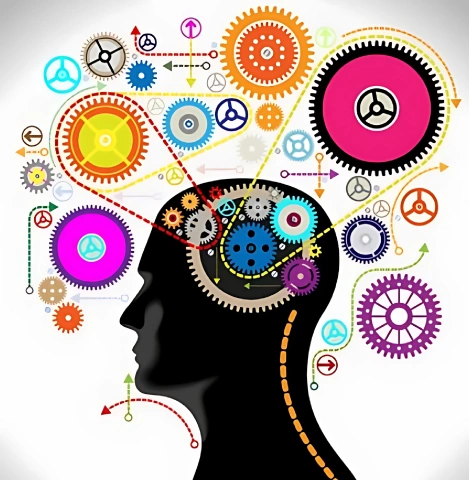
A Heap of Tasks, A Scattered Mind, and the Tale of Lost Focus
Imagine it’s 10 PM. You’re lounging in bed with your phone in hand.
You’re doing a bunch of things at once—
chatting with friends on WhatsApp, scrolling through Facebook with one eye, watching a funny video on YouTube, maybe even listening to the news on TV in the background. In between, you open your emails to check a draft of an office report—and then back to scrolling!
Wow! You feel almost like a techno-human with ten hands doing everything simultaneously.
But the real question is—what are you actually losing when you try to do so many things at once?
📌 Multitasking: Myth vs Reality
Many people claim—“I can multitask!”
But neuroscience tells us—the human brain actually cannot perform multiple cognitive tasks simultaneously in the true sense.
What we do is actually switching rapidly between tasks. This is called Attention Switching.
Whenever you switch from one task to another, your brain has to change its processing settings—and this switching is very costly.
🔬 How Does the Brain’s “Task Switching” Work?
Let’s say you’re writing a report and chatting on Messenger at the same time.
• Writing a report requires your Prefrontal Cortex to focus on complex thought processes.
• To chat, your Social Brain network and Language network are activated.
• Your Attention network uses up energy every time it has to shift to a new task.
This constant switching consumes your brain’s attentional fuel—this is known as Switching Cost.
💡 Multitasking Means Cognitive Overload
One Stanford study found that heavy multitaskers are actually less productive, get distracted easily, and can’t filter out irrelevant information.
Similarly, London’s Institute of Psychiatry reports that multitasking can drop your IQ by up to 10 points!
This is equivalent to the cognitive decline of being sleep deprived.
📚 Real-life Examples:
1️⃣ Exam Time Multitasking:
Many students listen to lectures, group chat on Facebook, and write notes all at once—in the end, they remember almost nothing properly. Their reading focus keeps breaking.
When revising the next day, they’re left speechless—I didn’t understand anything!
2️⃣ Office Call & Social Media:
Many people open their inbox or Messenger during Zoom meetings. They hear only half of what the boss says—leading to wrong decisions later.
At the end of the meeting they say, All good, but then there are mix-ups at work later.
3️⃣ Parenting & Phone:
A parent might be playing with their child, but their mind is on the phone—checking notifications, scrolling feeds.
The child keeps calling—attention is scattered. There’s no real connection with the child.
⚡ How Does Multitasking Damage the Brain?
✔️ Decision-making capacity decreases.
✔️ Working memory gets exhausted.
✔️ Stress hormone (Cortisol) increases.
✔️ Attention span is reduced.
✔️ Ability to do deep work declines.
🔑 So, What Should You Do?
👉 Learn monotasking.
Do just one thing at a time—give it your full attention.
👉 Pomodoro Technique—25 minutes of work, 5 minutes of break.
👉 Distraction-free zone—silence your phone, turn off notifications.
👉 To-do list—work according to priorities.
👉 Mindfulness practice—train your brain to get used to single-tasking.
🎯 Food for Thought
Are you truly a multitasker, or an attention jumper?
Whenever you’re about to juggle many things at once—ask yourself:
– By doing all these tasks at once, are any of them actually getting done well?
– Wouldn’t the outcome be better if I finished one task before moving to the next?
✅ My Thoughts
The human brain is an incredible instrument—but if you force it into ten fronts at once, its energy gets scattered.
Focus sunlight on one spot and it creates fire—but spread it out, and it’s just light.
So in life, not a thousand notifications at once, but one meaningful focus at a time—that is your power, your potential.
Md. Iftekhar Hossain
Medical Student, Cox’s Bazar Medical College |
Interested in neuroscience, habit formation, and behavioral changes in the human brain.