Dr. Moshiur Rahman
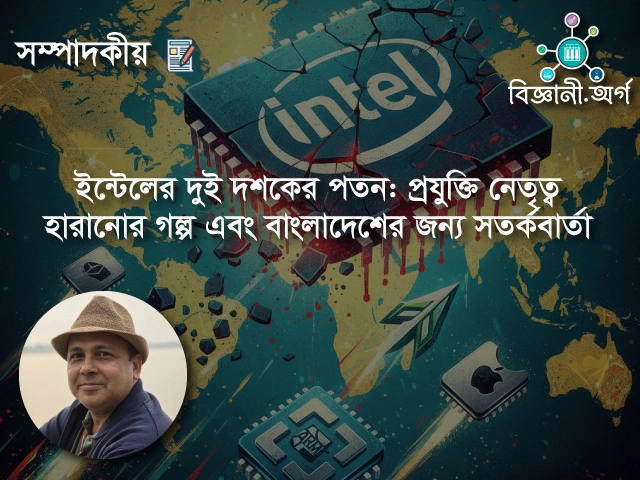
In the history of human civilization, some institutions have stood not only as symbols of economic power but also as benchmarks of technological capability. In the 1980s and 90s, ‘Intel’ was just such a name. It was almost impossible to imagine a personal computer without their processor, and some of the tech world’s biggest innovations silently but tirelessly came from this company. Yet today, in just two decades, this once-leading chip maker has fallen behind in the global contest and even become a center of political controversy.
This story of decline begins in the early 2000s. At that time, Intel was considering breaking into new fields beyond the PC market. So, they started acquiring companies in the telecom and wireless technology sectors one after another. The idea was that, with the spread of the internet and the era of the mobile revolution, these sectors would become the goldmines of the future. But acquisition is itself an art—where choosing the right target, ensuring integration, and leveraging new technologies are all crucial. Intel lacked experience in these areas. The result—$12 billion in investments ended up yielding zero or negative returns. Harvard Business School Professor David Yoffie later said, “100% of those acquisitions failed.”
Then came a historic mistake—a failure to adopt the right approach at the right time to the mobile processor market. Intel used to supply chips designed by the British company Arm for the popular Blackberry phones. But they decided to make chips using their own x86 architecture to keep production under their own control. The plan was to bring a competitive product to market within a year, but in reality, it didn’t happen even after ten years. In the meantime, Apple, Qualcomm, and Samsung took over the market, and Intel was forced to withdraw from the smartphone processor industry.
Over the years, management problems continued to grow. Delays in launching new chips, failures in production technology, and the inability to bring competitive products to market—all combined to weaken Intel’s position. By 2021, they were two generations behind their competitors. At that point, their rivals were Taiwan’s TSMC and South Korea’s Samsung, who were not only technologically advanced but also able to meet global demand through the ‘foundry model.’
During such a time, Intel brought back their former engineer Pat Gelsinger as CEO. Gelsinger took on the ambitious goal of reviving advanced chip production in the United States. But persistent manufacturing issues, a failure to restore market confidence, and falling share prices led the board to replace him at the beginning of 2025 with Lip-Bu Tan.
Within just a few months of Tan’s appointment, fresh controversy erupted. On August 7, 2025, former President Donald Trump claimed on Truth Social that Tan was “deeply embroiled in conflicts of interest” and must resign immediately. Behind this were allegations from Senator Tom Cotton that Tan had multiple ties to Chinese companies and that, under his leadership, a multinational had violated US export laws. Although Tan denied the charges, the market reacted negatively—a 5% drop in stock value followed.
Intel’s Rise and the Global Semiconductor Landscape
In 1968, Robert Noyce and Gordon Moore founded Intel in Silicon Valley. Moore’s “Moore’s Law”—which stated that chip capacity would double every two years—shaped the trajectory of the technology industry for decades. In 1971, Intel launched the world’s first commercial microprocessor, the Intel 4004.
In the 1980s and 90s, the Intel and Microsoft partnership—“Wintel”—dominated the market. Dell, HP, Compaq—all the major PC makers used Intel chips. Japan was a big competitor in the global semiconductor industry then, but Intel’s technology and strategy kept them at the top.
But in the 2000s, the market landscape shifted. The rise of the internet, mobile phones, and smartphones transformed the nature of demand for chips. TSMC and Samsung leapt ahead with the ‘foundry model’—manufacturing advanced chips for others in their state-of-the-art factories rather than designing their own. Apple, Nvidia, Qualcomm—all rapidly adopted this model. Intel ignored this transformation, which led to long-term disaster for them.
National Security and the Chip Industry
Today, advanced chips are not just a commercial commodity but also a matter of national security. Modern military technology, cybersecurity, and artificial intelligence—all depend on semiconductors. At present, however, the world’s most advanced chips are produced only in Taiwan and South Korea. This poses a risk for the United States since, amid rising geopolitical tensions, this supply chain could collapse.
In this context, the US Congress passed the CHIPS and Science Act in 2022, offering billions of dollars in subsidies to boost domestic chip production. Intel received the largest promise—$8 billion in grants and loans. Still, without resolving production issues, they have failed to take proper advantage of this opportunity.
Lessons for Bangladesh
There are several important lessons for Bangladesh in the story of Intel’s decline.
First, maintaining technological leadership depends on continuous innovation and swift decision-making. Today’s leaders can fall behind tomorrow if they fail to adapt to technological changes.
Second, government subsidies are no guarantee of success. More than just money, effective management, skilled workforce, and timely delivery are equally important.
Third, the tech industry is now a part of national security. Satellite technology, cyber defense, advanced chips—all these are strategic assets. Bangladesh needs a long-term technology policy.
Fourth, human resource development is the biggest investment. Without a sufficient pool of skilled engineers, researchers, and managers in advanced technology industries, it’s impossible to stay competitive.
Fifth, we must take up strategic positioning in the global supply chain. Even if we can’t produce semiconductors, we can play a significant role in software, design support, IT services, and hardware assembly.
Intel’s story is, in fact, a cautionary tale—it’s hard to reach the pinnacle of the tech industry, but staying there is even harder. For Bangladesh, now is the time to unite policy, investment, education, and innovation, so that we can not only be participants in the market but also become guides for technological direction.