News Desk, Biggani.org
In 2008, Ecuador set an unprecedented example. For the first time, the country’s new constitution, in Articles 71 to 74, declared that nature itself has its own rights. These rights recognize the importance of the existence of nature, its essential services to human life, and its crucial role in maintaining environmental balance. When nature’s rights are violated, the state is obligated to take action to protect and restore them. Through this groundbreaking declaration, Ecuador has prompted the world to reconsider a new idea: can a river have its own vitality?
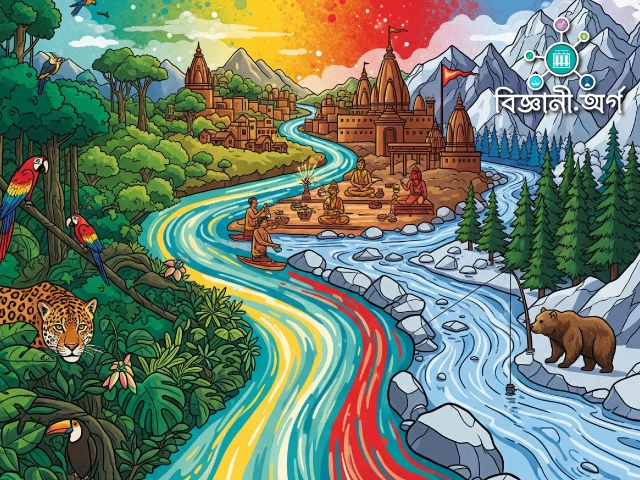
Renowned nature writer Robert Macfarlane explores this question in his recent book, “Is a River Alive?” Macfarlane’s journey focuses on rivers in three vastly different environments: rivers deep within the forests of Ecuador, India’s historic Ganges, and the remote rivers of eastern Canada. In the book, he offers deep insights and discussions into the sovereignty and vibrant presence of rivers themselves.
A river is not just a flow of water—it is a living system. Connected to a river is a delicate, interconnected world of countless plants, animals, and microorganisms. This biodiversity supports human life, sustains livelihoods, and keeps the environment healthy. For thousands of years, various indigenous communities have revered and worshipped rivers as living entities. Based on their beliefs and traditions, a river is not just a geographical boundary, but a representative of nature’s soul and spiritual essence.
However, in the modern era, rivers are facing extreme crises. Climate change, industrial and corporate pollution, and government neglect have endangered both the existence and functioning of rivers. In his book, Macfarlane delves deep into these problems, showing how rivers are losing their vitality and the frightening consequences that may result. He writes, “A river is at once powerful, determined, sacred, and neglected. For ages, rivers have existed between the realms of geology and spiritual belief.”
He especially highlights the example of India’s Ganges. For thousands of years, the Ganges has not only been at the heart of India’s religious life, but also at the core of its economic, social, and cultural activities. Although the waters of the Ganges are deemed sacred, today they have become polluted due to industry and waste. This pollution has become so severe that, according to the World Health Organization, the Ganges is now one of the most polluted rivers in the world. This situation underscores the crucial need for international attention and government action to revive the Ganges.
On the other hand, the rivers of eastern Canada, such as the Saint Lawrence, are in relatively better condition due to integrated management by both people and nature. But even here, the rivers have not escaped the effects of climate change. Especially due to warming and melting ice, river ecosystems have been directly impacted. Therefore, the importance of scientific and cross-border cooperation in water management and conservation continues to grow.
The rivers deep in the forests of Ecuador’s Amazon are facing even more severe crises. Mining, illegal logging, and oil exploration activities are causing devastating harm to the rivers’ natural protection and biodiversity. In the face of such environmental damage, the Ecuadorian government has sparked a revolution by granting legal recognition to the rights of nature.
Robert Macfarlane’s book inspires us to realize that rivers are our companions, our fellow travellers. He believes, “We may never be able to think like a river, but we can learn to think with a river.” This perspective can help us form a new outlook toward rivers. We must not see rivers as inanimate objects, but as integral parts of life and the environment.
In the context of Bangladesh, this message is highly relevant. Our country is riverine, where hundreds of rivers are deeply intertwined with the environment, economy, and culture. However, these rivers today are victims of encroachment, pollution, and neglect. For Bangladesh, respecting the life of its rivers and actively working to protect their ecosystems must begin now.
In conclusion, questions about the life of rivers touch all of us. If a river truly is alive, then it is our moral duty to honor its rights and to protect it. Macfarlane’s perspective serves as an urgent call—not just for rivers, but for the generations to come.