With the launch of OpenAI’s GPT-5, it feels as though human civilization has moved one step closer to that day—when we will stand before an artificial intelligence that leaves each of us far behind in thought, planning, analysis, and creativity. The closer that day comes, the more my anxiety grows. Yet, the cause of this anxiety might not be the one you expect.
If you ask someone what their fear about AI is, most people will mention its massive impact on the job market, the illusions created by deepfake technology, or the concentration of immense power in the hands of a few large corporations. But surprisingly, very few people have considered—on the day artificial superintelligence becomes accessible to everyone, what will life be like the day after?
By artificial superintelligence—or ASI—we mean a system that will surpass humans in nearly every aspect of cognition: making complex plans, logical analysis, solving problems, strategizing, or creative innovation. Such a system will solve problems in fractions of a second that even a brilliant specialist might take months or years to tackle. The fear is not about some ‘doomsday’ scenario; rather, the concern is—if this intelligence is helpful and benevolent, it could still shake the very foundations of our human identity. Because then we will all know that the AI assistant on our mobile device is faster, smarter, and more creative than our own brains.
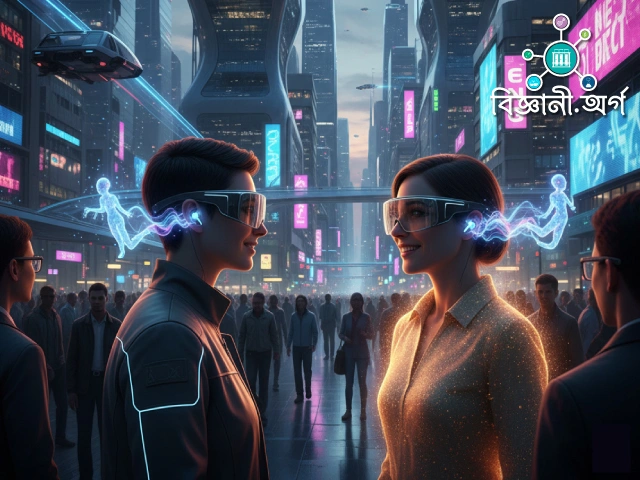
Then the question arises—will we begin to seek advice from AI before making every big or small decision? Or, even more worryingly, will we rely more on AI than we trust our own judgment? In reality, our interactions with AI are still mostly confined to a question–answer framework, much like Captain Kirk did on ‘Star Trek’ back in 1966. But that era is about to end. Very soon, AI will be seamlessly integrated into wearable devices—equipped with cameras and microphones—so that the AI can understand everything we see and hear, and whisper instructions into our ears without us even asking.
This is the age of ‘augmented mentality’—where AI-enabled glasses, earbuds, or small pendants will be linked to every moment of our experience. Meta, Google, Samsung, Apple—everyone is now racing to capture the market for these ‘context-aware’ AI devices, which will soon replace handheld phones.
Imagine, you’re walking down the street. A colleague is approaching, but you can’t remember their name. Your AI assistant instantly tells you the name and reminds you not to forget to ask about their wife’s surgery. Your colleague is pleased, and moments later brings up your recent promotion—perhaps on the advice of their own AI. So, are you really speaking to the person, or to the AI agent whispering in their ear?
On one hand, it will feel as if we carry an invisible superpower in our pockets—keeping our memories intact, making conversations more engaging, detecting lies. On the other hand, we may soon realize—the naturalness of human interaction is disappearing somewhere. An invisible, intelligent mediator starts intervening in human relationships, shaping our decisions, reactions, even our emotions.
Many experts believe that wearable AI assistants will make us more powerful. But just as likely, they could rob us of our confidence. The core pride of human identity lies in our minds—upon which we have built civilization for thousands of years. And yet, very soon, we may bow down to an AI instead of relying on our own minds, one that surpasses us in every respect. Then the question becomes—is this truly empowerment, or a ‘bot-authored’ reality where we are mere spectators?
I raise these concerns as a technology innovator—someone who has spent a lifetime building technology to empower people. From augmented reality to conversational agents, I have always believed that technology can make people more capable. But in the case of superintelligence, there is a fine line between enhancing and completely replacing human capability. Whether we cross that line will depend on how cautiously we bring this technology into society. Otherwise, there will always be the risk—that one day we may no longer think for ourselves; instead, someone or rather ‘something’ will think on our behalf.