Dr. Moshiur Rahman
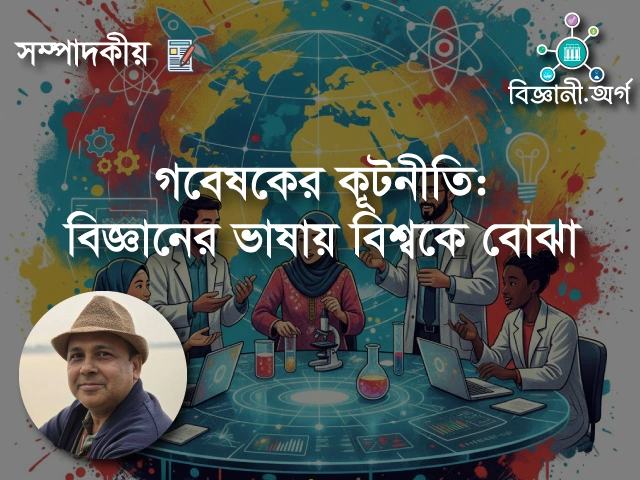
Research is not just about test tubes in a laboratory or lines of code on a computer screen; research is about seeing society, the country, and the world in a new light. Recently, Professor Michinori Kanno of the University of Tokyo, and former Science and Technology Advisor at Japan’s Ministry of Foreign Affairs, remarked in a discussion that we should see the researcher not only as a scientist, but also as a diplomat. This is because the language of science can be the bridge between nations and cultures.
What do we understand by diplomacy in the world of research? Traditionally, diplomacy means a balance of power, security, or trade agreements between two states. But scientific diplomacy is different. Here, the aim is to share knowledge through research, create new opportunities, and build mutual understanding. When researchers participate in international conferences, seek new collaborations, or join joint research projects, they are not just pursuing knowledge; at the same time, they are also playing a diplomatic role.
According to Dr. Kanno, diplomatic skills in research begin with listening. We often think communication only means speaking, but the core of scientific diplomacy is attentive listening. Just as a clinical doctor who prescribes medicine without listening to the patient’s complaints breeds distrust, so it is in the field of research. Listening to international partners, understanding their needs, and generating new ideas from that—this is the right starting point.
But it’s not just about listening; the ability to persuade with logic is also essential. In Western scientific culture, the discussion style is such that debate or expressing differing opinions is seen as natural. On the other hand, in our Eastern culture, “peace” or “consensus” is often prioritized. This difference between the two worlds can create hesitation in joint research projects. Therefore, researchers need to learn—when to prove something with logic, and when to exercise diplomatic patience to maintain relationships.
This brings up the question of self-identity. In the West, a researcher is often asked—“Where is your originality?” Though this question can seem exhausting, it distinguishes the researcher. Conversely, in many Asian societies, research often flows under the shadow of the mainstream or authority, where dissent or new perspectives are given less space. Yet true science is born from questioning. So, practicing self-identity and originality is extremely important for researchers in the international arena.
Diplomacy in research means not just collaboration, but also the birth of new innovations. A notable study found that the most cited scientific papers largely come from interdisciplinary collaboration. Research confined to a single field rarely has a major impact. Therefore, researchers should learn to take risks, seek new partnerships, and not fear failure. Scientific diplomacy gives researchers the courage to sit with researchers from other cultures and ask new questions together.
This lesson is especially important for young researchers from developing countries like Bangladesh. If you go abroad for study or research, not only language skills, but also the ability to clearly present your ideas is essential. Being fluent in English is not enough; if you cannot effectively express your stance, the significance of your research, or your responsibility to society—even in your own mother tongue—then it becomes difficult to represent yourself on a global stage.
Here lies the connection between diplomacy and personal growth. Referring to Maslow’s hierarchy of needs, Dr. Kanno explained that only when a person is secure in basic safety and resources do they move toward creativity and self-actualization. Research is also part of that stage—not just working for survival, but for the joy of discovering something new. Scientific diplomacy helps spread this joy of researchers to a global scale.
Finally, one question remains—are our researchers ready to take on this diplomatic responsibility? When young Bangladeshis participate in foreign conferences, work in international labs, or join joint research projects, their duties will not stop at data analysis; forming relationships will also be essential. Like diplomats, researchers must learn when to ask questions, when to answer, and when to remain silent and give space to others’ ideas.
Today, science is not just a search for knowledge; it is a language that unites the world. If a researcher can play the role of a diplomat, he or she will not only contribute to their own research, but also become an inseparable part of humanity’s advancement. The diplomacy of science teaches us—know others, understand yourself, and together build a new future.
Source: This article is based on remarks delivered at a program by the Japan Science and Technology Agency