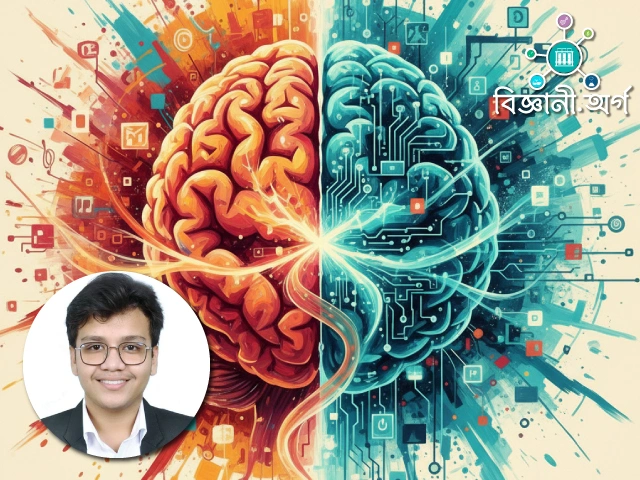
The history of technology began when humans first learned to control fire. Since then—the wheel, iron, electricity, computers—have all taken human civilization beyond its own boundaries. But today, humanity stands at a crossroads, having created a rival for itself: Artificial Intelligence (AI). The question arises, have we truly managed to create an intelligence akin to our own? Will machines ever be able to think, dream, or love like a human? Or will the human brain remain forever unique? These questions are no longer science fiction; they are now affecting every level of scientific labs, technology centers, and human life itself.
The Wonder of the Human Brain
The human brain is the most complex and delicate biological system in the history of the Earth. An average human brain weighs only about one and a half kilograms, but within it lie approximately 86 billion neurons and countless synaptic connections—with a total number exceeding 10¹⁵. Each neuron sends and receives electrical impulses, forming an intricate network with others. It is within this network that our thoughts, feelings, decisions, and imagination arise.
Neuroscientists say the brain is a “biological computer”—but its computational method is far from simple like a machine. While each part of the brain has a specific function, they constantly communicate with one another. For example, the prefrontal cortex is the center for our decision-making and planning, the amygdala regulates emotion, while the hippocampus is responsible for memory. As a result of this complex coordination, humans are capable of creating language, developing morality, and questioning their own existence.
The source of the brain’s power is its plasticity—the ability to adapt to change. When we learn something new, the brain’s connections are reorganized; some become weaker, others stronger. This adaptive mechanism is what keeps us on the path toward learning, creative thinking, and self-improvement.
The Birth and Development of Artificial Intelligence
The concept of Artificial Intelligence began in the mid-20th century. In 1956, John McCarthy at Dartmouth College first used the term “AI.” Back then, computers were nothing more than calculating machines, but scientists began to wonder—if taught, could a computer make decisions like a human?
Early AI was rule-based systems—in other words, machines were taught through specific rules and conditions. But this method could not implement human-like reasoning. Later, with the advent of machine learning (ML), things changed. Here, the machine itself can learn patterns from data and make decisions based on them. For example, neural networks and deep learning have laid the foundation for today’s modern AI.
Today, AI is everywhere, not just in theory, but in reality as well. Voice assistants on smartphones (Siri, Alexa), ChatGPT, self-driving cars, medical analytics, financial forecasting—all make use of AI. Since 2020, the pace at which AI is evolving is unprecedented in human history.
Human Learning versus Machine Learning
The human brain learns from experience and context. We can understand the meaning behind events because our internal morality, emotions, and contextual experiences all work together. But AI learns from data—it is statistical learning. The more data a machine has, the better it recognizes patterns, but it cannot think creatively outside of the data.
For example, if an AI learns from thousands of pictures to distinguish between cats and dogs, it can recognize the difference in new images. But if it encounters a strange creature, it will be confused. A human, on the other hand, uses logic and imagination to deduce—“This is like a cat, but a little different.”
This is where the human brain excels—in its abilities for abstraction and generalization. On the other hand, AI is powerful in terms of precision and speed.
Real Applications and Impacts of AI
AI has become so ingrained in today’s society that we feel its impact every day, whether we want to or not. In healthcare, AI can diagnose diseases with high accuracy. In radiology and genomic medicine, AI models like DeepMind Health are achieving remarkable results in cancer detection. In education, AI-based tutoring systems such as Khanmigo or ChatGPT Edu offer personalized learning for students. In agriculture, AI systems based on drones and sensors can detect crop diseases and ensure timely treatment. In transportation, self-driving cars like Tesla Autopilot or Waymo are minimizing human errors and helping to reduce road accidents. In the entertainment industry, AI-generated music, film scripting, and even digital actors are taking human creativity to a new level.
However, these effects are not one-sided. The more benefits AI brings, the more concerns it raises—particularly regarding employment, privacy, and ethics.
Similarities and Differences Between the Human Brain and AI
Both the human brain and artificial intelligence process information, but their structures and processes are completely different.
Structural Differences: The brain is biological and cell-based; AI is synthetic and based on circuits.
Learning Method: The brain learns through feelings and experience, AI learns through data and algorithms.
Flexibility of Process: The brain is adaptable and flexible (plastic); AI is limited to fixed frameworks.
Consciousness: Humans are aware of their own existence; AI is still merely an information processor.
Still, there are some similarities. Both use neural connections to transmit information. AI’s artificial neural network (ANN) is modeled after the human brain’s structure. Each node is a counterpart to a neuron. This architecture has sparked a revolution in machine learning.
Strengths and Limitations
AI can process information more rapidly than humans. It never tires, never needs rest, and can compute with perfect accuracy. For example, in weather forecasting or DNA sequencing, AI is incredibly efficient. But humanity’s strength lies elsewhere—in creativity, emotion, and ethics.
AI never truly “knows” what is “good” or “bad”; it has to be taught these. Humans understand because they possess inner values and social awareness.
No matter how advanced AI becomes, it still cannot answer the question “why.” It knows “how” things work, but why something should be done—this remains the domain of human consciousness. This is still an exclusive human prerogative.
Ethics and Risks
The stronger AI becomes, the more pressing ethical questions become.
If an AI rejects someone for a job, who is to blame? The AI? Or its programmer?
If AI is used in weapons, who bears responsibility for the killings?
These questions are no longer theoretical. In 2023, the European Union passed the AI Act regulating AI usage, categorizing AI systems by risk—low risk, high risk, and unacceptable risk.
But enforcement is still difficult, because AI is self-learning. The more humans try to maintain control, the more autonomous machines become.
Moreover, data privacy is now a major concern. AI collects data from our daily conversations, preferences, locations—even our emotions. Misuse of this data can directly harm personal freedoms.
The Human Brain and AI: Companions on the Journey
We need not fear AI, but rather understand it. Throughout history, every new technology sparked fear at first—electricity, computers, even the internet. But proper use has always advanced humankind. AI is no exception.
When human creativity and AI’s mathematical prowess come together, inventions are possible that seem unimaginable today. Personalized medicine in healthcare, combating climate change, space research—all will see vital roles for this collaboration.
Scientists are now working on Brain–Computer Interfaces (BCI), which can directly connect the human brain to computers. Projects like Neuralink can read brain signals and translate them into machine commands. This is a beacon of hope for paralyzed patients, but it has also sparked ethical debates—where does the line between human and machine lie?
The Horizon of the Future
The future of AI is “Artificial General Intelligence (AGI),” which will be able to understand, learn, and apply anything like a human. For now, we are still at the stage of “Narrow AI,” which excels at specific tasks. If AGI becomes a reality, it could change the fabric of society, the economy, and even politics.
But how safe that future will be depends on us. For AI learns from human-made data, and if that data is biased, so too will be the AI. That’s why scientists insist—the development of AI is as much a matter of ethics as of technology.
The human brain is nature’s creation, artificial intelligence is humanity’s creation. One carries feelings, love, and imagination; the other pursues precise analysis and instruction. But together, they can propel civilization to heights once only dreamed of.
AI has not come to replace humanity, but to collaborate with it. The human brain dreams, sets goals; AI can become a powerful force on the path to realizing those dreams.
But there’s just one condition—AI must remain under human control, and humans must not lose their humanity. Because in the end, it is the dreaming mind that shapes the future.
And today, that human brain sets forth with its new companion—artificial intelligence—on the journey toward the infinite horizons of the future.
Tahsinur Raiyan,
Eighth grade student,
With a special interest in science and mathematics.
Founder and Director, Raiyan’s Readers Corner.