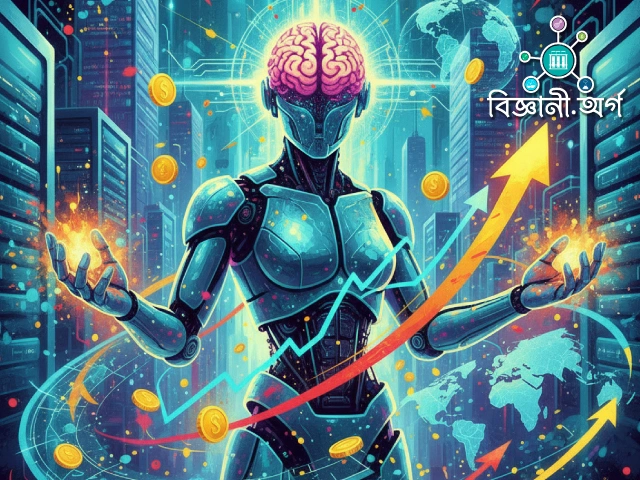
A fresh wave of excitement about artificial intelligence (AI) is sweeping across the globe. This technology has brought transformative change to business, healthcare, education, and even art. But the question remains—can it help wealthy nations reduce their mounting debt? Harvard University Professor and former IMF Chief Economist Kenneth Rogoff says, “AI will change many things, but viewing it as a fix for fundamental economic crises is a dangerously simplistic idea.”
According to Rogoff’s analysis, the possibility that AI might accelerate economic growth has created excessive optimism in recent years in global markets. Stock markets are soaring, and investors are highly enthusiastic. Yet political gridlock in Europe, budgetary complications in the United States, and the loss of skilled labor in the UK all indicate that the reality is not so simple. In other words, there remains a huge gap between market exuberance and the real economy.
No matter how powerful AI is, its sustainability will depend on meeting many conditions. For example: electricity supply, the shortage of skilled AI workers, data security, intellectual property laws, and rules governing information exchange among chatbots. Without strengthening these basic infrastructures, AI’s full potential cannot be realized. Furthermore, AI companies currently survive at great loss in the race for users and data, but ultimately they will need to establish sustainable revenue streams—just as social media platforms have done with advertising.
Another major impact of AI is on the job market. Anyone who works at a computer now faces the risk of automation. In banking, law, education—across the board, computers are not just assistants, but are becoming replacements. According to Rogoff, “If a few large companies replace millions of jobs and political turmoil does not follow—that would be pure fantasy.”
There are already signs of new political movements in the United States. Young socialist Zohran Mamdani—a leading contender in the next New York mayoral election—has made the threat of AI-driven job losses among youth a central issue in his campaign.
Beyond economics, Rogoff cautions about a troubling aspect—many of AI’s most advanced applications are military. The competition for automated drone fleets and AI-powered weapons systems could spark a new arms race. This will not only heighten tensions among major powers, but also empower smaller countries and terrorist groups—since they’ll be able to access advanced scientific knowledge with a single click. Such a situation, over the long term, is more likely to create new conflicts, divisions, and uncertainties than to drive economic growth.
Although the Trump administration is determined to push AI forward, the unanswered questions of ethics and coding human values persist. These decisions are currently in the hands of a handful of developers, but in the future will become topics for discussion in Congress, the courts, and on the international stage.
At the same time, Rogoff reminds us that the threat of climate change still looms large. “If AI is really that powerful, perhaps it will decide to save the planet by reducing the human population,” he comments—with a hint of irony.
Another potential consequence of AI is that economic control will become even more concentrated in the hands of capital. A greater share of production will go to capital, with the share going to labor decreasing. As a result, although stock markets may rise, ordinary workers’ incomes will decline. Rogoff says, “The profits companies now anticipate depend on reduced labor costs. Those profits are not the same as total economic growth.”
In the past, it was believed that as the economy grew, government tax revenue would also increase. But in the AI-driven era, it’s no longer that simple. Taxing capital is much more difficult than taxing labor—because capital is both politically influential and can easily move across borders.
If countries try to prevent capital flight by imposing high tariffs, in the end, they will only harm themselves. In this situation, if Western countries think they can solve their budget crises through AI, this would be “economic self-delusion.”
According to Rogoff’s analysis, AI is now a new front in global economic competition—especially between the U.S. and China. But the idea that “AI will solve our debt problems” is a dangerously simplistic one.
He says, “AI might change the nature of work, might reshape society in new ways. But the budget deficits that human politicians have failed to close cannot be solved by artificial intelligence alone.”