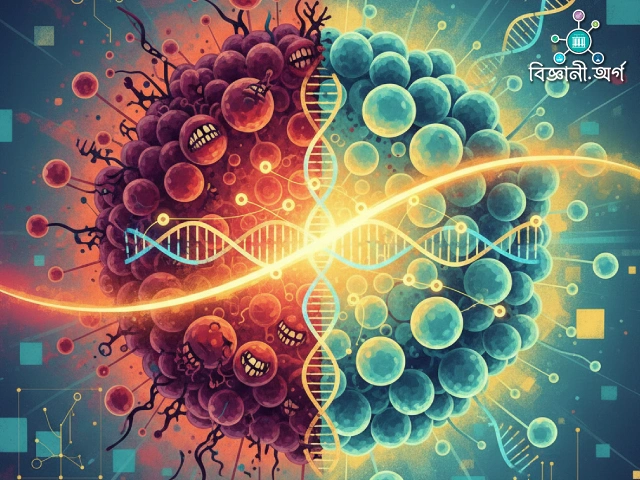
Scientists in South Korea have recently taken a groundbreaking step in cancer research. Until now, we have always thought of cancer treatment as a war—destroy the cells, erase the cancer. But this new research delivers a huge blow to that conventional notion. They suggest that instead of killing cancer cells, it is possible to reprogram them or return them to their normal state. Hidden in this idea lies a new philosophy of treatment, which may guide the future of medical science.
This project was led by Professor Kwang-Hyun Cho of the Korea Advanced Institute of Science and Technology (KAIST). His team has developed an innovative computational system—Boolean Network Inference and Control, or BINEIN. Though the name sounds complex, it actually works on a very simple principle: it identifies the ‘molecular switches’ within the genetic network of cancer cells, which can be turned on or off to change the cancerous behavior of the cells. In other words, they have tried to intervene in the root programming code of the disease.
The research primarily focused on colon cancer. The scientists discovered that simply silencing three specific genes—MYB, HDAC2, and FOXA2—causes cancer cells to lose their aggressive traits. Surprisingly, these cells gradually begin to behave like healthy intestinal cells again. In other words, the disease can be pushed towards normalcy without destroying it. This is not merely science fiction; the effectiveness of this process has been proven in both cell cultures and animal trials in the laboratory.
In animal models, it was observed that reprogrammed cells significantly reduced the size of tumors. Not only that, these cells displayed genetic markers of healthy tissue and many cancer-causing pathways were substantially suppressed. Even the expression patterns of genes closely matched those of normal tissue. It was as if the disease stepped back and started to play in harmony with good health once again.
The greatest promise of this method lies in its potential to transform the future of treatment. Traditional chemotherapy or radiation therapy works by destroying cells to curb the spread of disease, but they also harm healthy cells. As a result, patients suffer a host of severe side effects—hair loss, weakness, organ damage, and psychological distress. In contrast, if cancer cells can be guided back toward a healthy life without killing them, then perhaps much of this cruel suffering can be avoided.
This is not just a theoretical concept restricted to the laboratory. KAIST’s research has already entered the industrial sector. Based on this discovery, a company named BioRevert Inc. has been established, which is working towards developing effective and practical cancer reversion therapy. This means, within the next few decades, we may witness the beginning of an entirely new chapter in cancer treatment.
But this is not the end. Every great scientific achievement opens the door to bigger questions. How long-lasting is this technology? Will the reprogrammed cells revert to cancerous behavior again? Will it work equally well for all types of cancer? The answers to all these questions are yet to be found. Even so, the truth is that every step forward in medical history has come through bold experiments, and this research is part of that journey.
In countries like Bangladesh, where cancer devastates thousands of families every day, discoveries like this offer hope. Here, diagnosis is often delayed, treatments are expensive, and access to effective management is limited. If one day such therapies spread worldwide, it will become not only a story of scientific achievement but also a story of victory for humanity.
The fight against cancer often feels like an endless race. On one hand, the disease learns new tricks to survive within our bodies, and on the other, science relentlessly tries to overcome it. This success from South Korea proves that perhaps the way to defeat cancer lies not in destruction, but in renewal. And this philosophy teaches us to think anew—medicine is not just about averting death, but about restoring life.