
In today’s world, business is no longer limited to just selling products or providing services. Now, business means data, speed, accuracy, and smart decisions. At the heart of these four words sits something crucial—automation. From banking to e-commerce, education to logistics—automation has become almost mandatory in every sector. If every task relies on people, mistakes happen, it takes more time, and costs increase. But when the system handles the work, it gets done faster, information stays organized, and making decisions becomes easier.
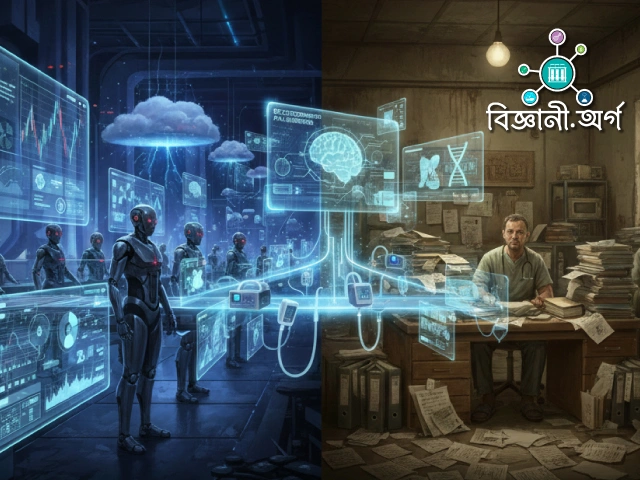
Yet, even in this modern era, one sector still lags surprisingly behind—healthcare. In a place where life and death are at stake, information is still written in notebooks, reports get lost, and a patient’s history often needs to be recreated when moving from one hospital to another. The sector that ought to be the most data-driven is, in reality, the most chaotic.
If a startup launches an e-commerce business today, they’ll use an automated payment gateway, run inventory management software, and put chatbots in customer support. No one manually copies orders anymore. Yet a patient’s prescription, test reports, and medication records are still often written on paper, get lost, or are misunderstood.
The biggest problem caused by a lack of automation in healthcare is the excessive dependence on humans. If a doctor isn’t having a good day, quality of care drops. If a nurse makes a mistake, lives are at risk. If a data operator inputs something wrong, the entire report can become meaningless. Healthcare is not just about empathy—it demands the highest level of accuracy. Here, 99% accuracy means the remaining 1% can be catastrophic.
That’s why a major transformation is now beginning in healthcare worldwide—digital health, automated hospitals, AI-based diagnostics, electronic health records, remote monitoring. These are no longer visions of the future—they are present realities. In developed countries, patients can measure their blood pressure at home, reports go straight to the cloud, and doctors review them on their phones to make decisions. Here, technology isn’t a luxury—it’s a lifesaving tool.
The startup community is playing the leading role in this change. Large corporations move slowly, but startups move fast. They spot problems and create solutions. The bigger the problems in healthcare, the bigger the opportunities. A startup that can automate hospital appointment management, digitize patient reports, or make doctor-patient communication easier could become the next unicorn of the coming decade.
But just building an app isn’t enough. Healthcare isn’t just about code—it’s about trust. There’s no room for error. You must uphold data privacy, understand medical regulations, and speak the “language” of doctors. Healthcare startups need to be even more responsible than regular startups.
If a business doesn’t automate, it gradually becomes obsolete. Those still keeping records in ledgers today won’t survive in the market tomorrow. Those storing reports on paper today will lose patient trust tomorrow. Healthcare is no exception. In fact, it needs to change even faster—because here, what’s at stake isn’t money, but lives.
Automation doesn’t mean removing humans. It means freeing humans from errors. The doctor’s job is to diagnose and make decisions—not search for files. The nurse’s job is to care for patients, not fill out forms. That’s exactly what automation does—it takes mechanical tasks off people’s shoulders and lets them focus on truly human work.
That’s why today, the question is no longer ‘Is automation necessary?’ The question is, who will do it first, who will do it best, and who will survive? And in healthcare, the question is even deeper—who will save lives and who will fall behind?
The biggest call to action right now for the startup community is to enter the healthcare sector. This sector isn’t just about business—it’s about creating change. Here, profit and impact go hand in hand. Even failure here brings valuable learning, while success can transform thousands of lives.
In tomorrow’s world, business means automation. And in healthcare, automation means safeguarding the future. The time has come to decide: will we stay spectators—or become creators?