Every year with the arrival of spring, nearly two hundred species of birds head towards the Arctic—there they lay eggs, raise their young, and return south as winter approaches. While today, this journey seems perfectly normal to us, scientists once wondered—when did this tradition of migration begin? Recent discoveries in the ice-covered land of northern Alaska seem to hold the ancient answer to that question.
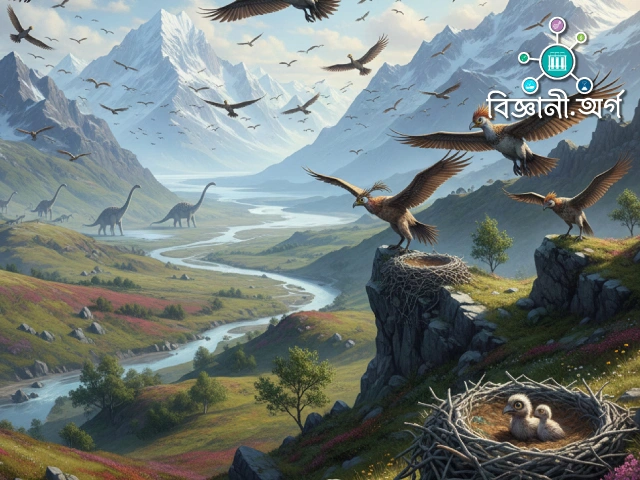
Paleontologists have found more than fifty three-dimensionally preserved fossil bird bones there, along with countless teeth, many of which belonged to chicks. Evidence suggests that in the Cretaceous era, at least 73 million years ago, three types of birds lived alongside non-avian dinosaurs in northern Alaska. In other words, for nearly half of the time since birds first appeared on Earth, they have been nesting in the Arctic.
This information is not just history—it’s also a crucial clue for today’s natural world. The seasonal arrival of birds in the Arctic creates a unique cycle of biodiversity there. During the summer, birds not only breed but also play key roles in pollinating flowers and dispersing seeds, helping plant life to thrive.
They control populations of insects and rodents, which indirectly reduces the risk of disease outbreak. Another remarkable aspect is that birds, carrying tiny microbes, seeds, or insects on their bodies, travel thousands of kilometers, sowing the seeds of new life in the farthest polar regions. In this way, birds have been a fundamental force in shaping the ancient Arctic ecosystem.
Scientists say that research on Arctic birds is ongoing. Paleobiologists Lauren Wilson and Daniel T. Ksepka have written, “So far, we only have indirect evidence that the birds came to the Arctic for breeding, not to stay year-round.” However, they hope that by using a modern technique known as ‘stable isotope analysis’, even more certainty can be achieved.
This analysis measures the relative abundance of different isotopes of the same element within an animal’s teeth or bones, which can reveal what the animal ate, the environments it lived in, and where it traveled during its life. Imagine: when the roar of dinosaurs shook the earth, even then, tiny-winged birds were nesting in the chilly Arctic summers, giving birth to new generations.
Even today, they carry on that ancient journey every year. To the human eye, this migration is not just a marvelous spectacle but a vivid remnant of nature’s deep mysteries. When the calls of thousands of birds ring out across the silent Arctic tundra, it feels as though we too share an invisible bond with this eternal rhythm of nature—a bridge built across millions of years of evolution.