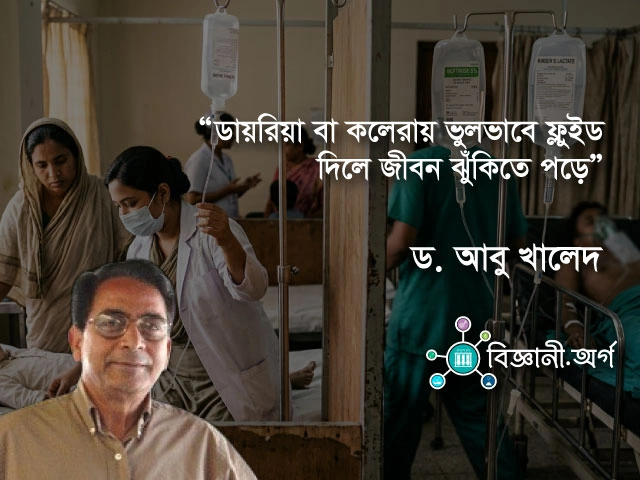
In Bangladesh, especially among children, dehydration or a deficiency of essential body water is a common but potentially fatal issue. Due to cholera, diarrhea, or other infections, the body’s water is lost rapidly, and if not properly assessed, treatment may go in the wrong direction. Many doctors often estimate dehydration based on appearance—such as dryness of the eyes and lips, the appearance of a white film in the eyes, or the patient’s movements—but these assessments are not always accurate. It was through experiencing this real-life problem that Dr. Abu Khaled realized that relying solely on symptoms and guesswork is not enough; knowing the body’s internal measurements scientifically is what truly saves lives.
Dr. Khaled said, “Dehydration can be seen, but it’s science that measures and saves lives.” His entire research philosophy is hidden behind this statement—especially when he describes how innovative results are achieved by developing methods to calculate the body’s water and fat content using electrical current.
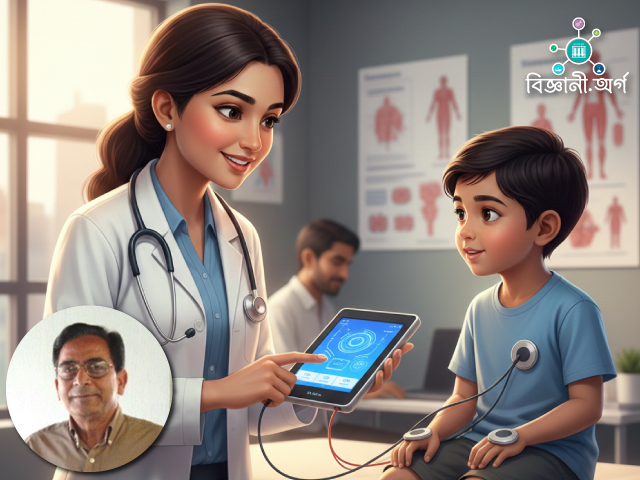
Around 1988, he introduced the ‘Bioelectrical Impedance Analysis’ (BIA) method to Bangladesh for the first time. BIA is a modern yet simple device. When a small electrical current is passed through the body—water and electrolytes conduct this current easily, but fat tissue creates resistance. By measuring this resistance, the amounts of water and fat in the body can be determined. This is done non-invasively—without any scalpel or incision—making it safe and quick for patients.
Dr. Khaled says, “At icddr,b, we first demonstrated how, following dehydration due to cholera or diarrhea, fluids work within the body after treatment.” He explains that previously, doctors only guessed the severity of dehydration (mild, moderate, severe) by visual observation. However, with the BIA device, it can be detected quickly and accurately. This means that both underestimation and overestimation of dehydration—often due to poor assessment—can be avoided. Over-administration of fluids may cause water to accumulate in the patient’s lungs—meaning over-hydration is also a significant risk.
The BIA method not only helps to understand a patient’s current condition but also provides insights into future risks. It is possible to determine how children grow—whether fat or protein is increasing—based on nutrition intake. Dr. Khaled has been able to obtain deep insights into children’s growth through this method. Later on, it even became possible to predict the survival chances of premature babies using this approach.
In fact, the use of the BIA method is not limited to Bangladesh, but is being applied globally in medical and health care contexts. Even institutions like the World Health Organization recognize it as a reliable standard. Dr. Khaled himself has commented, “If we can make this method even cheaper and available as a portable, solar-powered device, then in rural areas without electricity it would be possible to use it at minimal cost.”
One striking aspect of Dr. Khaled’s research is that he has not confined his innovations or discoveries to only a small group. He wants science to reach the doorsteps of everyday people—especially where child mortality, dehydration, premature birth, and malnutrition are daily challenges.
It should be noted that BIA is just one example. Throughout various stages of his research, Dr. Khaled has shown how data-driven methods and technology can lead to more accurate diagnoses, moving beyond treatment based only on external appearances. He has taught us that, especially in developing countries like ours where medical facilities are limited, proper measurement and evaluation can truly save lives.
Whether in Bangladesh or on a global scale, if health research only focuses on the number of diagnoses, it will not be possible to properly safeguard patients’ lives. But when we can analyze what’s happening inside the body, only then will treatments be swift, precise, and effective. And it is this path—integrating science with human welfare as a shared goal—that Dr. Khaled has clearly defined through his research and his words.
Read Dr. Khaled’s full interview: