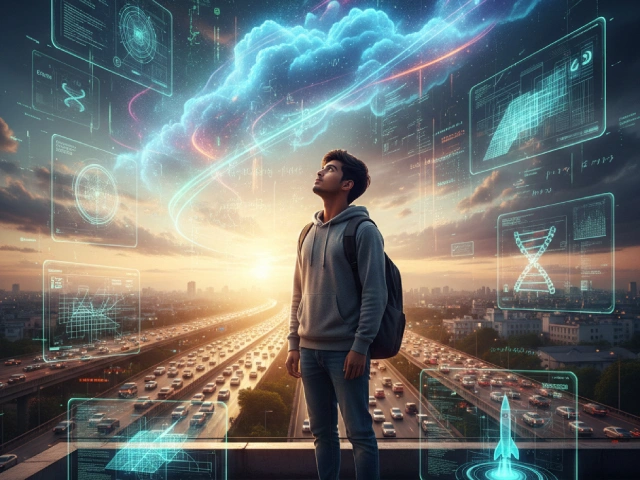
A student stands on the roof of a college somewhere in Dhaka, gazing up at the sky. Below, the noise of traffic jams; above, drifting clouds. A question keeps circling in his mind: “What would happen if rainfall in this city doubled?” He doesn’t know it yet, but one day, this ‘what if’ will become science’s most powerful weapon—simulation. Before taking action in reality, humans first experiment in their imagination. There’s no need to break anything, to burn anything; just switch on a screen and you can run the whole world.
We live in an era where decisions are made on computers first, then in reality. War strategies, city designs, medicine dosages, stock prices, even human behavior—nowadays everything is “tested out” first. The language of this testing is called modeling. And when that model comes alive, it’s called simulation. This ability to test safely before stepping into the real world has put modern science on the Olympic stage, where to win, imagination must be disciplined by calculation.
When people in Bangladesh hear about simulation, many think it’s a luxury. But in reality, it’s a tool for survival. Deciding who to evacuate from the coast before a cyclone strikes, how many hours’ advance warning is needed—these decisions are no longer based on guesswork. They’re backed by models. According to the World Meteorological Organization, thanks to early warnings and advances in modeling, global disaster mortality rates have fallen by nearly 60% over the past four decades. In a country like Bangladesh, this figure is even more meaningful, as here every accurate forecast means thousands of lives saved.
Remember the days of COVID? When would lockdowns happen, would schools reopen, how safe were vaccine doses—these questions weren’t answered only by politicians, but by computers. Millions of simulated people were made sick inside a computer, treated, given medicine—all so that real people might survive. This seemingly cruel use of imagination, in fact, gave birth to humane decisions. Without simulation, we would have walked blind.
In the world of industry, simulation means saving costs, reducing mistakes, and glimpsing the future. According to the World Economic Forum, the global use of digital twins and virtual modeling in manufacturing saves hundreds of billions of dollars each year. In German factories, new machines aren’t physically installed before their virtual shadow is deployed. That reveals where heat will build up, where screws may loosen, where accidents could happen. The future is repaired before it even arrives in reality.
In medicine, the power of imagination is shaking hands with life itself. Before heart surgery, doctors now run a patient’s digital heart. Which incision will cause less bleeding, which path is riskier—all these calculations happen on a computer first. Studies show that when virtual simulations precede surgery, the risk of complications drops significantly. There’s no magic in this; it’s simply the power to transform imagination into science.
In Bangladesh, when we say, “Such advanced things aren’t for us,” that’s when we make our biggest mistake. Because it’s here that simulation is most needed. The price of error is high, budgets are tight, and time is short. So leaping before testing means courting disaster. Whether a river embankment needs widening, how much load the metro rail can bear, how many patients a new hospital can accommodate—these things are now designed not just in notebooks, but onscreen. Where problems are big, the cost of virtual mistakes will always be less than real ones.
But this technology isn’t just a toy for engineers. An economist builds models of the national budget, a sociologist traces migration routes, an environmentalist imagines the future of forests. Everyone is playing the same game—the game of seeing the future.
Einstein said imagination is greater than knowledge. Today, that’s proven in server rooms, in lines of code, in the turns of a graph. If Darwin were alive today, he might not hunt birds in the Galapagos; he would build a thousand islands on his computer first. Before Newton ever saw an apple fall, his model could have predicted where it would land.
As you read this, you might be thinking, “These are big things—what can I do?” But remember, today’s grand simulations began with small curiosities. Even the game on your phone is a kind of simulation. While playing, you know in advance which path leads to defeat, which to victory. Life is just such a game, in which only in imagination do you get free trials to make mistakes.
If you truly want to be a scientist, don’t just study the world—learn to build it. Try designing your own city, run a river, spread a disease, launch a business—even if it’s virtual, the learning is real.
The future of this country won’t change by magic, but by modeling. The sooner we grasp that, the less pain we’ll endure. That understanding begins in the heart of a solitary reader like you.
If tonight you type into Google, “How to build a simple simulation,” that will be the first line of code for your future.
And the day you learn to run your imagination according to the laws of reality, you’ll realize science isn’t just about knowing—it’s about seeing ahead.