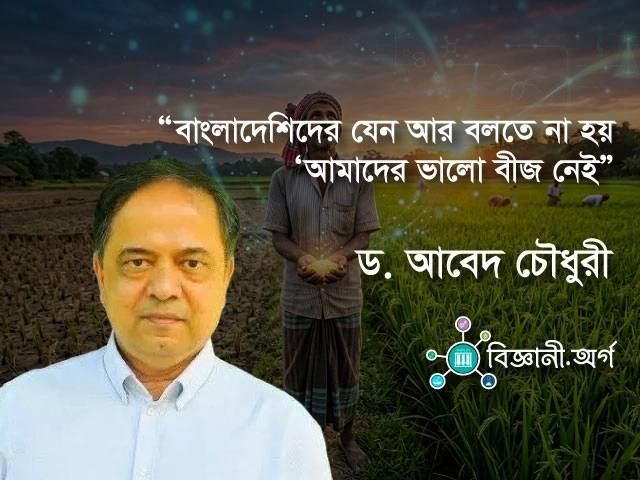
Whenever the topic of agriculture comes up in Bangladesh, there is often a common fear heard—seed companies are supposedly establishing a monopoly over farmers. Once a farmer uses a company’s seeds, the claim goes, they are forced to buy seeds from that same company year after year. This fear isn’t limited to villages; it has spread even among the educated in cities. But plant scientist Dr. Abed Chowdhury believes the issue is not so simple or one-sided. His clear statement is, “If there is no business centered around seeds, investment won’t come to agriculture.”
Are Seeds Just ‘Commercial Products’?
We often tend to think of seeds simply as the farmer’s personal asset. But in modern agriculture, seeds represent research, technology, and years of testing. To develop an improved variety of seed, scientists must spend years researching, conducting field trials, and testing disease resistance. This entire process requires significant investment. According to Dr. Abed Chowdhury, if there’s no sustainable business structure for this investment, no one will be interested in developing better seeds in the long term.
He explains the matter with a simple example from everyday life. Just as people don’t make their own toothbrushes or toothpaste, it is natural for improved seeds to be produced by specialized organizations. Farmers will buy seeds, just as they buy fertilizer or pesticides. There is nothing fundamentally wrong with this, as long as farmers have options and the pricing is fair.
Monopoly Fears: Where Is the Real Problem?
The fear around the seed business arises when farmers are left with limited options. If a farmer becomes completely dependent on one company’s seeds, they can truly be at risk. Dr. Abed Chowdhury believes that the real problem is not in the concept of business itself, but rather in the potential for monopoly and exploitation. If policies can ensure farmers’ rights, and if there are multiple reputable seed producers in the market, farmers can choose seeds based on their needs and capacities.
There are also many misconceptions about hybrid seeds in Bangladesh. Hybrid means creating a new, improved variety by combining the traits of two different parent plants. This results in higher yields and increased disease resistance. In many cases, farmers are required to purchase new hybrid seeds each year, because crops grown from the previous year’s seeds don’t produce the same quality harvest. Dr. Abed Chowdhury sees this as a technological limitation, not exploitation. However, he stresses that farmers must have alternatives—high-quality traditional seeds should be as readily available as hybrids.
Farmers’ Rights and the Question of Fairness
From Dr. Abed Chowdhury’s perspective, the most important issue is the freedom of farmers to choose. Farmers should have the right to use their own saved seeds if they wish, or to buy improved seeds from a company—this decision should always be in the farmers’ hands. Forcing farmers, through policy or business contracts, to purchase seeds from a specific source is what constitutes real injustice.
The role of the state is also vital here. Ensuring competition in the market, regulating seed quality, and protecting farmers’ interests—these three responsibilities belong to the government. If fair pricing and quality seeds cannot be ensured, farmers’ trust in the agriculture system erodes, which in the long run weakens the entire food system.
The Need for Coordination on the Path to Sustainable Agriculture
According to Dr. Abed Chowdhury, just as it is unrealistic to completely reject the business of seeds, it’s also unacceptable to exploit farmers in the name of business. Sustainable agriculture requires a combination of science-based seed development, ethical business structures, and robust policy-making. Only when these three work together will farmers benefit from advanced technologies, and the country achieve a stable food production system.
To face the challenges ahead for Bangladesh’s agriculture, it’s essential to move past ongoing misconceptions and unnecessary fears about seeds and have realistic discussions. Seeds are not just products—they are the heart of agriculture; yet without science and investment, this heart cannot survive.
Read Dr. Abed Chowdhury’s full interview: