These days, the term “AI” has spread so rapidly that many students cannot tell what is actually AI, what is machine learning, and what is deep learning. This creates confusion right at the beginning of their learning journey. But if you can think of these three concepts in sequence, the world of technology becomes much clearer.
First, let’s take AI, or artificial intelligence, as a big goal. The aim is to create technology that can act intelligently like humans—such as making decisions, solving problems, understanding language, recognizing images, or working through planning. There are multiple ways to achieve this goal. Just as you can reach a city by bus, train, or walking—there are many paths to the same destination. AI is the same; it’s an umbrella under which various methods can exist.
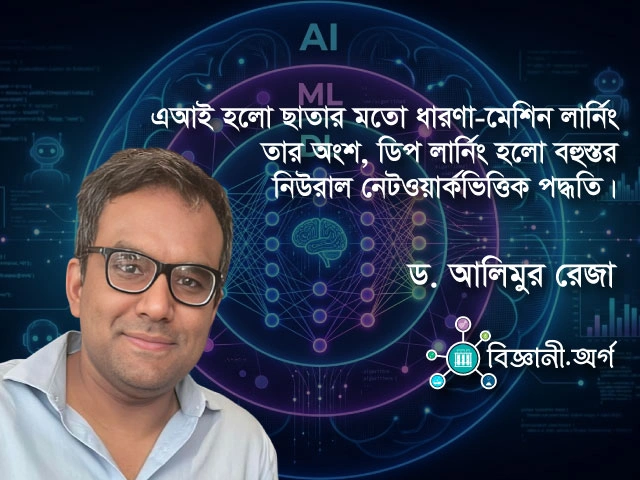
Under this umbrella, the most familiar and currently the most effective approach is machine learning. Machine learning means learning from data. Just as humans learn by seeing examples—we recognize a cat after seeing many cats—machine learning also learns to create rules by observing examples (data), rather than being explicitly told “this is how you recognize it.” You provide it with many examples, and it develops a ‘pattern’ internally. Dr. Alimur Reza says that, more specifically, we can call machine learning “statistical machine learning” because it is closely tied to statistical concepts (like probability, average, deviation, error measurement).
Then comes deep learning. Deep learning is a branch of machine learning that uses neural networks as its learning engine. You can think of a neural network as a computational model inspired by the human brain—where many tiny units (like neurons) work together. Dr. Alimur Reza explains the word “deep” in deep learning very simply: depth means layers. That is, there are multiple hidden layers inside the network which extract features step by step. To put it like humans, when you recognize someone, you don’t make all decisions at once; you notice the structure of the face, then facial features, then familiar expressions—combining all these to form your final judgment. Deep learning similarly tries to understand through stages.
Drawing from his teaching experience, Dr. Alimur Reza says he starts his classes with the perceptron—an early neural concept proposed in 1958. Gradually, he covers multi-layer perceptrons, convolutional neural networks, recurrent neural networks, and the more recent transformers. This historical perspective is important for students, as it shows technology doesn’t appear overnight; bigger concepts are built on smaller ones. A major factor behind new models is architecture design—in other words, figuring out how to structure the network so learning is improved. According to Dr. Alimur Reza, nowadays people sometimes think more about arranging the network differently than about improving the actual learning, in hopes of achieving better intelligence.
However, the most instructive part of his explanation is its ‘realism.’ He advises focusing on the problem, not just the tool or technique. That’s because supervised, unsupervised, and reinforcement—all types of learning have applications. Which you choose depends entirely on what question you are trying to answer. This is a great guideline for students. Many run after trends—today transformers, tomorrow something else. But the foundation of science is built on good questions. Once you define your question, choosing the right tool becomes much easier.
In the full interview, Dr. Alimur Reza discusses his educational journey, research details, the future of robotics, and real-world questions about AI in greater depth. Read and watch Dr. Alimur Reza’s full interview below.