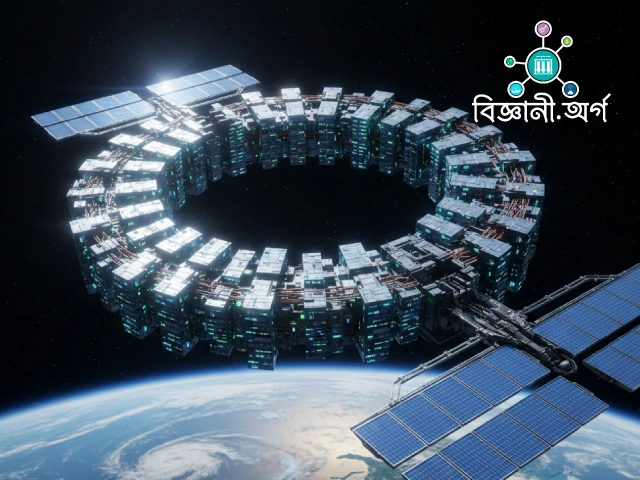
What once sounded like science fiction is now being backed by a range of people, from billionaires to city councils. However, whether this idea is actually feasible is a completely different question.
Companies that build and lease data centers are fully aware that they’re putting pressure on the power grid, increasing emissions, and consuming enormous amounts of water. The electricity demand for AI data centers alone could grow by up to 165 percent by 2030. Currently, more than half of the energy supplying these massive facilities comes from fossil fuels, which threatens to undermine progress in tackling the climate crisis.
Some of the biggest AI companies claim they have a solution: sending huge computer clusters into space. In an interview, OpenAI CEO Sam Altman said, “I suspect that, over time, a large part of the earth will be covered by data centers.” Altman has even suggested he’s willing to spend trillions of dollars, and OpenAI is part of the $500 billion Stargate project.
Altman admits many people may not like this idea. That’s why he has proposed—“Maybe we should just put them in space.” According to him, there isn’t a clear answer yet, but it’s important to explore this direction.
Altman isn’t alone—Jeff Bezos and Eric Schmidt are also investing in this idea. Altman has gone a step further, even suggesting the construction of a Dyson Sphere of data centers around the sun. But building such a massive structure would require more resources than are available on Earth, risking the planet’s habitability. Meanwhile, more realistic efforts are already underway. Startups like Starcloud, Axiom, and Lone Star Data Systems have raised millions of dollars to develop space-based data centers.
Currently, the United States alone has about 5,400 data centers, ranging from small facilities to vast “hyperscalers.” By 2028, these could consume up to 12 percent of the country’s total electricity. If relocated to space, they could utilize 24/7 solar energy and free local communities from air, noise, and water pollution.
There are also proposals grounded in science. In 2016, Caltech electrical engineer Ali Hajimiri applied for a patent for a “massively parallel computational system” in space—essentially a data center. His team’s recent proposal is for a lightweight and efficient space-based solar power system that could generate electricity at only 10 cents per kilowatt-hour—cheaper than on Earth. In theory, this could operate data centers in orbit, but when this will actually become possible remains uncertain.
Of course, there are challenges—data centers in space would operate more slowly, suffer damage from radiation, and be nearly impossible to repair or upgrade. According to Hajimiri, it will be possible one day, but the cost and effectiveness depend on time.
For now, it’s still much cheaper to build data centers on Earth in places like Virginia. Still, there’s one thing that could attract companies: there are currently no regulations for space. On Earth, building a data center requires municipal permits, and there’s often community opposition over water or power usage. In space, though, there are no neighbors to complain.
Michelle Hanlon, a space law expert at the University of Mississippi, says, “If you’re a US company and you want to set up a data center in space, you need to move as fast as possible—before Congress realizes regulation is needed.”