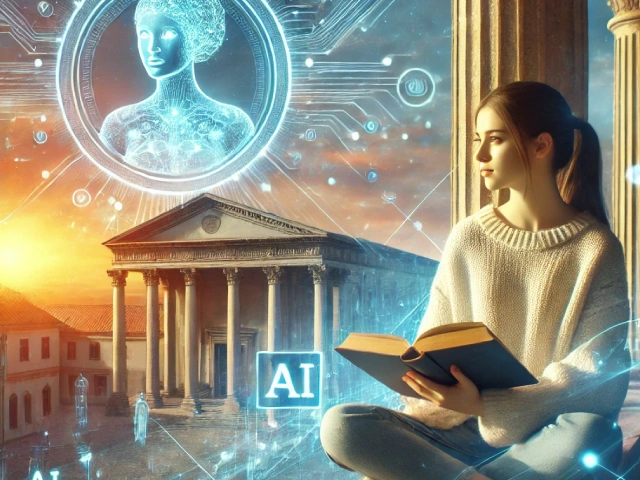
Sitting on the veranda of her single-story home awash in yellow light, Rupa was flipping through the pages of a book. There was a strange uncertainty in her gaze. Ever since completing her postgraduate degree in History, she had been wondering for some time—does studying ‘Humanities’ really offer any good career prospects in this era of technological innovations? The next morning, while scanning a daily newspaper, a new term caught her eye—“AI Wrangler.” The headline in bold letters read, “Want A Job in AI? Get a Humanities Degree.” Surprised, Rupa began to dream: how is the need for subjects like History, Psychology, and Philosophy growing in the world of technology?
Like Rupa, thousands of students and young professionals are now considering—how, in this new era, can AI be given a truly ‘human’ touch through a blend of not just coding skills but also sensitivity and other competencies?
AI Opens Doors Beyond Technology
In recent years, the development of artificial intelligence (AI) has opened up new horizons beyond just technological capabilities. Steven Johnson, Editorial Director of Google Labs’ ‘NotebookLM’, recently said at an event, “AI has now reached a point where knowledge of disciplines like philosophy, psychology, and cultural studies has become essential. It’s not enough just to understand technology—one must also shape AI’s tone, ethical standpoint, and how it communicates naturally with people.”
Johnson’s words suggest that in the future, simply being able to write code won’t guarantee opportunities in the AI industry. To ensure AI connects with and coexists alongside humans, education in the humanities and the subtleties of these perspectives are crucial.
‘AI Wrangler’—The Rise of a New Profession
A new job title has recently emerged in the tech world: ‘AI Wrangler.’ In Steven Johnson’s words, “An AI Wrangler is a professional who truly understands both the strengths and weaknesses of AI models. They may not necessarily know how to write code, but they have a deep understanding of how to best utilize AI.”
An AI Wrangler could be someone from a humanities background—someone who, by understanding language, human emotion, culture, and psychology, can shape AI to suit specific needs.
A regular reader, Anupam, shared: “I don’t know any programming language. But I try to understand people, why we behave a certain way in specific situations. Now I’m hearing that this is actually a major strength for giving AI a human touch! Who knew, someday there’d be career opportunities in this?”
Human Perspective and Ethical Responsibility
The challenge is that AI research and development are still largely dominated by engineers and software developers. After the core architecture and structure of the main model are defined, the refinement—such as language application and behavioral rules for AI—then falls to experts in philosophy, psychology, or linguistics. For example, Amanda Askell, a philosopher at Anthropic, is working on the “ethical outlook of AI models.” She has questioned, “Should artificial intelligence even be taught to consider ethics? And if so, which human ideals or principles should guide it?”
The responsibility for finding answers to these questions falls to the philosophers and psychologists associated with AI projects, who often remain somewhat apart from the core engineering teams. As a result, although the contribution of the humanities to AI is recognized, some argue that this contribution isn’t fully reflected because they are not involved in key decision-making from the very start.
The Question of Power and Future Perspectives
Many believe that the importance of the humanities will only increase as AI moves to the next level. But some analysts have warned: “If specialists in philosophy or psychology are only brought in at the stage of polishing the personality or ethics of finished models, the real power and control will still remain with the engineers.”
If linguists, philosophers, and sociologists are not involved in the process when the core logic of AI is being determined, their influence on the model will be limited. In the future, the major opportunity for professionals in the humanities will be to participate in the design of AI from the very beginning, not just in refinement or revision.
Conclusion
As Rupa flipped back through the pages of her history book, she realized—perhaps studying history isn’t just about stories of the past, but can also play a role in future AI decisions. Understanding humanity’s cultural evolution and value systems will help guide AI in the right direction. Beyond coding, critical thinking, creativity, ethics, and moral philosophy—all these could become vital drivers in tomorrow’s AI development.
As Steven Johnson said, “AI is now at a point where technology and humanity will move forward hand in hand. It’s not just coders who are needed, but also those who can infuse AI with the true reflections of society.”
Indeed, times are changing. The colors of humanity are blending into the world of code. On this transformative path, endless possibilities are opening up for the new generation working from a humanities background. All that’s needed is the patience and planning to secure a proper place for humanistic rationality in the foundational design of technology. Needless to say, the future of AI will shine brightest when human values and the diverse needs of society are carefully woven into the core of AI itself.