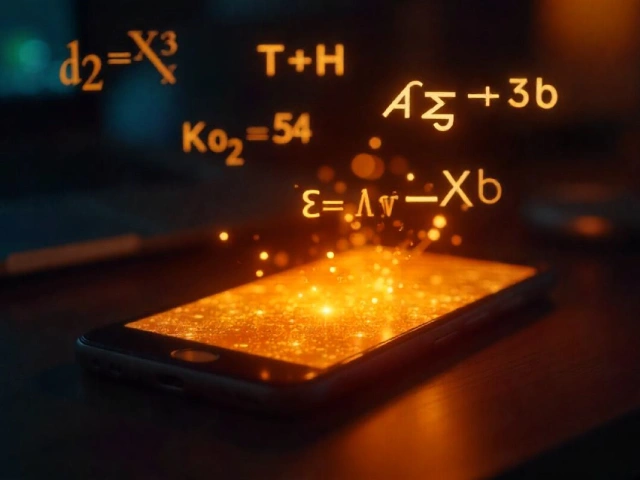
In the middle of the night, a notification suddenly rang out from the smartphone lying on the table. Reaching out, Rashed picked up the phone. The screen read—”Your favorite new movie is now available on Netflix!” Rashed was startled; it seemed as if his phone understood all his likes and interests. After thinking for a while, he wondered, “Can it really recognize me?”
Can your phone or computer truly recognize you, or is there some other mystery at work behind it?
To answer this question, we have to turn to history, when scientists discovered the remarkable power of mathematics. Once, the British physicist Isaac Newton explained the theory of gravitation through mathematics after seeing an apple fall to the ground. Through math, James Clerk Maxwell gave us the astonishing equations of electromagnetism. And the famous scientist Paul Dirac, using nothing but mathematical equations, predicted the existence of antimatter. It all seems like the magic of mathematics!
In the same way, modern artificial intelligence (AI) is not some magical entity. It is entirely a model built upon mathematical foundations.
World-renowned computer scientist and deep learning expert Yann LeCun says, “People think AI means there’s a person living inside the computer. In reality, it is simply a complex mathematical system capable of learning patterns from data.”
One of the most important inventions of the modern age is deep learning. It works using a special mathematical structure known as neural networks. The foundations of deep learning were laid by Geoffrey Hinton, Yann LeCun, and Yoshua Bengio. With their methods, computers can learn from millions of data points, and can even accurately recognize faces or diagnose diseases like a human.
Experts say that deep learning relies primarily on complex mathematical methods such as linear algebra, calculus, and probability theory. Bangladeshi data scientist Dr. Raihan Hasan remarks, “To understand AI or deep learning, it’s crucial to explain the underlying mathematics simply. It isn’t a mystical magic. The easier we make math to understand, the faster our young people will be able to apply it practically.”
A recent survey showed that almost 75 percent of people believe artificial intelligence can think just like humans. But the reality is different. It is merely a powerful algorithm based on mathematical formulas, without any feelings or consciousness of its own.
So, the next time your phone reminds you of your favorite movie or food, remember—it’s really the result of a series of complex mathematical calculations, not the thoughts of a contemplative computer mind.