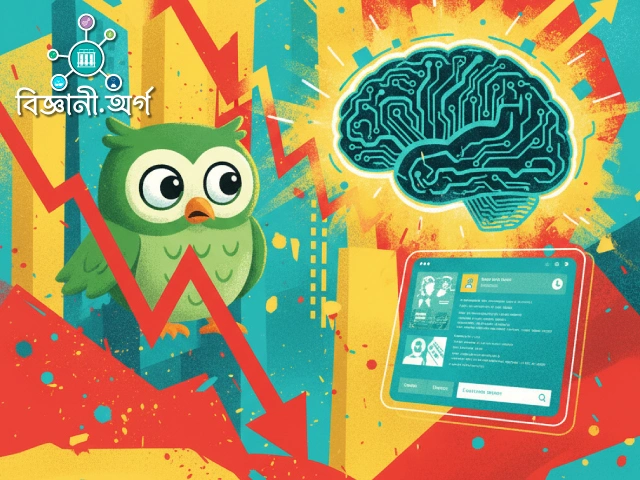
In today’s tech market, a company that soars into the sky today may come crashing down tomorrow—though it sounds dramatic, it’s increasingly the reality now. Last week, world-renowned language learning platform Duolingo had just such an experience.
The week started out brightly for them. They announced excellent quarterly results: the number of new subscribers had grown, profits surpassed expectations, and thanks to the use of AI technology, costs had gone down. Investor confidence shot up, driving share prices up by 30% in a single leap. Everything was going smoothly—until another major event shook the tech world.
OpenAI unveiled its new AI model, GPT-5. With just a few lines of instructions, it demonstrated a fully functional language learning app. It even included flashcards, a progress tracker, and an entertaining “cheese-and-mouse” game for learning vocabulary. The result? Within a few hours, investors realized—what took Duolingo years to build, anyone could now create in just minutes. Share prices rapidly halved, and by the week’s end, the downturn had deepened further.
This is where the lesson lies, which is invaluable for tech entrepreneurs in Bangladesh. Many startups are emerging in sectors like e-learning, e-commerce, fintech, or healthcare. But, if the core technology behind a product or service can easily be replicated—especially with AI—it won’t take long for competitors to arrive. Just like Duolingo, the market can deliver a shock in an instant.
In Bangladesh, we often hear—“Our product idea is very unique.” But the question is: is that uniqueness technologically secured? Or could someone use a few AI tools to build a similar, or even better, version? As Duolingo’s annual report clearly stated—new technology can quickly outpace existing brands—this risk applies equally to our startups.
Another important aspect is that AI is a double-edged sword. A major reason for Duolingo’s success was the smart use of AI—conversation features for learners, cost reduction, improved user experience. But the same AI, in someone else’s hands, became a threat for them. If Bangladeshi companies also adopt AI, they must remember—just as it can increase your competitive advantage, it can equally empower your competitors.
We can see another economic aspect here as well. On Wall Street now, AI infrastructure or hardware companies are in higher demand than software companies. That’s because you can’t build data centers, produce chips, or create large AI servers with “vibe coding” alone. If Bangladesh wants to stay in the AI race in the long run, the focus should not just be on creating apps, but also on infrastructure, advanced computing, and building our own datasets.
Finally, whether it’s language learning or any skill acquisition, no matter how advanced technology becomes, replacing the human touch completely is difficult. Even if Duolingo faces fierce competition, my or your French teacher—whether online or in person—can tailor lessons to a student’s specific needs, which a standard app simply cannot do. This is the opportunity for Bangladeshi entrepreneurs—to combine technology with human service to create something that cannot be easily replicated.