

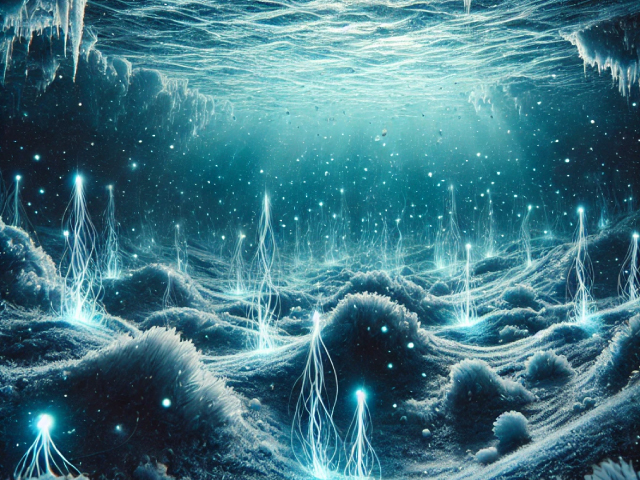
It is hard to imagine life without sunlight. Photosynthetic organisms like plants and algae absorb sunlight and use it to generate chemical energy. But what if there is a place where sunlight never reaches? Scientists previously believed that in such conditions, photosynthetic organisms would become inactive. However, a recent study has revealed that in the ice-covered depths of the Arctic Ocean, there are algae that survive and even grow with almost zero light.
Photosynthesis in the Kingdom of Darkness
The Bengali name for the Arctic is the North Pole region—the northernmost area of the Earth. During winter in the Arctic, sunlight disappears completely. The ocean water beneath the ice is plunged into deep darkness. Until now, scientists thought that during this time, algae and other photosynthetic organisms become dormant, waiting for spring and the return of light. But the research of biochemist Clara Hoppe from Germany’s Alfred Wegener Institute has proven this assumption wrong.
In the winter of 2020, she and her team stayed on a research vessel to test how little light is needed for photosynthesis to occur. Their study showed that there are algae in the depths of the Arctic Ocean that can sustain their life cycle even in the faintest presence of sunlight.
Harvesting Energy Without Light
At first, researchers believed that these algae under the ice wait to become active during summer. But a 2015 study revealed that these organisms remain active even in winter. Hoppe’s team collected samples of seawater and ice, and found high levels of chlorophyll, the main component of photosynthesis. This means that these algae continue their life cycle even in the winter months.
How Is It Possible?
Scientists believe these algae survive in a few possible ways:
- Using stored energy: Some algae may survive by utilizing organic matter collected earlier.
- Photosynthesis in minimal light: The study found that these algae remain active even when exposed to as little as 0.04 micromoles of photons, which is theoretically the absolute minimum for photosynthesis.
- Absorbing organic matter: Some algae can absorb dissolved organic substances from water, helping them survive through the winter.
New Insights, New Possibilities
This discovery may transform our understanding not only of the Arctic life cycle but also of the animal kingdom in the deep sea. According to Hoppe, if algae in the Arctic can adapt to such extreme conditions, algae in the deep sea may be able to survive in the same way.
This research teaches us that life always finds new ways, even in adversity. If even the faintest light can support the development of life, then perhaps elsewhere in the universe, where light is extremely scarce, there might also be the possibility of finding life.
This is not just a study—it is a remarkable example of nature’s resilience and adaptability.
Source: https://www.wired.com/story/how-does-life-happen-when-theres-barely-any-light/