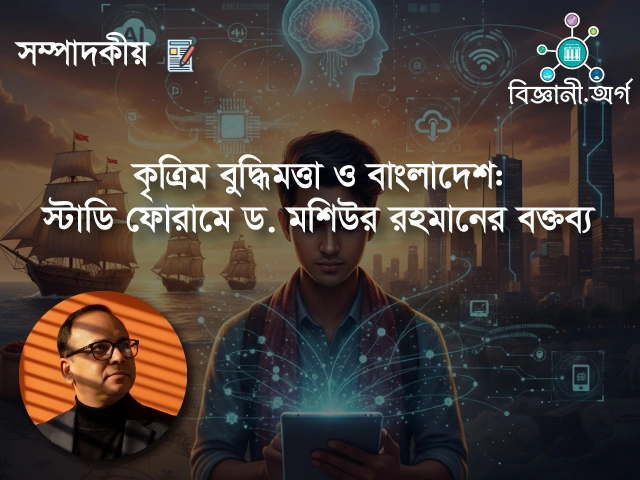
Dr. Mashiur Rahman
The beginning was not with a slide title—but with a story. Three hundred years ago in South Asia; spices like cardamom, cinnamon, and cloves would arrive by sea from Sri Lanka, braving storms and pirates and danger; and their consumers were mainly kings or the elite class of society. But what about today? In any market in Dhaka, even in the little shop below your apartment, these spices are easily accessible. Dr. Mashiur Rahman described this transformation as the journey ‘from rare to accessible’—the path that humanity has discovered over generations, which is essentially the name for better distribution, better organization, and gradually the creation of a kind of ‘equilibrium’ in society.
This concept of “balance” takes us to the ancient Greek philosopher Aristotle. Dr. Mashiur explained that the good, or beneficial path in human life, usually doesn’t lie at any extreme; it lies in the middle—what Aristotle called the Golden Mean, or the Middle Way. According to Aristotle, the sustainable and humane path is the one in between two extremes—where balance is achieved.
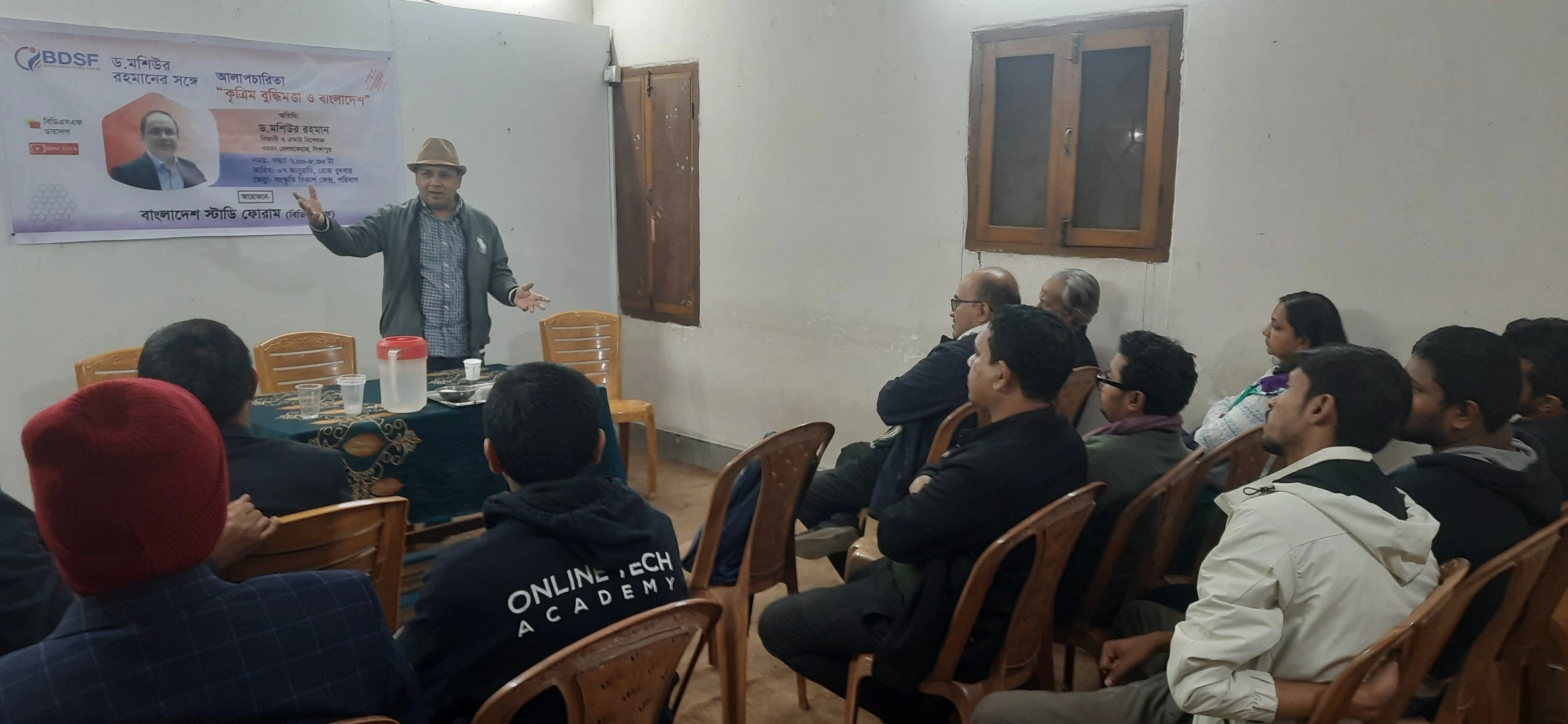
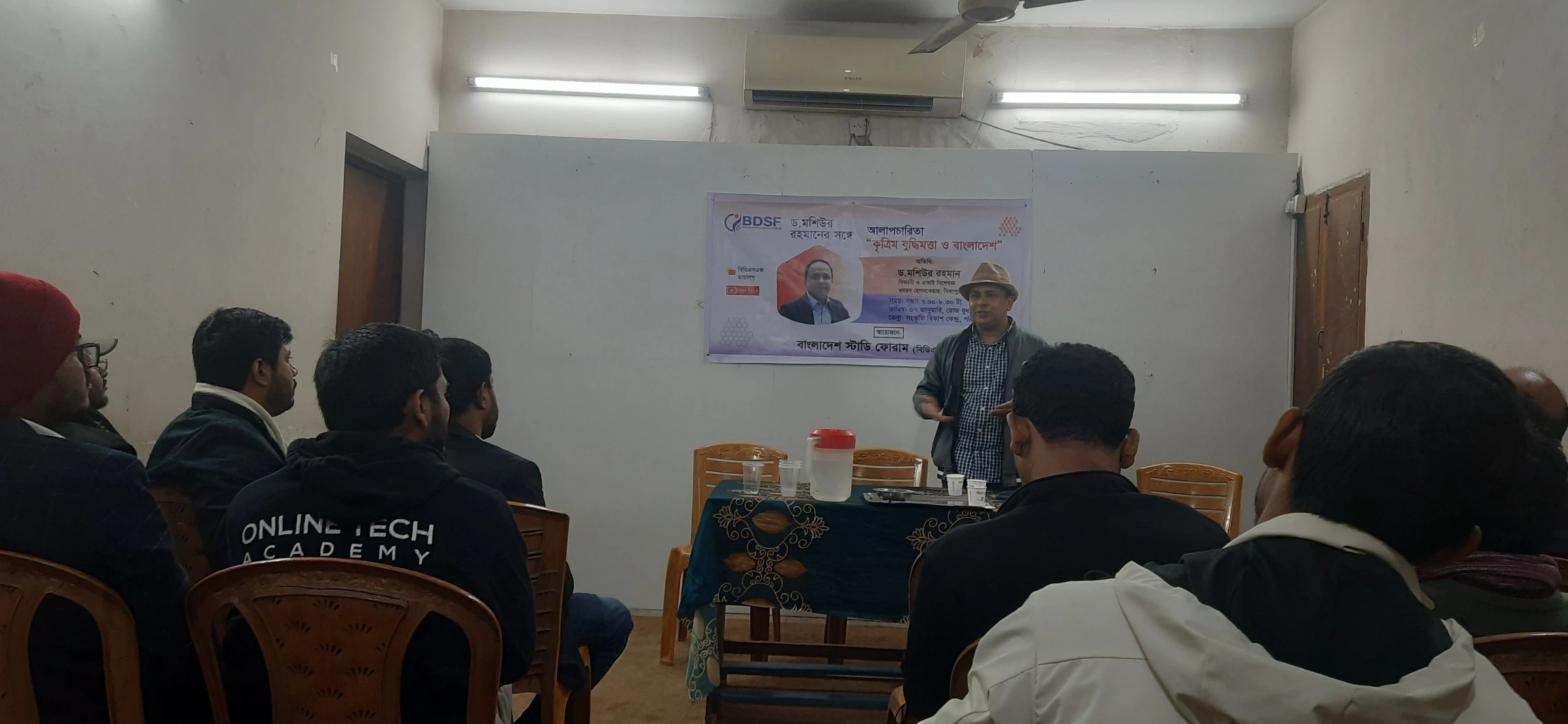
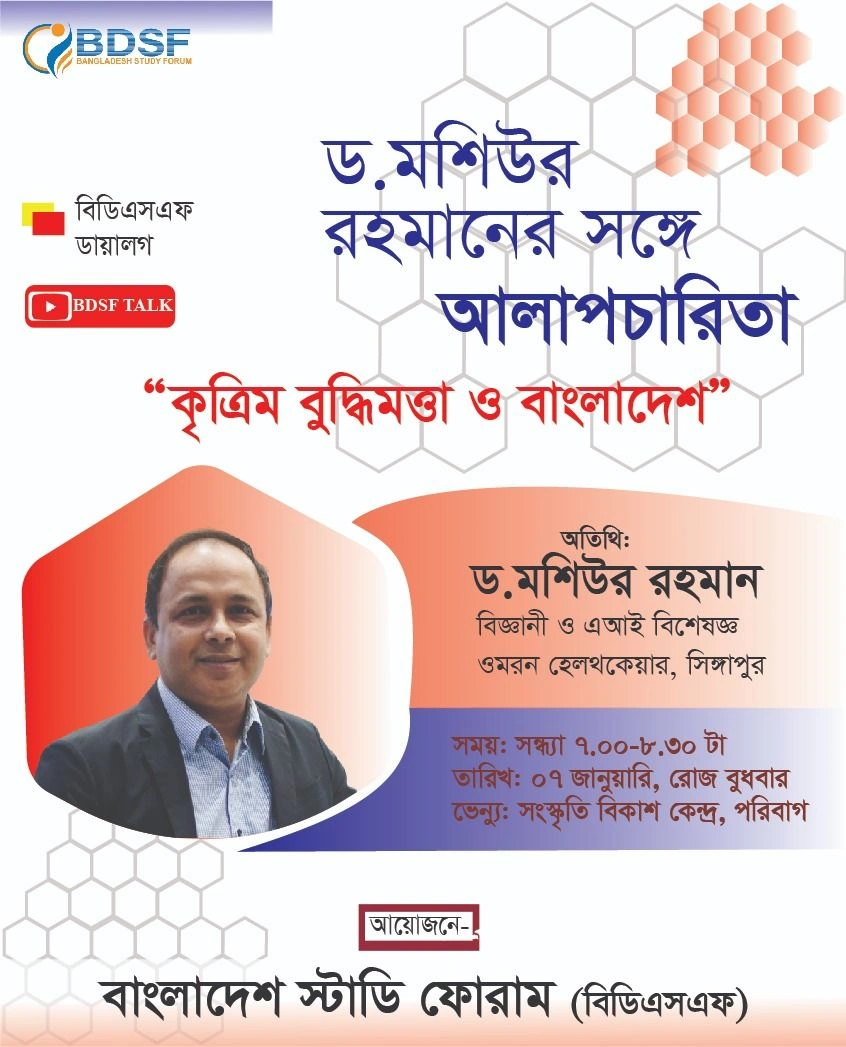
He shared this story in a discussion session of the Bangladesh Study Forum, titled “Artificial Intelligence and Bangladesh”—an event to directly engage with the thoughts, questions, hopes, and concerns of Bangladesh’s youth. His argument was—what was once reserved for the elite (spices, books, education, information), technology and time have eventually made accessible to ordinary people. In his view, today’s artificial intelligence (AI) is the new stage of this ‘distribution of knowledge’.
This article is a rewritten, serialized feature based on the full transcript of that conversation/seminar.
A Scientist’s Identity—Lab, Leadership, and Science in Bengali
To call Dr. Mashiur Rahman simply a “speaker on AI” would be to greatly diminish his journey. On one hand, his professional work—digital healthcare, cloud, data analytics, artificial intelligence, IoT—stands at the roots of these fields, solving real-world problems. On the other, he champions a kind of cultural-knowledge movement—bringing science in Bengali to the masses.
He notes in his biography that his undergraduate and graduate studies were at Toyohashi University of Technology (Electrical Engineering), and he earned a PhD in physics from The Graduate University for Advanced Studies. His career began with designing hardware-software systems for researchers, data acquisition, and building reporting/analysis infrastructure—especially for biomedical, nanotechnology, and biosensor fields.
Over time, he took on leadership roles—managing teams and developing products involving mobile apps, cloud solutions, AI, analytics, telehealth/e-health, wearable devices, and IoT. Currently, he works at Omron Healthcare in Digital Healthcare Solutions; his roles span Singapore and Japan, and he notes experience leading and mentoring multinational teams across Asia.
His other public identity is as the founder of Biggani.org, an online platform for science communication in Bengali. In 2010, this initiative won special recognition in the Science & Technology category of Bangladesh’s National e-Content and ICT for Development Awards—a story also featured in the media at the time. Dr. Mashiur Rahman himself has said that the platform’s goal was to deliver scientists’ research, experiences, and interviews from Teknaf to Tetulia—covering even the country’s remotest corners; essentially, an online version of ‘knowledge distribution’.
He also works with youth on career development and higher education; his book “Ways to Build a Successful Career” has been published in this genre. This multidimensional identity—professional leadership in digital health and science communication in Bengali—makes his AI-related insights especially significant for young people in Bangladesh.
How Artificial Intelligence Democratizes Knowledge
At the core of Dr. Mashiur Rahman’s speech was a vision of “knowledge equity”—so that no matter whether you are in Dhaka, Hatiya, or New York, access to information and learning is equally close at hand. He explained that in the 1990s, the Internet gave people access—it brought distant information closer. But the next challenge after the Internet was: “Information exists—but how do we understand it? How do we find it? How do we organize it to fit our needs?” AI, he argued, is capable of “distributing and organizing” knowledge—this was his main point.
To explain this “equilibrium,” he used a metaphor that, while not philosophical, is easy to understand in terms of physical science. Two rooms—one hot, one cold; open the door, and after a while the temperature starts to equalize—this is the basic view of thermal equilibrium. In scientific terms, this is when, after the exchange of heat, there is no net heat flow between the rooms.
He extended this logic to society—arguing, with some optimism, that even in politics or ideology, extremes tend over time to pull toward the middle. While this social explanation may be debatable, his point was clear: bringing the rare to the common takes long-term technological and social adaptation—he sees AI as part of this tradition.
Explaining how AI works in historical context, he highlighted several milestones. In 1950, Alan Turing raised the possibility of a machine thinking like a human and discussed the “Imitation Game”—which later became known as the ‘Turing Test’. In 1956, “Artificial Intelligence” was officially used as a research project name at Dartmouth College—thus naming the field.
In Dr. Mashiur Rahman’s account, real-world applications soon followed—recognizing handwritten numbers, sorting postal letters, and detecting text from scanned books. The use of Optical Character Recognition (OCR) technology to read handwritten addresses or zip codes in postal services is a part of this; the development of such technology for mail processing automation dates back to the 1960s.
The next barrier was language—a major challenge. It isn’t enough for computers to read characters; they must understand human language. This need led to fields like Natural Language Processing (NLP), whose aim is to enable computers to identify, interpret, and generate language as humans do. He noted—now you can simply write (or say) “turn on the fan,” and many smart devices will understand; this is how the Internet of Things (IoT) connects household appliances to follow commands.
Modern AI systems trained on vast amounts of data—language, books, Wikipedia—have now reached a level where, for example, you can ask for all references to “rain” in the poetry of William Shakespeare, or to organize Rabindranath Tagore’s writings about “monsoon”—in Dr. Mashiur Rahman’s words, knowledge is as if “arranged in a warehouse,” ready to be fetched as required.
This is where he frames AI as the next step after the Internet: the Internet builds “roads,” while AI hands you the “map” to navigate those roads.
Digital Healthcare: Life Decisions from Blood Pressure Data
When talking about AI in Bangladesh, discussions often stall at worries like “Jobs will be lost,” or “Robots will take over.” Dr. Mashiur Rahman, however, shifted the conversation to real, urgent everyday issues—how AI can be an ‘assistant’ for everyone, be it farmer, patient, student, or writer.
His example for agriculture was simple: an abnormal spot on a crop leaf—which disease is it? Previously, a farmer might have to visit an assistant agricultural officer or seek the advice of an expert. With an AI-enabled app, according to him, a farmer could simply take a photo and receive a preliminary idea—saving time and enabling faster decisions. (Here he also notes that the human role will remain for final decisions; as wrong advice is a risk.)
He placed particular emphasis on healthcare—because that is his professional field. Using the example of sorting postal letters, he explained: there is an abundance of data in healthcare, but if it isn’t “organized,” it’s unused. His work at Omron Healthcare involves analyzing blood pressure data from their devices to help people improve their lifestyles and control hypertension—finding solutions for these issues.
This is highly relevant for Bangladesh. According to WHO data, in 2024 there were about 1.4 billion adults aged 30–79 worldwide with hypertension—and a large proportion live in lower- and middle-income countries. For strokes, WHO lists hypertension as the main contributory risk factor—having high blood pressure significantly increases stroke risk. In this reality, regularly measuring blood pressure, understanding risk through data, and making lifestyle changes become even more important.
Digital health interventions (mobile apps/SMS/remote monitoring) can help control blood pressure—international research supports this. In rural Bangladesh, studies of mHealth-based initiatives to improve hypertension awareness and lifestyle change also show that, with proper design and education, technology can have a real impact on behavior.
Another important part of Dr. Mashiur Rahman’s message was “patient empowerment.” He said—with AI, an ordinary person can scan a medicine label to know about possible side effects or drug interactions in advance; this enables patients to raise questions about their treatment and be more aware. While he mentions a high figure (mortality from medication errors) in the discussion, it is scientifically and policy-wise accepted that unsafe or incorrect medication practices are a major cause of patient harm worldwide, with significant financial and human costs.
Risks, Bias, and Regulation: From Deepfakes to Policy
Dr. Mashiur Rahman did not cast AI as a fairy-tale hero. He consistently emphasized—every major invention brings “benefits and harms” together. He gave the example—a scalpel can save lives in the hands of a surgeon, yet it can also be used to commit a crime. Technology itself is not moral; how it is used—that is the real question. From this perspective, he highlighted several key risks and challenges.
First, “hardware and power”—how much computing muscle does AI require? In the Q&A, he made a simple distinction: AI creation (training) is not the same as AI use (inference). Training—like arranging scattered potatoes in a warehouse—requires enormous computing power; a regular CPU is not sufficient, you need specialized chips—GPUs. In modern AI, training and inference are efficient with GPUs due to their advantage in parallel computing; NVIDIA itself explains why GPUs are faster and more energy efficient for this work.
But the user asking a question on mobile doesn’t have a supercomputer in their phone. Dr. Mashiur Rahman explained—the question goes to the “cloud”; the answer comes back from a large server in the cloud. That’s why many popular AI tools rely on the Internet. Still, he offered hope—lightweight models and local-run technology are advancing; various tools have been introduced to run local models. Nowadays, with software like Ollama, it is very easy to run local language models on Mac, Windows, or Linux operating systems. Especially after Meta Platforms unveiled their Llama series models (with details on Meta’s official blog), using AI locally has become much more realistic and effective for average users.
Second, “deepfakes and scams”—he noted, AI-powered fake videos/audio (deepfakes) can be so realistic that, in court or online testimony, they could create crises; without new legal frameworks, trust could erode. Judicial bodies and research have already raised concerns about the risks of AI-generated evidence—“fabricated evidence” has always existed, but creating it is now far easier and cheaper.
AI-driven deception is not limited to courts—it can enter personal life as well. Dr. Mashiur Rahman discussed scams/fraud—requests for help using a cloned voice of a loved one, fake messages—new types of awareness are needed to detect these. Globally, there are increasing warnings about voice-cloning-based scams.
Third, “hallucination and misinformation”—Dr. Mashiur Rahman warned that AI can produce completely wrong information with great confidence; so verification habits are essential, especially in medical/legal/high-risk domains. ‘AI hallucination’ means when a model confidently produces wrong or misleading output by finding patterns that don’t exist in reality.
Fourth, “bias”—perhaps the most pragmatic caution in his talk. In response to an audience question, he said AI bias comes from data; whatever you use to train the model, it will reflect the society, history, and culture present in that data. He gave the example that if data from different cultures are included, the same question may produce different outputs; even in image generation, the AI may display bias in skin color/occupation/geography. Such bias has been well documented in research—particularly in health education or medical imaging, where lack of representation increases risk.
To manage all these risks, he repeatedly returned to the word “accountability”—users are responsible, institutions are responsible, and the state is responsible. As a global framework for this accountability, UNESCO’s recommendations on AI ethics emphasize human rights, transparency, fairness, and human oversight.
The same tone is reflected in Bangladesh’s policy landscape. The Bangladesh government’s recent ICT Division draft policy document speaks of human-centric principles, anti-bias measures, accountability, and risk-based control frameworks. The policy also notes—prioritize Bangladesh-specific language models and domestic hosting when considering the risks from insecure foreign/API-based AI systems; and ensure that training datasets reflect “Bangladesh’s demographic diversity.” The policy also clearly stresses maintaining fundamental skills in reasoning, writing, and problem-solving in education, instead of over-reliance on AI—echoing Dr. Mashiur Rahman’s comments.
Finally, he addressed another major point—chips and geopolitics. The Q&A covered “chip wars,” censorship/filtering, and military applications. Control of advanced chips (especially for AI), tough export policies, and technology supply chains are now strategic resources; there is policy analysis on this. The use of autonomous/semi-autonomous weapons on the battlefield raises urgent ethical concerns, and organizations like the International Committee of the Red Cross call for emergency international action.
Dr. Mashiur Rahman’s overall message: “Stopping out of fear” is not a solution; the answer is to develop regulation, policy, education, and ethical awareness alongside technology.
The Future, Education, and a Call to the Youth
A common concern about AI is heard: “With AI, people will stop reading books.” Dr. Mashiur Rahman viewed this fear in a historical context. Once, handwritten manuscripts were the only medium of knowledge; when the printing press arrived, some feared the loss of scribes’ livelihoods, or that widely available books would become uncontrollable. But in the end, it was the press that advanced mass education—such is his point. He said, paper books may fade—but PDFs, e-books, screens—these may change form, but the “thirst for knowledge” will still drive people to read.
At another point, he made a profound statement—our capacity for language, communication, and exchange of knowledge is what makes us human. So, even if AI provides information, people still need to nurture language skills, comprehension, and questioning ability. For this reason, he kept emphasizing “use”—consider AI as a tool; use it as a doctor, teacher, editor—whatever role you assign, it will assist you in that—but the ultimate judgment and wisdom remains yours.
Asked about the future, he is cautious—will AI remain a “tool,” or become an independent “entity”? He said, there is a lot of speculation about AGI (Artificial General Intelligence)—some say by 2030, others later; but certainly, all of this is “speculative,” meaning uncertain. This very uncertainty is the greatest lesson for young people—technology will change fast, but fundamental skills (language, math/logical reasoning, ethics, practical problem understanding) will not.
As a science communicator and technology leader, if Dr. Mashiur Rahman’s message to young people can be summarized in a few sentences, it’s this:
Bangladesh cannot remain just a consumer of technology; we must create knowledge and data in Bengali, solve local problems, and build capability for fair and transparent use of technology—only then will the knowledge distance between Hatiya, Dhaka, and New York truly narrow.
In the end, we return to the story that opened this feature—the cardamom story. Three hundred years ago, cardamom was a symbol of power; now it is a common ingredient in the kitchen. Dr. Mashiur Rahman wants to show that knowledge is the same—if we develop better distribution systems, empower our language, make policy accountable, and link technology to ethics.
His own life journey stands as a kind of symbol—studying at a Japanese university, working with digital healthcare products and data, and at the same time tirelessly working to popularize science in Bengali. For Bangladesh’s youth, this offers one clear inspiration: world-class scientific work is not “for other countries”—if we can hold together our mother tongue, the problems of our people, and global knowledge, science becomes a source of national pride and a tool to build the future.
Link: Bangladesh Study Forum Facebook page https://www.facebook.com/BangladeshStudyForum/photos
The event was held on January 7, 2026, at the Centre for Cultural Advancement in Dhaka, organized by the Bangladesh Study Forum. The main speaker was Dr. Mashiur Rahman.